Many of us have heard some version of the idea that “what you eat as a child shapes your health as an adult.” The notion that nutrition during the fetal and early-life period influences later obesity, diabetes, and aging has long been recognized under the concept of DOHaD (Developmental Origins of Health and Disease). Yet exactly what happens inside the body to produce this effect has remained largely unknown. On September 24, 2026, a research team at Japan’s RIKEN institute announced that they had identified, in fruit flies, a molecule that offers a clue to solving this puzzle. The findings were published in the journal Nature.
Title: Lsp2 links early-life diet to adult translation and lifespan in Drosophila
Authors: Kosakamoto, H. et al.
Journal: Nature (2026)
DOI: 10.1038/s41586-026-11031-3
The experiment: change the diet only during the larval stage
The research group (the Nutrient Response Research Team at RIKEN’s Center for Biosystems Dynamics Research, led by Team Director Fumiaki Obata, with Hina Kosakamoto and colleagues) fed fruit fly larvae a protein-restricted diet only during the larval stage, then returned the flies to a normal diet as adults and raised them for life. They combined chemically defined (synthetic) diets to control nutrition precisely, metabolic analysis, tracing of nutrients with stable isotopes (atoms that differ in mass but behave almost identically in chemistry), and genetic techniques.
Result 1: Lifespan rose by up to about 20%
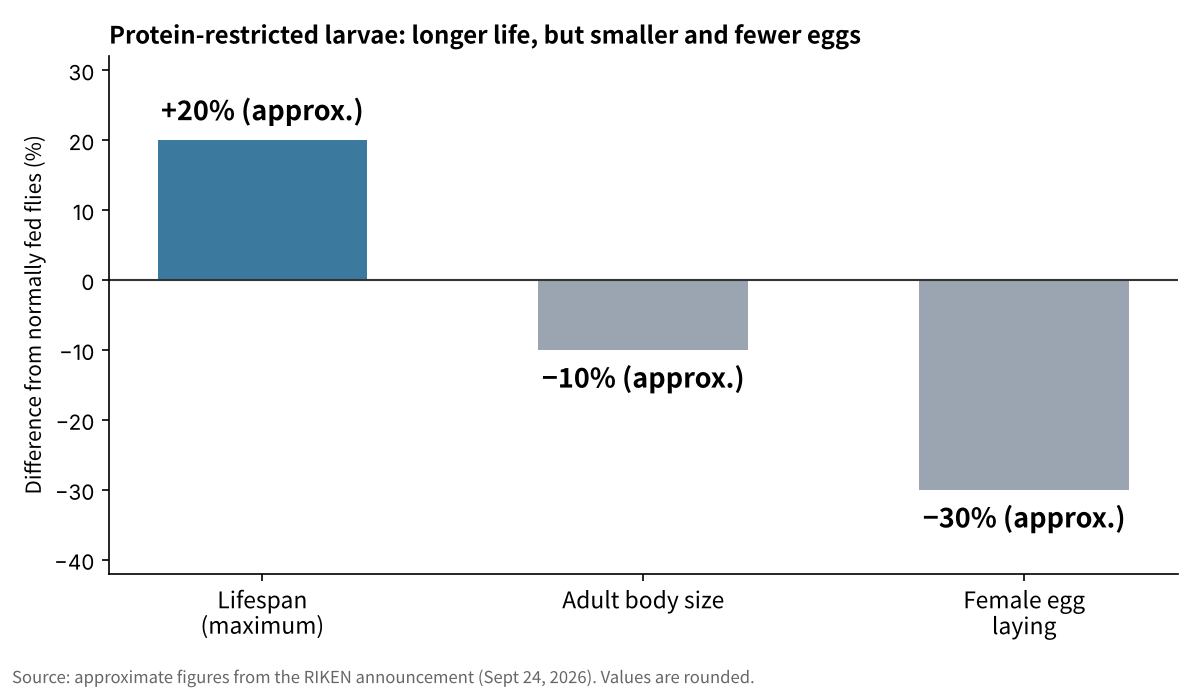
Restricting protein only in the larval stage extended adult lifespan by up to roughly 20%, even though the adults ate a normal diet for the rest of their lives. The effect was seen in both males and females. Restricting only the amino acids in a synthetic larval diet gave a similar extension of up to about 20%. The benefit came with a cost: adults were about 10% smaller, and females laid roughly 30% fewer eggs. In other words, the longer life came with a trade-off against growth and reproduction.
Result 2: Larval amino acids were still in the adult body
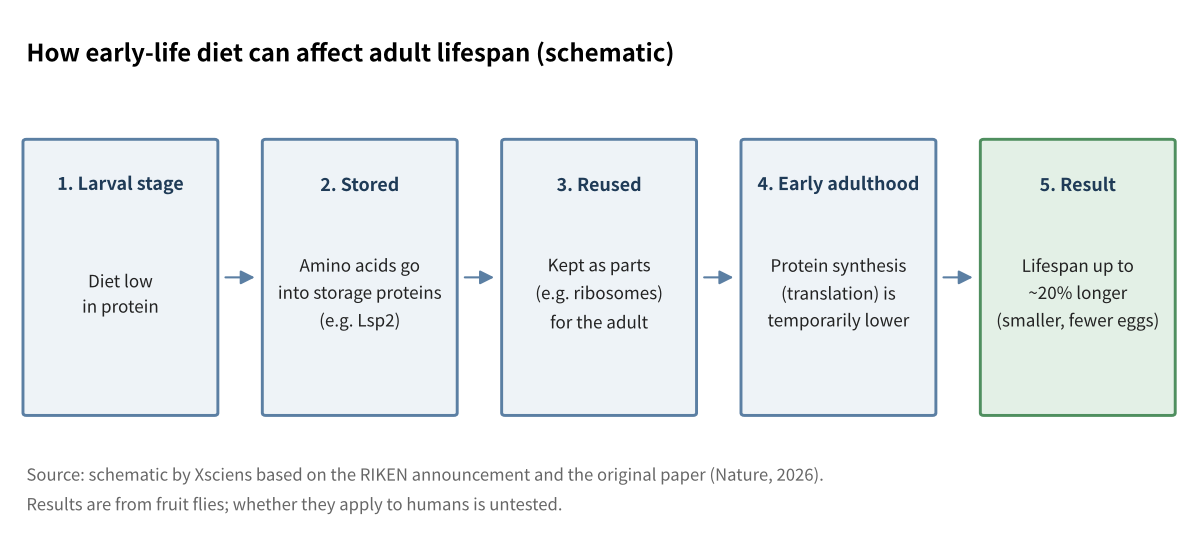
When the team tracked amino acids (the building blocks of proteins) labeled with stable isotopes, they found that amino acids taken up in the larval stage remained in many proteins after the flies became adults. In 6-day-old adults, about half of all proteins were still built from amino acids acquired during the larval stage. (The analysis used heads, where cell division has less influence on the result.) Larval amino acids were especially common in the parts of ribosomes, the molecular machines that make proteins inside cells.
In flies that had been protein-restricted as larvae, early adults had fewer ribosomes and lower protein-synthesis activity (translation). This decline was limited to roughly the first week of adulthood; by day 14 the difference was gone. The researchers think this moderate, temporary suppression of translation is a major pathway behind the longer lifespan.
Result 3: The key is a storage protein called Lsp2
Amino acids taken up in the larval stage stay in the body as a storage protein called Lsp2, which is later reused as raw material for building new ribosomes in the early adult stage. When larvae were protein-restricted, Lsp2 levels fell, and the reduction persisted into early adulthood. Reducing Lsp2 alone by genetic knockdown (weakening the activity of a specific gene) lowered protein synthesis and extended lifespan just as dietary restriction did, and with almost no effect on body size or egg-laying. The team concludes that Lsp2 plays a central role in controlling lifespan.
Lsp2 is rich in aromatic amino acids such as tyrosine and phenylalanine. Restricting just one of these amino acids in the larval diet was enough to reproduce the drop in Lsp2 and the longer lifespan. The team proposes a new mechanism in which a storage protein “remembers” early-life nutrition and carries that information into adulthood to regulate lifespan.
What it means for humans (and what it does not)
The result offers a new lead for thinking about the molecular basis of the DOHaD hypothesis, which holds that nutrition in the fetal and infant period affects the risk of lifestyle-related disease in adulthood. RIKEN also raises the possibility that a decline in stored amino acids is read by the body as reduced nutrition, something like “eating until 80% full,” and mentions proteins that might play a similar role in humans, such as albumin and globulin in blood. Whether a similar mechanism exists in mammals remains to be tested.
Because this work was done in fruit flies, it cannot be applied directly to human diets. The longer lifespan came with a smaller body and fewer eggs, so the finding does not mean that restricting a child’s diet would help them live longer.
Xsciens Editorial Note
The study offers a molecular clue that nutrients taken in early in life can persist in the body as building blocks into adulthood. It does not say that restricting children’s diets will make them live longer.
- Separate what was observed from what was interpreted. What was observed: protein restriction in larvae extended adult lifespan by up to about 20%, and about half of all protein in the heads of 6-day-old adults came from larval amino acids. The idea that a temporary dip in early translation contributes to longer life is an interpretation drawn from experiments and genetics. “Up to” also means the gain can be smaller under other conditions.
- Fly results, with costs. The longer-lived flies were about 10% smaller and females laid about 30% fewer eggs. The DOHaD hypothesis rests mainly on observational studies in humans, and whether this molecular mechanism exists in mammals is untested. Another group has reported that restricting larval diet also extends lifespan in flies, but that the effect depends strongly on the adult diet and works through a different route (lipid autotoxins), so longevity is unlikely to have a single mechanism.
- What to watch next. Whether mammals have a similar “early nutrition stays in the body” mechanism, how timing and amount of restriction change the outcome, and whether the growth and fertility costs can be avoided.
- Our imagination (speculation) — We wonder whether, if we learn where and how much of early-life nutrition stays in the body, it might become possible to spot health risks sooner in people who had a disadvantaged start, or to make up for it later. At the same time, the trade-off with body size and egg laying suggests the practical path is not “eat less” but finding ways to target only the parts that matter. This is only our speculation.
References for this note: Stefana et al., Nature Communications (2017), “Developmental diet regulates Drosophila lifespan via lipid autotoxins” (Francis Crick Institute), Lacagnina, “The Developmental Origins of Health and Disease (DOHaD)”, American Journal of Lifestyle Medicine (2019)
Key terms
- DOHaD (Developmental Origins of Health and Disease): the idea that nutrition in the fetal and infant period affects health and disease risk in adulthood
- Lsp2: a storage protein made in large amounts by fruit fly larvae that remains in the body into adulthood
- Ribosome: the molecular machine in cells that makes proteins
- Translation: the process of making proteins from genetic information (protein synthesis)
- Knockdown: weakening the activity of a specific gene by genetic manipulation
Sources: RIKEN press release, “The mechanism by which early-life nutrition determines lifespan” (September 24, 2026), Kosakamoto, H. et al. Nature (2026)
Leave a Reply