Tag: RIKEN

  • A Green Hydrogen Catalyst Lasts Longest at the Freezing Point — RIKEN Finds

    A Green Hydrogen Catalyst Lasts Longest at the Freezing Point — RIKEN Finds

    Cool a chemical reaction down, and it should slow to a crawl — that’s basic chemistry. But for one hydrogen-making catalyst, the story turns out to be more complicated than that. Researchers at Japan’s RIKEN institute have found that a manganese oxide catalyst used to split water into hydrogen degrades the least right around the freezing point of water, and then degrades faster again once the water is chilled further still. The finding offers a new angle on one of green hydrogen’s stubborn cost problems: catalysts that wear out too fast.

    原論文情報 / Original Paper
    Title: Cooling Water to Near Freezing Breaks the Activity-stability Trade-off of Water Oxidation Electrocatalysis
    Authors: Wardhana, A. C. et al.
    Journal: Nature Chemistry
    DOI: 10.1038/s41557-026-02274-8

    The Weak Link in Green Hydrogen

    Splitting water into hydrogen and oxygen using electricity from solar or wind power is the core process behind “green hydrogen,” a carbon-free alternative to fossil fuels for power generation, steelmaking, and transport fuel. Hydrogen produced this way could, in principle, replace fossil fuels across a wide swath of heavy industry, which is why so much research funding is chasing it.

    The catch is cost. At the electrode where oxygen is released, the chemical environment is harshly oxidizing, and over time the catalyst coating that electrode slowly dissolves away. Replacing or maintaining it is a recurring expense, and durability problems like this are a big part of why electrolysis-based hydrogen still costs more than hydrogen made from natural gas. Any discovery that makes catalysts last longer without a complete materials overhaul is worth a closer look.

    Speed Versus Durability: The Old Rule

    Chemical reactions generally speed up as temperature rises — a basic rule of chemistry known as the Arrhenius relationship, named after the 19th-century chemist who first described it. Raise the temperature and a water-splitting reaction goes faster, which sounds like a straightforward way to boost hydrogen output. But raise the temperature too much, and the catalyst itself degrades faster too, since the harsh oxidizing side-reactions that eat away at it also speed up with heat. Cool things down, on the other hand, and the catalyst tends to last longer — but the water-splitting reaction itself slows to match. Engineers have generally treated this as a fixed trade-off: push for speed, and durability suffers; push for durability, and speed suffers.

    A Sweet Spot Right at Freezing

    A team led by Ryuhei Nakamura, team director at RIKEN’s Center for Sustainable Resource Science and a professor at the Earth-Life Science Institute at the Institute of Science Tokyo, decided to test that assumption directly. Using a manganese oxide (MnO2) catalyst, a common and inexpensive choice for this kind of reaction, the team ran the electrolysis across a wide temperature range — from a warm 80°C down to -12°C, well below the normal freezing point — and carefully tracked two things at once: how fast oxygen bubbled off the electrode, and how much manganese leached out of the catalyst as it broke down.

    The results were not what a simple reading of the Arrhenius relationship would predict. As the temperature dropped from 80°C toward 0°C, both the reaction rate and the degradation rate slowed down, as expected. But the degradation rate fell off by far more than the reaction rate did. In practical terms, that means that near 0°C, the catalyst could last substantially longer while giving up comparatively little reaction speed — a sweet spot hiding in plain sight. The team confirmed this wasn’t just a snapshot measurement: in longer-duration tests that ran a steady electric current through the cell and tracked how long the catalyst held up, lifespan peaked right around 0°C and then declined again as the electrolyte was chilled further, tracing out a distinct peak rather than a straight line.

    Why Colder Water Breaks It Faster

    The more surprising twist showed up below 0°C. Instead of continuing to degrade more slowly as temperatures kept dropping — which is what ordinary chemistry would predict — the catalyst flipped and started breaking down faster the colder it got. Chemists call this an “anti-Arrhenius” pattern, because it runs exactly opposite to the usual temperature rule. The effect was visible to the naked eye: an electrolyte solution held at -8°C turned noticeably deeper pink than one held at 2°C, a color change consistent with a buildup of permanganate ions, a telltale marker of the catalyst breaking down.

    Below 0°C, the colder the water got, the faster the catalyst broke down — the exact opposite of what ordinary chemistry would predict.

    The explanation traces back to a strange property of water itself, known as “supercooling.” Below 0°C, the sulfuric-acid electrolyte solution in the experiment didn’t freeze immediately — it stayed liquid in an unstable, supercooled state, confirmed in the study by triggering ice formation with mechanical shock and watching how the liquid behaved beforehand. Using Raman spectroscopy to examine the molecular structure of the water, the researchers found that the network of hydrogen bonds connecting water molecules in this supercooled state looks markedly different from the structure of ordinary water above 0°C. The team’s working hypothesis is that this altered molecular structure is what accelerates manganese loss from the catalyst, driving the faster breakdown seen at sub-zero temperatures.

    Catalyst durability has traditionally been tackled by redesigning the material itself — changing its chemical composition or its microscopic structure to make it more resistant to the oxidizing environment. A sulfur-based material that produces hydrogen from sunlight, developed elsewhere, is one recent example of that materials-first approach to cheaper hydrogen production. What stands out about this study is that it doesn’t touch the catalyst material at all. Instead, it shows that something as simple as tuning the temperature of the reaction environment can shift the balance between how active a catalyst is and how long it survives.
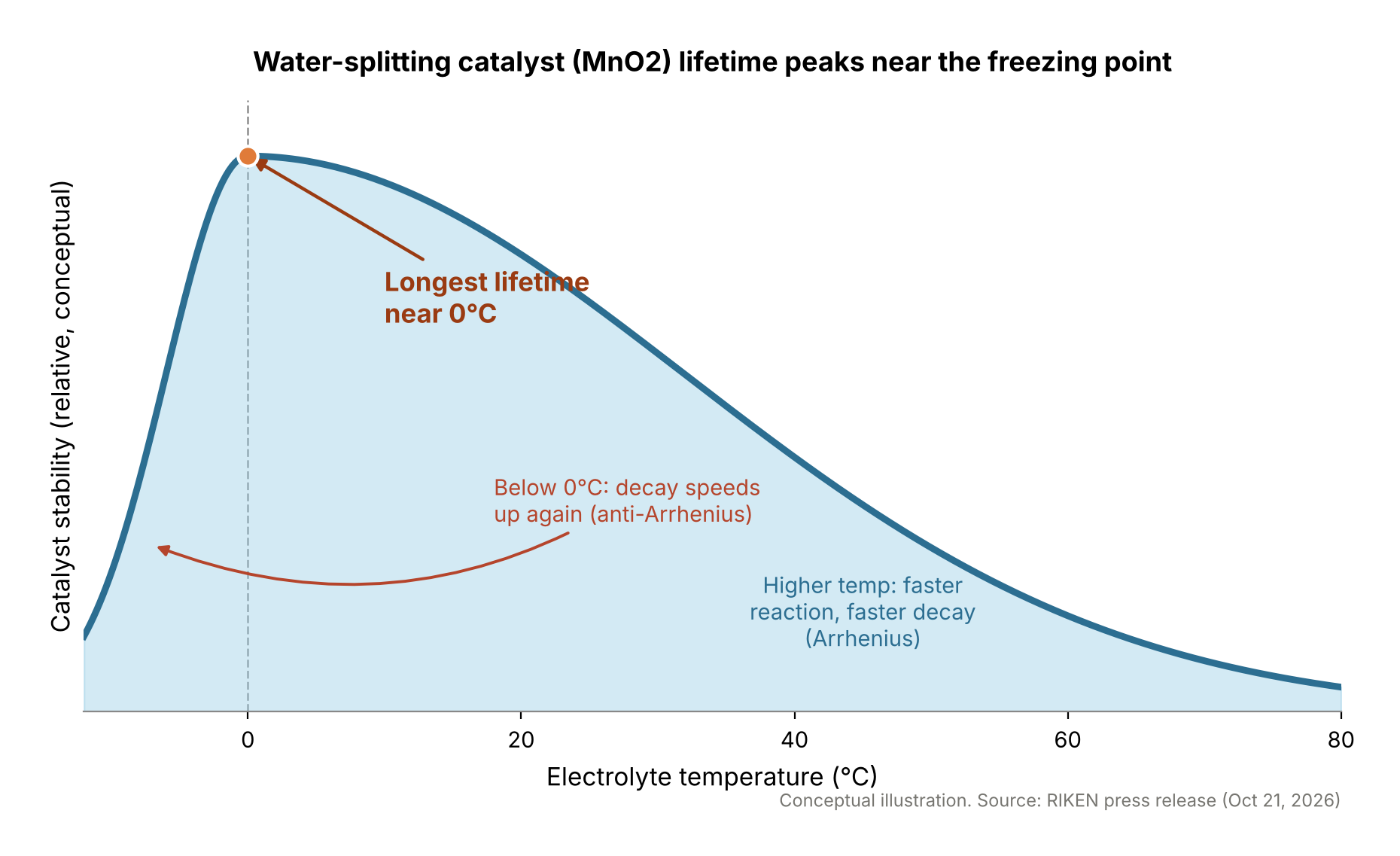
    Conceptual diagram showing catalyst stability peaking near 0C electrolyte temperature
    Based on the description in RIKEN’s press release (Oct 21, 2026)

    From Cold Climates to Icy Worlds

    The researchers see temperature as a new design lever that engineers could use alongside, or even instead of, changes to catalyst chemistry, to balance activity against stability. That has implications that go beyond ordinary industrial electrolyzers. The same principle could inform the design of electrochemical systems built to operate in cold or polar climates, where keeping equipment near room temperature is itself an energy cost. More speculatively, the findings could also help explain electrochemical reactions involving low-temperature water on other planetary bodies, where near-freezing or supercooled water may be common. The research team frames the work as contributing to UN Sustainable Development Goals centered on clean water and clean, affordable energy. The results were published October 21, 2026, in the journal Nature Chemistry, with support from Japan’s GteX program, JSPS KAKENHI, and other funding bodies.

    Not Just the Material, But the Setting

    A catalyst’s performance isn’t dictated by its composition and structure alone — that’s the central insight of this study. Something as simple as the temperature of the surrounding water can shift the balance between how fast a reaction runs and how long the catalyst that drives it survives. This result won’t make green hydrogen cheaper overnight, and plenty of engineering work stands between a laboratory finding and a commercial electrolyzer. But the idea of designing catalysts around the conditions they operate in, rather than focusing solely on the materials they’re made from, gives engineers a new variable to work with — one that costs nothing to install, since it only requires controlling a temperature that already has to be managed anyway.

    Sources: RIKEN press release, “Electrolysis catalyst becomes longer-lived near 0°C”, Nature Chemistry (DOI: 10.1038/s41557-026-02274-8)

  • [Science] Kids With Older Siblings Have Different Gut Bacteria — A Clue to Allergies?

    [Science] Kids With Older Siblings Have Different Gut Bacteria — A Clue to Allergies?

    Children with older siblings tend to develop fewer allergies — and new gut-microbiome research may point to part of the reason why. A team led by Japan’s RIKEN institute, together with researchers at five Japanese universities, analyzed stool samples from 903 two-year-olds enrolled in a nationwide birth cohort study, with 684 of them followed up again at age four. The number of older siblings a child had was linked to distinct gut-bacteria “types” and to the levels of health-related metabolites in their stool — and, notably, the association held from infancy all the way through the preschool years, a period earlier studies had largely left unexamined.

    原論文情報 / Original Paper
    Title: Sibling factors associated with gut microbiota and fecal short-chain fatty acids in preschoolers
    Authors: Tanaka Y. et al.
    Journal: Pediatric Research (online, October 14, 2026)
    DOI: 10.1038/s41390-026-05478-3

    Siblings and gut bacteria: what’s the link?

    Epidemiological studies have long reported that children with older siblings face a lower risk of developing allergic diseases. One proposed explanation, the “hygiene hypothesis,” suggests that exposure to microbes picked up from siblings may shape how a child’s immune system develops. But most earlier research focused on infancy or children under three, leaving it unclear whether the link persists into the preschool years — or what pathway might drive it. Sibling composition is tangled up with many other factors, from breastfeeding and diet to daycare attendance and antibiotic use, which has made the relationship hard to untangle. The gut microbiome itself is a hot topic in medicine, linked not just to immunity but to metabolism and long-term risk of allergies, obesity, and autoimmune disease. Families today look very different than they did a generation ago, with more children growing up as only children, so understanding exactly what siblings contribute — and through which biological pathway — has practical stakes well beyond basic science.

    Three gut-bacteria types in 903 toddlers

    The researchers analyzed stool from 903 two-year-olds across five regions of Japan (Chiba, Hyogo, Kochi, Miyagi, and Toyama), using 16S rRNA gene sequencing to profile bacterial composition and measuring short-chain fatty acids and other metabolites. Short-chain fatty acids are compounds gut bacteria produce by fermenting dietary fiber, thought to play a role in gut-barrier function and immune regulation. By grouping samples with similar bacterial profiles, the team identified three broad gut-microbiota “types,” or enterotypes. Type 1 had the lowest bacterial diversity and the lowest fecal propionate levels, with a high proportion of the Ruminococcus (Mediterraneibacter) gnavus group; Type 2 was dominated by Faecalibacterium; Type 3 by Ruminococcus. At age two, Type 1 was most common, accounting for 413 children (46%); by age four, Type 2 had become most common among the 684 children followed up, at 345 (50%) — a shift that itself suggests a toddler’s gut community keeps maturing well past infancy, rather than settling into a fixed state early on. It’s worth noting that this classification reflects differences in microbial composition, not a direct measure of a child’s health status or disease risk. A “low-diversity” label does not, by itself, mean a child is less healthy or more prone to illness; it simply describes which bacterial groups happen to dominate.

    More siblings, lower odds of Type 1

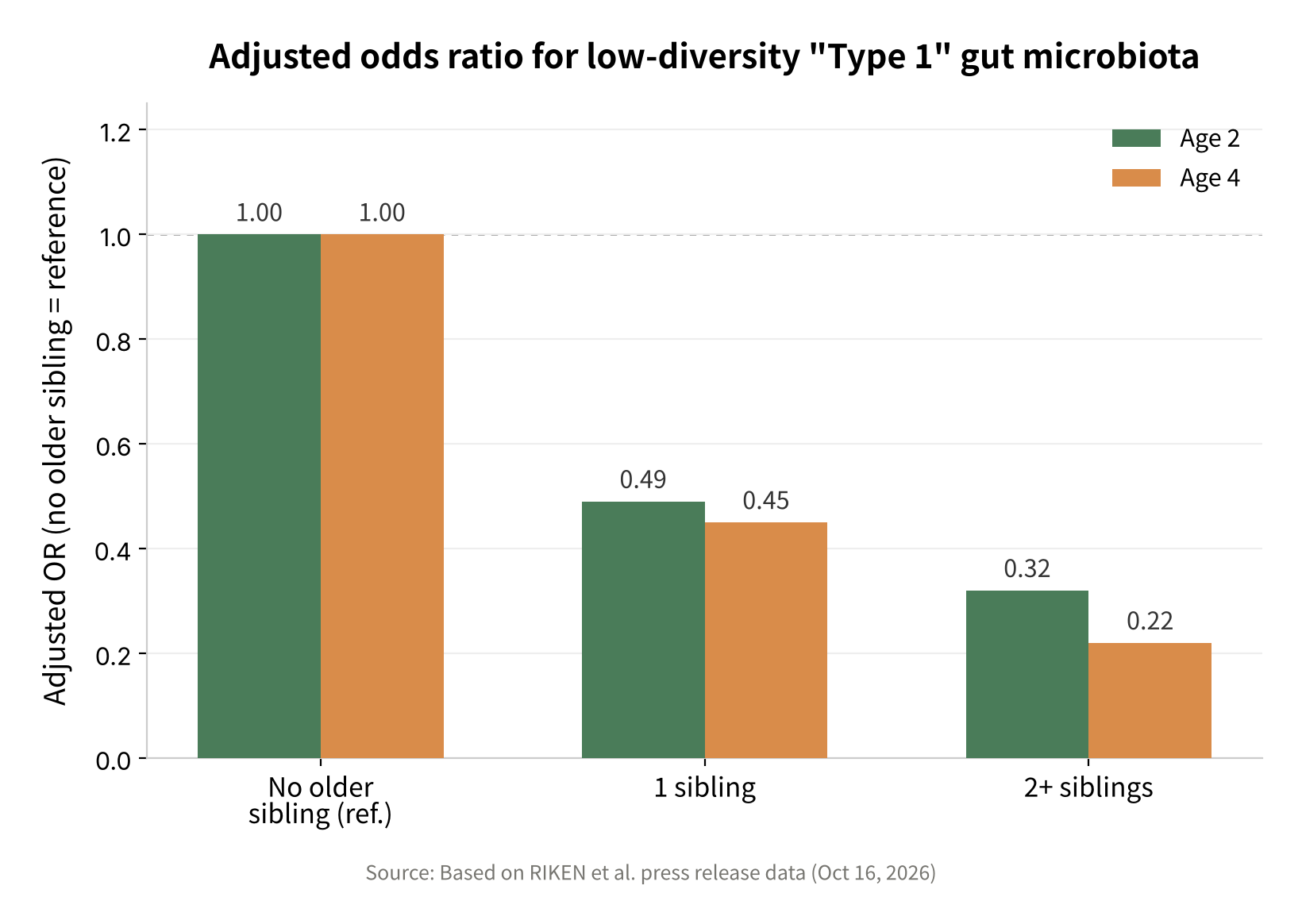
    The study’s central finding concerns how the number of older siblings relates to gut-microbiota type. Compared with children with no older siblings, the adjusted odds ratio for falling into Type 1 (versus Type 2) at age two was 0.49 for children with one older sibling and 0.32 for those with two or more. The same pattern held at age four among the 684 children followed up: 0.45 with one sibling, 0.22 with two or more. In other words, children with two or more older siblings had roughly a third of the odds of being classified as Type 1 compared with those who had none — not a third of the probability of being Type 1, a distinction worth keeping in mind. The association held even after adjusting for socioeconomic status, birth conditions, household size, and pet ownership, among other factors — a level of statistical control that makes it harder to dismiss the finding as a byproduct of some other feature of larger families, such as income or living space.

    Chart of adjusted odds ratio for gut microbiota Type 1 by number of older siblings
    Source: Created based on data from RIKEN et al.

    Metabolite levels followed a related pattern. At age two, several short-chain and branched-chain fatty acids correlated positively with the number of older siblings (with the exceptions of acetate and hexanoate); at age four, propionate alone showed the same association. It’s striking that something as variable from household to household as the number of siblings shows up this clearly in a toddler’s internal biology.

    What breastfeeding and daycare don’t explain

    Because sibling composition correlates with breastfeeding practices, diet, daycare attendance, and antibiotic use, the team ran a mediation analysis to see how much of the sibling-microbiota link these factors could account for — essentially, a statistical test of whether the “obvious” explanations were doing the real work behind the scenes. Most of the factors examined explained little of the association. The one exception: at age four, antibiotic use within the previous three months appeared to explain part of the link, though even that effect was modest.

    That doesn’t mean direct contact with siblings has been proven to be the cause. Unmeasured factors, or pathways the analysis simply couldn’t capture, may also be involved — perhaps the sheer frequency of everyday physical contact between siblings, or subtler lifestyle differences the survey wasn’t designed to pick up. This broader idea — that a child’s early environment can leave a lasting mark on later health — echoes another RIKEN finding on how early-life nutrition shapes long-term lifespan.

    Toward allergy prevention: what’s next

    The research team is careful to stress that the results don’t show that simply having siblings prevents disease. Whether these gut-microbiota differences actually translate into a lower risk of allergies and other conditions still needs to be tested, and causality is a much higher bar than the correlations described here.

    Children with two or more older siblings had roughly a third the odds, at age two, of being classified into the low-diversity gut-bacteria type compared with children who had none.

    The team plans to investigate next whether the sibling-linked changes in gut bacteria and metabolites actually translate into measurable differences in allergy outcomes, and whether specific bacterial groups or metabolites turn out to matter more than others. As a growing share of families raise only children, research like this could eventually offer clues toward interventions — dietary, probiotic, or otherwise — that help shape a healthy gut environment regardless of whether a child happens to have siblings at all.

    Sources: RIKEN press release, Pediatric Research (original paper)

  • [Science] RIKEN Focuses an Attosecond Laser 100 Times Tighter — From Watching Electrons Move to Putting That Motion to Work

    A team at Japan’s RIKEN institute has focused an “attosecond laser” — a flash of light lasting a mere quintillionth of a second — onto a spot smaller than a micrometer, at more than 100 times the intensity previous tabletop sources achieved. The team frames the advance as a shift from simply watching how electrons move inside matter to actively putting that motion to work. Down the road, the underlying technology could feed into nanoscale material processing and research on next-generation electronic materials and devices.

    原論文情報 / Original Paper
    Title: Submicrometer Focusing of Isolated Attosecond XUV Pulses Approaching 1016 W/cm2
    Authors: Imasaka, K. et al.
    Journal: Ultrafast Science (2026)
    DOI: 10.34133/ultrafastscience.0198

    What “attosecond science” means

    An attosecond is a quintillionth of a second (10-18 seconds) — a timescale almost impossible to picture. Electrons inside atoms move on exactly this scale, and the technique for capturing that instant won the 2023 Nobel Prize in Physics. What RIKEN produced is an “isolated attosecond pulse,” generated by driving a laser through a process called high-harmonic generation. This new result is a major upgrade to the focusing technology needed to turn that pulse from a tool for observation into one for processing and control.

    A 100-fold jump, a world record for tabletop sources

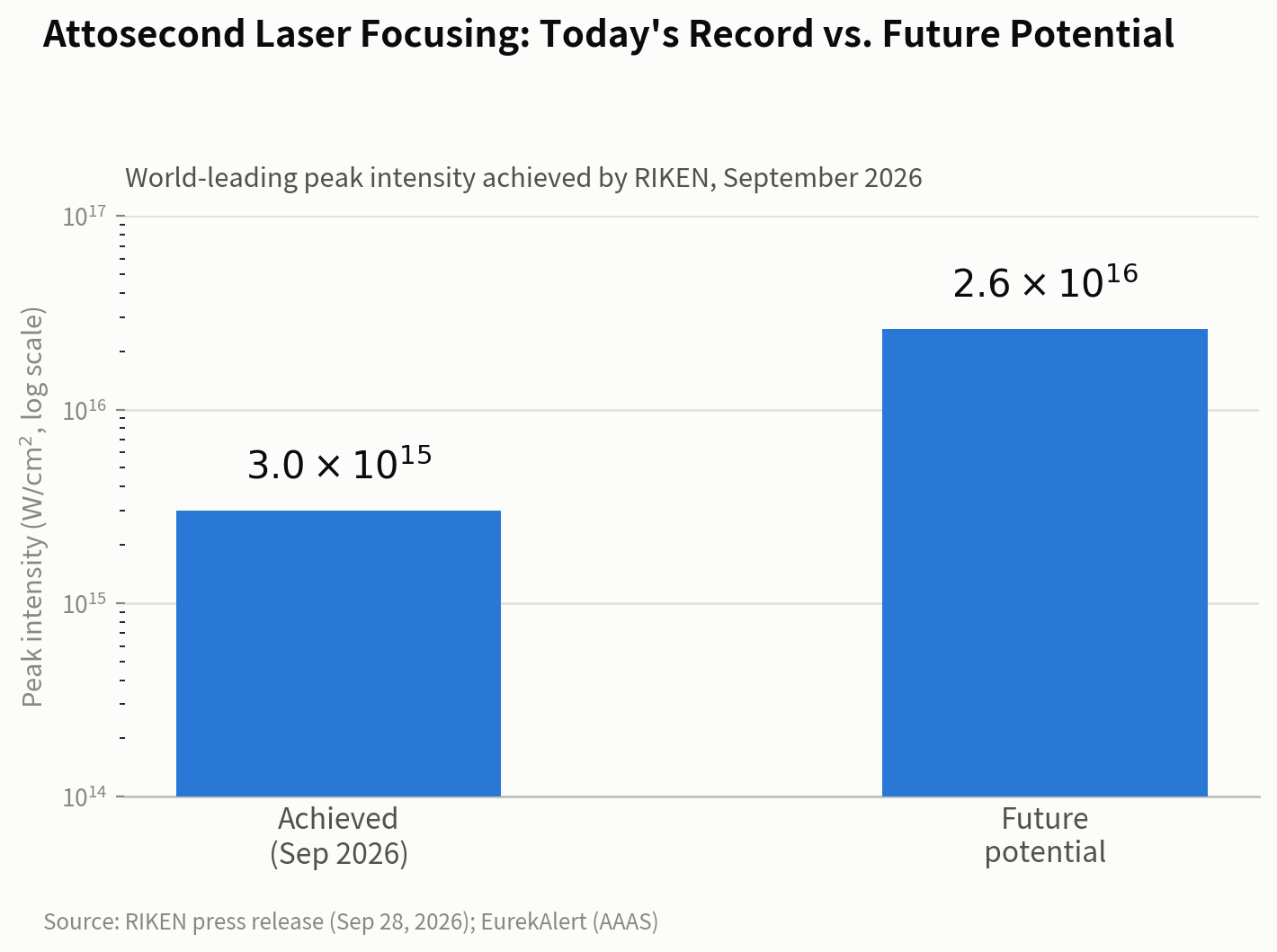
    A team led by Special Postdoctoral Researcher Kotaro Imasaka at RIKEN’s Center for Advanced Photonics built a new elliptical multilayer mirror finished to sub-nanometer surface quality (roughly 0.892 nm RMS roughness), paired with a real-time system that stabilizes the focal point. The result: a focal spot of just 460±130 by 360±120 nanometers — under a micrometer across — reaching a peak intensity of 3.0×10¹⁵ W/cm² (3 quadrillion watts per square centimeter) at the pulse’s peak. That is the highest peak intensity ever reported for an isolated attosecond pulse from a tabletop light source, more than 100 times beyond previous tabletop sources of the same kind.

    The team describes the achievement as opening the door to “a new ultrafast, high-intensity optical science” that moves beyond observing electron motion toward changing and harnessing it.

    EurekAlert, the news service run by the American Association for the Advancement of Science, corroborated the finding, reporting a peak pulse power of 1.1 gigawatts. It added that, with further refinement, the method could in principle reach 2.6×10¹⁶ W/cm² — about 8.7 times today’s figure — though that remains a future projection, not something already achieved. The underlying paper appeared online in the journal Ultrafast Science on September 23, 2026.

    Why it matters

    When light gets intense enough, a material’s response to it stops being simply proportional — unusual effects start to appear. That’s the realm of “nonlinear optics.” With higher intensity and tighter focusing, researchers can now push these nonlinear effects onto the attosecond timescale — “nonlinear attosecond optics” — not just in gases but in solids and liquids too. The team points to nanoscale surface processing and studies of ultrafast electron dynamics inside condensed matter as near-term applications, with possible spillover into future electronic materials and devices further out. For now, though, this remains basic research: turning it into real products or industrial applications will take further work.

    Bar chart showing attosecond laser peak intensity achieved versus future potential
    Source: created from data in RIKEN’s press release and EurekAlert

    Xsciens editorial note: reading the 100-fold claim

    Two qualifiers matter. First, the record is for tabletop sources: laser setups that fit in a laboratory rather than large facilities, so the comparison is with other tabletop systems and not with every attosecond light source in the world. Second, the headline intensity of 3.0×10¹⁵ W/cm² is what was achieved, while the 2.6×10¹⁶ W/cm² reported by EurekAlert is only what refinement could allow in principle, about 8.7 times higher.

    The advance is also in the focusing, not in making a stronger pulse. The team made the pulse hit a spot under a micrometer wide by building a very smooth mirror and keeping the focus stable in real time. That is why the work matters for experiments on solids and liquids, where tightly concentrated light is needed to trigger nonlinear effects. What to watch next is whether the nonlinear attosecond experiments the team describes are actually carried out in condensed matter, since for now this is basic research.

    Key terms

    • Attosecond: one quintillionth of a second, the timescale of electron motion in atoms
    • High-harmonic generation: a process in which an intense laser produces light at much higher frequencies, used to make attosecond pulses
    • Isolated attosecond pulse: a single, extremely short flash of light rather than a train of pulses
    • Nonlinear optics: the realm where a material’s response to light stops being proportional to its intensity
    • Tabletop source: a light source small enough to be built in an ordinary laboratory

    Sources: RIKEN press release, EurekAlert! (AAAS), Ultrafast Science journal article

  • [Science] How Low Protein Intake in Childhood Extends Lifespan: Drosophila (Fruit Fly) Study Reveals the Mechanism — RIKEN

    Many of us have heard some version of the idea that “what you eat as a child shapes your health as an adult.” The notion that nutrition during the fetal and early-life period influences later obesity, diabetes, and aging has long been recognized under the concept of DOHaD (Developmental Origins of Health and Disease). Yet exactly what happens inside the body to produce this effect has remained largely unknown. On September 24, 2026, a research team at Japan’s RIKEN institute announced that they had identified, in fruit flies, a molecule that offers a clue to solving this puzzle. The findings were published in the journal Nature.

    原論文情報 / Original Paper
    Title: Lsp2 links early-life diet to adult translation and lifespan in Drosophila
    Authors: Kosakamoto, H. et al.
    Journal: Nature (2026)
    DOI: 10.1038/s41586-026-11031-3

    The experiment: change the diet only during the larval stage

    The research group (the Nutrient Response Research Team at RIKEN’s Center for Biosystems Dynamics Research, led by Team Director Fumiaki Obata, with Hina Kosakamoto and colleagues) fed fruit fly larvae a protein-restricted diet only during the larval stage, then returned the flies to a normal diet as adults and raised them for life. They combined chemically defined (synthetic) diets to control nutrition precisely, metabolic analysis, tracing of nutrients with stable isotopes (atoms that differ in mass but behave almost identically in chemistry), and genetic techniques.

    Result 1: Lifespan rose by up to about 20%

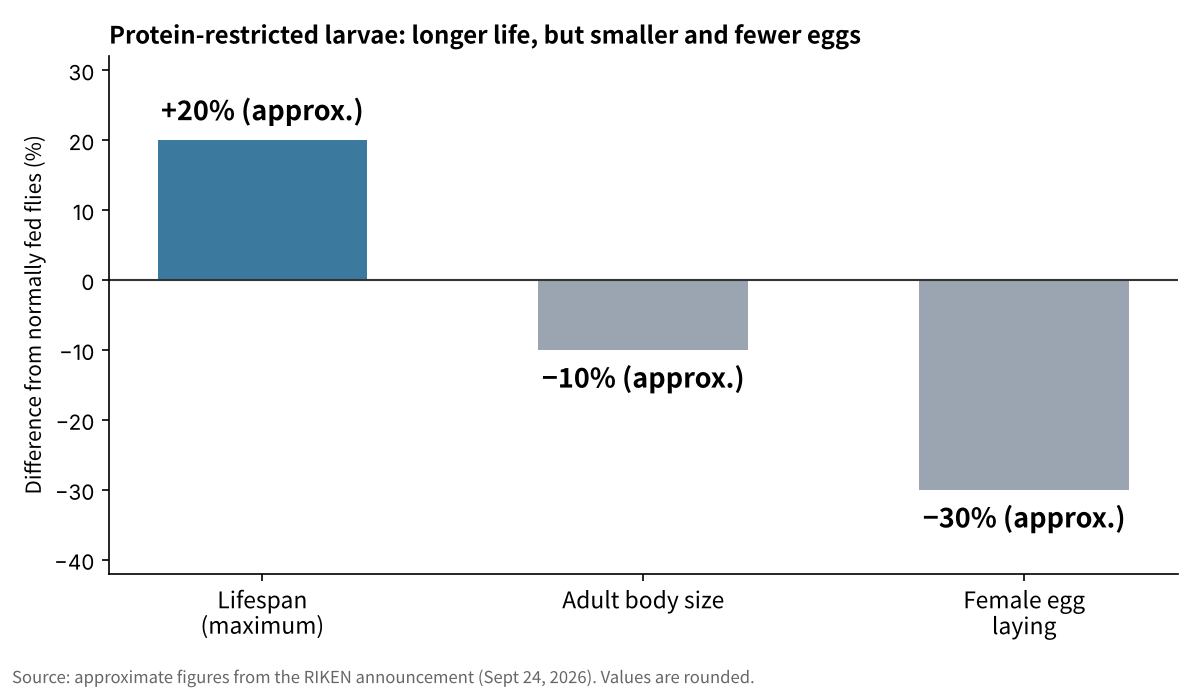
    Restricting protein only in the larval stage extended adult lifespan by up to roughly 20%, even though the adults ate a normal diet for the rest of their lives. The effect was seen in both males and females. Restricting only the amino acids in a synthetic larval diet gave a similar extension of up to about 20%. The benefit came with a cost: adults were about 10% smaller, and females laid roughly 30% fewer eggs. In other words, the longer life came with a trade-off against growth and reproduction.

    Bar chart: lifespan up about 20 percent, body size down about 10 percent, egg laying down about 30 percent
    Approximate differences from normally fed flies, based on the RIKEN announcement.

    Result 2: Larval amino acids were still in the adult body

    When the team tracked amino acids (the building blocks of proteins) labeled with stable isotopes, they found that amino acids taken up in the larval stage remained in many proteins after the flies became adults. In 6-day-old adults, about half of all proteins were still built from amino acids acquired during the larval stage. (The analysis used heads, where cell division has less influence on the result.) Larval amino acids were especially common in the parts of ribosomes, the molecular machines that make proteins inside cells.

    In flies that had been protein-restricted as larvae, early adults had fewer ribosomes and lower protein-synthesis activity (translation). This decline was limited to roughly the first week of adulthood; by day 14 the difference was gone. The researchers think this moderate, temporary suppression of translation is a major pathway behind the longer lifespan.

    Result 3: The key is a storage protein called Lsp2

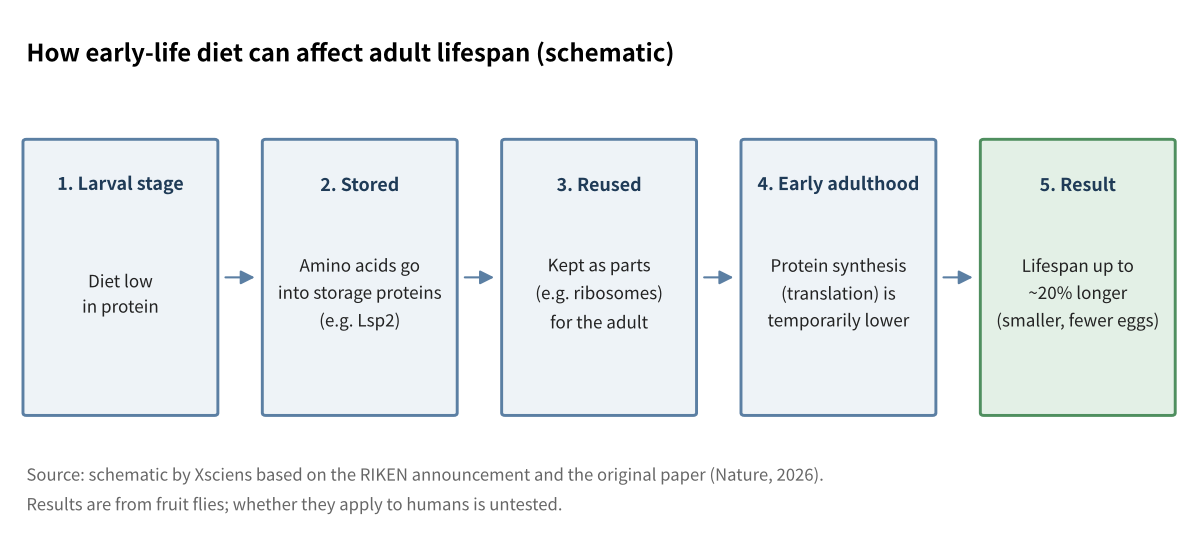
    Amino acids taken up in the larval stage stay in the body as a storage protein called Lsp2, which is later reused as raw material for building new ribosomes in the early adult stage. When larvae were protein-restricted, Lsp2 levels fell, and the reduction persisted into early adulthood. Reducing Lsp2 alone by genetic knockdown (weakening the activity of a specific gene) lowered protein synthesis and extended lifespan just as dietary restriction did, and with almost no effect on body size or egg-laying. The team concludes that Lsp2 plays a central role in controlling lifespan.

    Lsp2 is rich in aromatic amino acids such as tyrosine and phenylalanine. Restricting just one of these amino acids in the larval diet was enough to reproduce the drop in Lsp2 and the longer lifespan. The team proposes a new mechanism in which a storage protein “remembers” early-life nutrition and carries that information into adulthood to regulate lifespan.

    Flow chart showing how larval diet leads to longer adult lifespan in fruit flies
    How early-life diet can affect adult lifespan (schematic by Xsciens based on the RIKEN announcement and the original paper).

    What it means for humans (and what it does not)

    The result offers a new lead for thinking about the molecular basis of the DOHaD hypothesis, which holds that nutrition in the fetal and infant period affects the risk of lifestyle-related disease in adulthood. RIKEN also raises the possibility that a decline in stored amino acids is read by the body as reduced nutrition, something like “eating until 80% full,” and mentions proteins that might play a similar role in humans, such as albumin and globulin in blood. Whether a similar mechanism exists in mammals remains to be tested.

    Because this work was done in fruit flies, it cannot be applied directly to human diets. The longer lifespan came with a smaller body and fewer eggs, so the finding does not mean that restricting a child’s diet would help them live longer.

    Xsciens Editorial Note

    The study offers a molecular clue that nutrients taken in early in life can persist in the body as building blocks into adulthood. It does not say that restricting children’s diets will make them live longer.

    • Separate what was observed from what was interpreted. What was observed: protein restriction in larvae extended adult lifespan by up to about 20%, and about half of all protein in the heads of 6-day-old adults came from larval amino acids. The idea that a temporary dip in early translation contributes to longer life is an interpretation drawn from experiments and genetics. “Up to” also means the gain can be smaller under other conditions.
    • Fly results, with costs. The longer-lived flies were about 10% smaller and females laid about 30% fewer eggs. The DOHaD hypothesis rests mainly on observational studies in humans, and whether this molecular mechanism exists in mammals is untested. Another group has reported that restricting larval diet also extends lifespan in flies, but that the effect depends strongly on the adult diet and works through a different route (lipid autotoxins), so longevity is unlikely to have a single mechanism.
    • What to watch next. Whether mammals have a similar “early nutrition stays in the body” mechanism, how timing and amount of restriction change the outcome, and whether the growth and fertility costs can be avoided.
    • Our imagination (speculation) — We wonder whether, if we learn where and how much of early-life nutrition stays in the body, it might become possible to spot health risks sooner in people who had a disadvantaged start, or to make up for it later. At the same time, the trade-off with body size and egg laying suggests the practical path is not “eat less” but finding ways to target only the parts that matter. This is only our speculation.

    References for this note: Stefana et al., Nature Communications (2017), “Developmental diet regulates Drosophila lifespan via lipid autotoxins” (Francis Crick Institute), Lacagnina, “The Developmental Origins of Health and Disease (DOHaD)”, American Journal of Lifestyle Medicine (2019)

    Key terms

    • DOHaD (Developmental Origins of Health and Disease): the idea that nutrition in the fetal and infant period affects health and disease risk in adulthood
    • Lsp2: a storage protein made in large amounts by fruit fly larvae that remains in the body into adulthood
    • Ribosome: the molecular machine in cells that makes proteins
    • Translation: the process of making proteins from genetic information (protein synthesis)
    • Knockdown: weakening the activity of a specific gene by genetic manipulation

    Sources: RIKEN press release, “The mechanism by which early-life nutrition determines lifespan” (September 24, 2026), Kosakamoto, H. et al. Nature (2026)