Generative AI is everywhere in conversation, yet fewer than 3 in 10 people say they’ve actually mastered using it. According to “Quality of Society Index 2026,” an annual survey released on October 19, 2026 by Dentsu Soken, a large generational gap separates confident AI users from everyone else — and over the past year, anxiety about AI taking people’s jobs has spread beyond young workers to reach people in their 40s, 50s, 60s and 70s as well, narrowing a gap that used to be much wider. Here’s what the numbers show, why the gap between confidence and anxiety matters, and what it suggests about how workplaces should be handling AI training right now.
Title: “Quality of Society Index 2026” (クオリティ・オブ・ソサエティ指標2026)
Authors: Dentsu Soken Inc., Humanology Innovation Division, Quality of Society Center
Journal: Dentsu Soken Press Release
DOI: https://www.dentsusoken.com/news/release/2026/1019.html
Dentsu Soken’s think-tank arm, the Quality of Society Center, has run this survey every year since 2019 to track how people’s attitudes are reshaping Japanese society — covering everything from views on work and community to broader questions about what a “good society” looks like. The 2026 edition was fielded online from June 23 to 30, 2026, among 12,000 men and women aged 18 to 79 across the country, including high school students, through the research firm Dentsu Macromill Insight. With a sample that large, the margin of error works out to at most ±1.3 percentage points at a 95% confidence level. For the first time since the survey began, this year’s edition added questions about how well people feel they use AI, and how comfortable they are letting AI agents handle everyday tasks on their behalf — a timely addition, given how quickly AI tools have moved from novelty to daily habit for many people over the past two years.
Confidence in AI Still Lags Behind the Hype
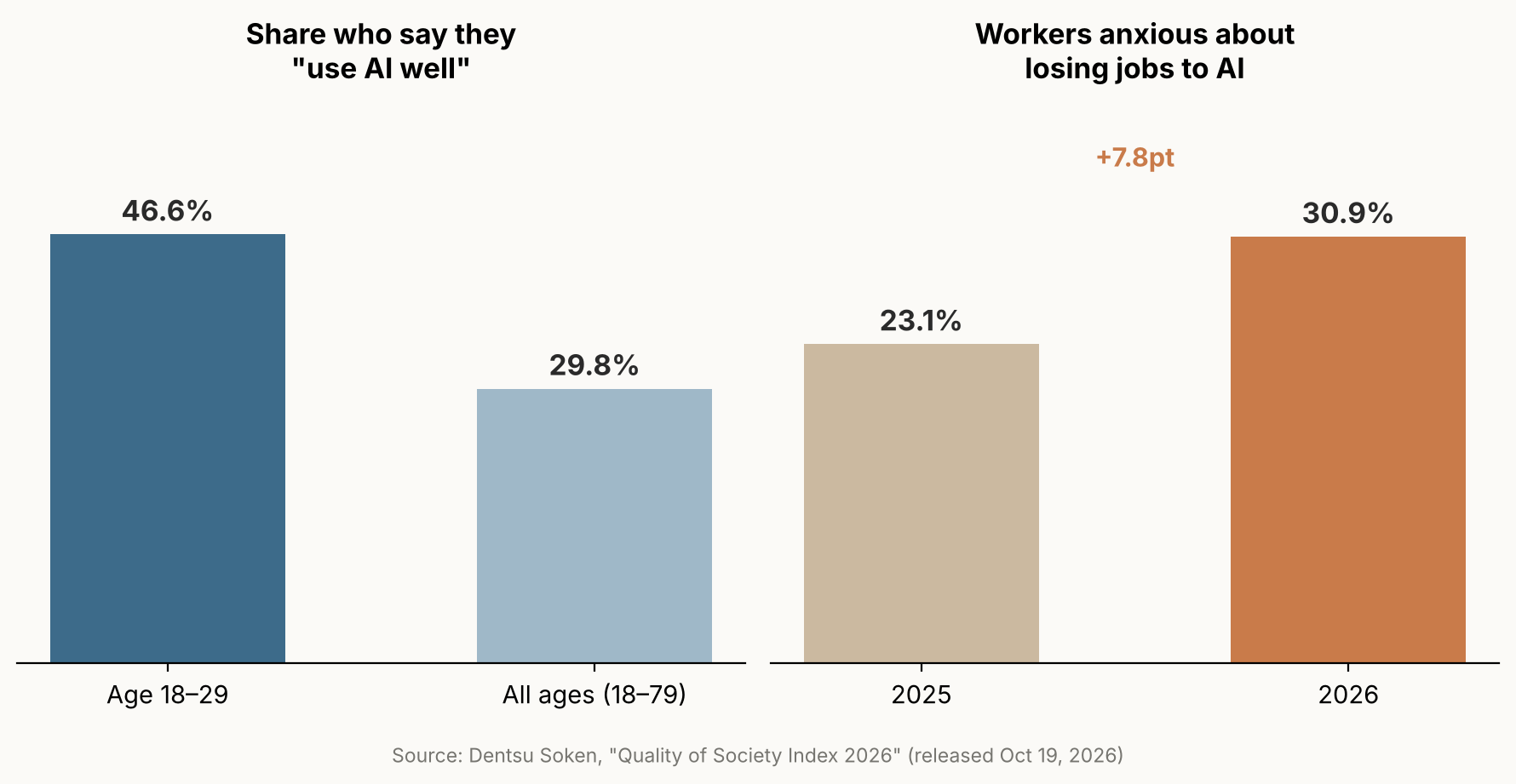
Asked whether they agreed with the statement “I feel I use AI well,” only 29.8% of respondents said yes. Confidence rose with youth, but even the most confident group — 18-to-29-year-olds — topped out at 46.6%, short of a majority. In other words, even among the demographic that grew up with smartphones and is usually assumed to be most comfortable with new technology, most people still don’t feel they’ve got AI figured out. Dentsu Soken reads this as a sign that while conversational generative AI has become familiar — most people have at least tried a chatbot by now — actually using it well remains a trial-and-error process for the majority. It’s worth being precise about what the 29.8% figure actually measures: it’s self-assessed confidence, gathered by asking people how they feel about their own AI use, not an independent test of how skillfully they actually use it. Someone who rarely uses AI at all and someone who uses it daily but still feels unsure could both end up in the “not confident” category.
Confident Users Trust AI Agents More
The survey also asked a more forward-looking question: would people accept letting an AI agent — an automated assistant that acts on a person’s behalf rather than simply answering questions — handle three everyday situations? The scenarios were managing money, such as investment decisions; helping spark a new friendship or romantic connection; and booking restaurants or travel. Across all three, people who said they use AI well were consistently more accepting of handing the task to an AI agent than people who didn’t feel confident. That’s a fairly intuitive result — people who already trust their own ability to work with AI are, unsurprisingly, more willing to extend that trust further — but it’s worth noting precisely what the data can and can’t support. The two measures clearly move together, but a single survey like this can only show that confidence and acceptance are correlated among respondents, not that one causes the other. It’s equally possible that people who are generally early adopters of new technology simply score higher on both measures at once.
Anxiety Jumps 7.8 Points, Gap Narrows
Regardless of how confident people felt about using AI themselves, anxiety about losing a job to AI grew across the board. Among currently employed respondents (n=5,734 in 2026, n=5,708 in 2025), 30.9% said they felt anxious about AI or automation taking their job, up 7.8 points from 23.1% the year before — a sizable one-year jump for a tracking survey like this. The shift wasn’t evenly distributed by age, though, and that’s arguably the more interesting part of the finding. A year earlier, anxiety about AI displacing jobs was concentrated among younger workers. In the 2026 wave, that anxiety rose among people in their 40s, 50s, 60s and 70s as well, pulling every age bracket toward roughly 30%, and narrowing what had been a fairly wide generational gap. Dentsu Soken points to a year of expanding AI adoption inside Japanese workplaces as a likely factor behind the broader spread of concern. That’s a reasonable reading of the trend, but it’s the survey organization’s own interpretation of the pattern — this kind of survey can show that anxiety rose and spread across ages, but it can’t, on its own, establish workplace AI adoption as the specific cause.
30.9% of workers now say they’re anxious about losing their job to AI — up 7.8 points in a year, with the generational gap narrowing as older workers caught up to younger ones.
Echoes of an Earlier AI Persistence Study
Put the two findings together and a pattern emerges: confidence in actually using AI well remains a minority experience, while anxiety about AI’s effect on jobs has outrun it, spreading across generations faster than comfort with the technology has. That pattern echoes something we covered previously on this site: a set of randomized experiments by researchers at UC Berkeley and several partner institutions, involving 1,222 participants across three separate trials, found that people who leaned on AI assistance to solve math or reading problems performed measurably worse afterward — once the AI was taken away — than people who had worked unaided from the start. In the first experiment, people who had used AI got only 57% of follow-up questions right on their own, versus 73% for the group that never had AI help. It’s important to be precise about what kind of evidence each study offers, though. The Berkeley work was a controlled experiment measuring task performance under lab conditions; the Dentsu Soken survey is a broad measure of public sentiment about jobs and confidence. They’re different kinds of evidence answering different questions, and one doesn’t prove the other. But read side by side, they point toward a broader unease about how people are relating to AI as it becomes more capable and more embedded in daily life and work.
The Real Risk: A Training Gap
If AI adoption keeps expanding at work — and the survey’s own data suggests it already has, given how sharply anxiety spread this year — companies will likely need to give employees concrete, hands-on ways to learn how to use AI tools well, along with room to experiment without fear of getting it wrong in front of colleagues or managers. This survey alone can’t say precisely what’s driving the rise in anxiety, or whether workers currently have enough opportunities to build real confidence with these tools. But the combination it does show is hard to ignore: confidence in using AI well remains rare, at well under a third of the population even among the young, while anxiety about AI’s effect on jobs has become common across every age group. That gap points to a practical, near-term challenge for employers: treating AI rollout and workforce training as a single connected problem, rather than assuming that giving people access to AI tools is the same thing as teaching them how to use those tools well.
Sources: Dentsu Soken, “Quality of Society Index 2026” press release, full survey report (PDF)
Leave a Reply