A chatbot that hands you the answer can make a hard problem feel easy — until the chatbot is gone. A new study from researchers at five universities found that people who solved problems with an AI assistant performed worse on the next problems, once that assistant was taken away, than people who had worked through the very same problems alone from the start. The gap showed up after roughly 10 to 15 minutes of AI-assisted problem-solving, and it held across three separate experiments involving 1,222 recruited participants — a pattern the authors say raises real questions about whether leaning on AI for answers can undermine people’s ability, or willingness, to solve problems on their own.
Three Experiments, One Pattern
The team — Grace Liu, Brian Christian, Tsvetomira Dumbalska, Michiel A. Bakker and Rachit Dubey, drawing on UC Berkeley’s Center for Human-Compatible AI along with Carnegie Mellon University, MIT, the University of Oxford and UCLA — ran three randomized controlled trials totaling 1,222 recruited participants (307, 585 and 168 after some participants were excluded under the researchers’ prespecified criteria). In the first experiment, 354 people were recruited to solve 12 basic fraction problems; half worked alone throughout, while the other half could ask a ChatGPT assistant, built on GPT-5, for help — before everyone, AI group included, had to solve three further problems entirely on their own. A second experiment repeated that design with 667 people, and a third, with 201 participants, swapped the math problems for SAT-style reading comprehension questions.
In every version of the study, the early pattern looked encouraging: while they still had access to the AI, the assisted group solved problems faster and scored higher than the group working alone — exactly what you would expect from a capable assistant. The twist came in the second half of each session, once the AI was removed and everyone, including the AI group, had to finish the rest of the problems unaided.
The Numbers Behind the Finding
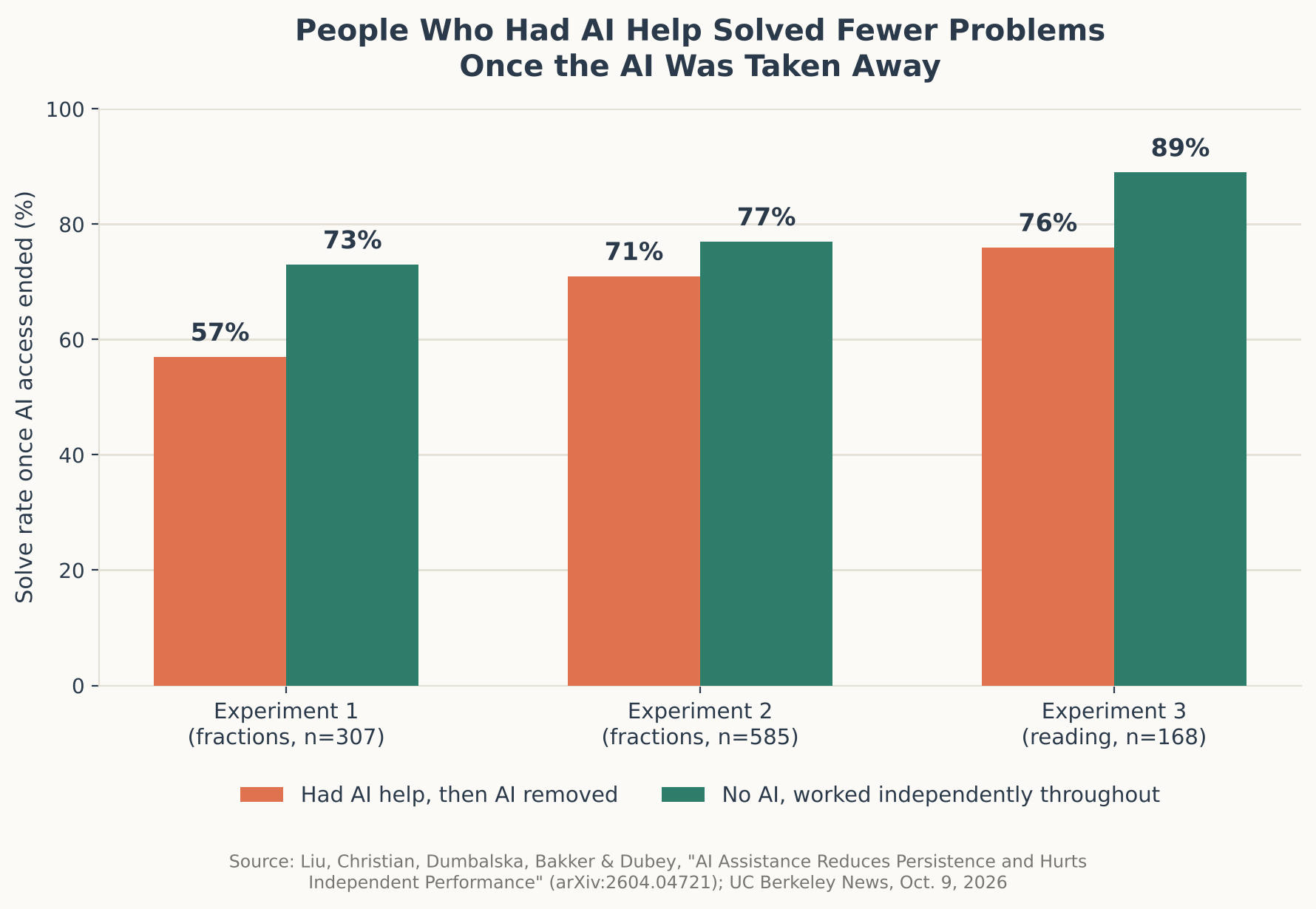
Once AI access ended, the previously assisted group fell behind the group that had never used it, and the gap was consistent across all three experiments. In the first fraction experiment, the former AI group answered an average of 57% of the three final problems correctly, versus 73% for the no-AI group — a statistically significant difference (p < 0.001). The larger replication of the same design found a smaller but still reliable gap: 71% versus 77% (p = 0.02). In the reading-comprehension experiment, the difference widened again, to 76% versus 89% (p = 0.007).
Giving up altogether followed a similar trend. In the first experiment, 20% of the former AI group skipped a problem rather than attempt it, compared with 11% of the no-AI group. The pattern was weaker in the larger replication (10% versus 7%, not statistically significant) but reappeared clearly in the reading task, where 8% of the AI group skipped questions versus just 1% of the control group. A closer look at how participants said they had actually used the AI while it was available sharpened the picture further, though this part of the analysis was observational rather than randomized, since people were not assigned to copy answers or ask for hints: those who reported simply copying the AI’s finished answers fared worst afterward, averaging just 65% correct on their own, while those who said they used the AI mainly for hints showed no statistically significant gap from people who never touched AI at all.
Participants were randomly assigned to the AI or no-AI condition, and the larger replication added a pretest to check the groups further: accuracy and the tendency to skip a problem did not differ significantly between groups beforehand, which strengthens the case that the later gap reflects the AI condition itself rather than pre-existing differences between participants. In that same larger replication, participants were also asked how they had actually used the AI while it was available. A small slice, about 12%, said they had barely used it despite having access, and this group performed about as well afterward as people who never had AI access at all — reinforcing the idea that it is the degree of reliance on AI, not mere availability of it, that predicts the later drop-off.
“It’s a striking finding, but in a way it supplies ammunition for a story that a lot of us kind of feel in our gut.” — Brian Christian, UC Berkeley
What Might Explain the Pattern
The authors propose two explanations, while cautioning that their experiments were not designed to prove which one is doing the work. The first is a kind of expectation mismatch: once someone gets used to near-instant answers, grinding through a problem by hand can suddenly feel disproportionately slow, which may make people more willing to give up rather than push through. The second is the loss of what the researchers call “productive struggle” — the idea that difficulty itself is not simply an obstacle to route around, but part of how people practice and strengthen the skills a problem requires. Bypass that effort often enough, the argument goes, and there may be fewer chances for those skills to get built in the first place.
It’s a different mechanism, but this study joins a related question this site has covered before: Georgetown University researchers recently found that AI-generated summaries of events can distort people’s memory of what actually happened. That study is about memory rather than problem-solving, but together the two point to a broader pattern worth watching — handing a mental task to AI can carry a hidden cost to accuracy or independent ability, even when it feels like pure convenience in the moment.
“Not Just Fractions and SAT Problems”
Christian has been blunt about how far he thinks the implications reach beyond a psychology lab. “This is not a story about fractions and SAT problems,” he said in comments accompanying the study’s release. “This is something that is happening to human knowledge and human expertise.” He described the irony directly: widely used AI assistants, he said, are “often helping us in ways that are kind of unhelpful” — lifting performance on the task directly in front of us while, the data suggest, working against the independent competence we will need the next time no AI is around.
The caveats matter here. The study measured performance minutes after AI access ended, not months or years later, so it cannot say how long this effect lasts or whether frequent users eventually adapt and recover. The breakdown by how people used the AI — copying answers versus asking for hints — was observational rather than randomized, so it shows an association rather than definitive proof of cause and effect. And all three experiments involved short, one-off tasks completed by paid online participants, a different setting from a student using AI across a semester of coursework or an employee weaving it into daily work.
What This Means for Using AI
None of this is an argument for avoiding AI assistance altogether — the same data show it clearly boosted short-term performance while it was available, and for many real-world tasks, getting the right answer quickly is exactly the point. The more useful takeaway from this one study may be about how AI gets used rather than whether: in the self-reported usage data, the steepest drop-off belonged to people who let the AI hand them a finished answer, while those who said they used it mainly for hints or partial guidance looked much closer to the group that never used AI at all. Treating a chatbot more like a tutor that nudges you toward a solution, rather than a vending machine that dispenses the finished one, looks like a reasonable bet for keeping your own problem-solving sharp — though it’s one study, in a narrow setting, and confirming how far that advice travels beyond fractions and reading quizzes will take further research.
Sources: UC Berkeley News, arXiv:2604.04721, “AI Assistance Reduces Persistence and Hurts Independent Performance”
Leave a Reply