Month: October 2026

  • [Science] What Is Backpropagation? A Simple Guide to How AI Learns

    [Science] What Is Backpropagation? A Simple Guide to How AI Learns

    Backpropagation is the algorithm that lets artificial neural networks learn from their own mistakes, and it quietly powers much of today’s AI — from chatbots that answer your questions to the apps that recognize a face in a photo. Understanding it, even at a basic level, is one of the clearest ways to understand how modern deep-learning systems actually learn.

    Original Paper

    Title: Learning representations by back-propagating errors
    Authors: David E. Rumelhart, Geoffrey E. Hinton, Ronald J. Williams
    Journal: Nature, Vol. 323, pp. 533–536 (1986)
    DOI: 10.1038/323533a0

    What Is Backpropagation, Exactly?

    In plain terms, backpropagation — short for “backward propagation of errors,” also known as error backpropagation — is a method for training a neural network by repeatedly working out how wrong its answer was, and in which direction each connection should adjust. A neural network is built from layers of simple, interconnected units (loosely inspired by neurons) joined by adjustable connection strengths called weights. When a network is first created, its weights are usually set to small, carefully chosen random values, so its first guesses are generally poor. Backpropagation is the procedure that turns that rough starting point into a network that can recognize a cat in a photo, translate a sentence, or predict the next word in a reply.

    There is one important distinction worth keeping straight: backpropagation calculates how much each connection contributed to the error, while a separate step called gradient descent uses that information to actually adjust the connections. People often use “backpropagation” loosely to describe the whole training process, but technically the two are different steps working together.

    How the Algorithm Actually Works

    Training with backpropagation happens in two passes. In the forward pass, an input — a photo, a sentence, a row of sensor data — moves through the network’s layers in order, and the network produces a prediction. That prediction is then compared with the correct answer using a loss function, a numerical measure of how far the prediction was from the desired result.

    Backpropagation doesn’t tell a network what to think. It tells the network how wrong it was, and in which direction each connection should move to be a little less wrong next time.

    A simple analogy helps before the math: imagine a product moving through several stages of a factory line, and the finished item turns out defective. To find the cause, managers work backward from the end of the line, and each stage reports how much it may have contributed to the problem, passing that information to the stage before it. The backward pass in backpropagation does something similar, except it uses calculus to work this out exactly. Starting at the output layer and moving back toward the input, the algorithm applies the chain rule — a technique for tracking how a change at one stage ripples through a chain of dependent calculations. Each layer combines information about how its own calculations affected the next layer with the error information passed back from that layer, producing a gradient: a measure of how sensitive the loss is to a small change in each weight, at its current value.
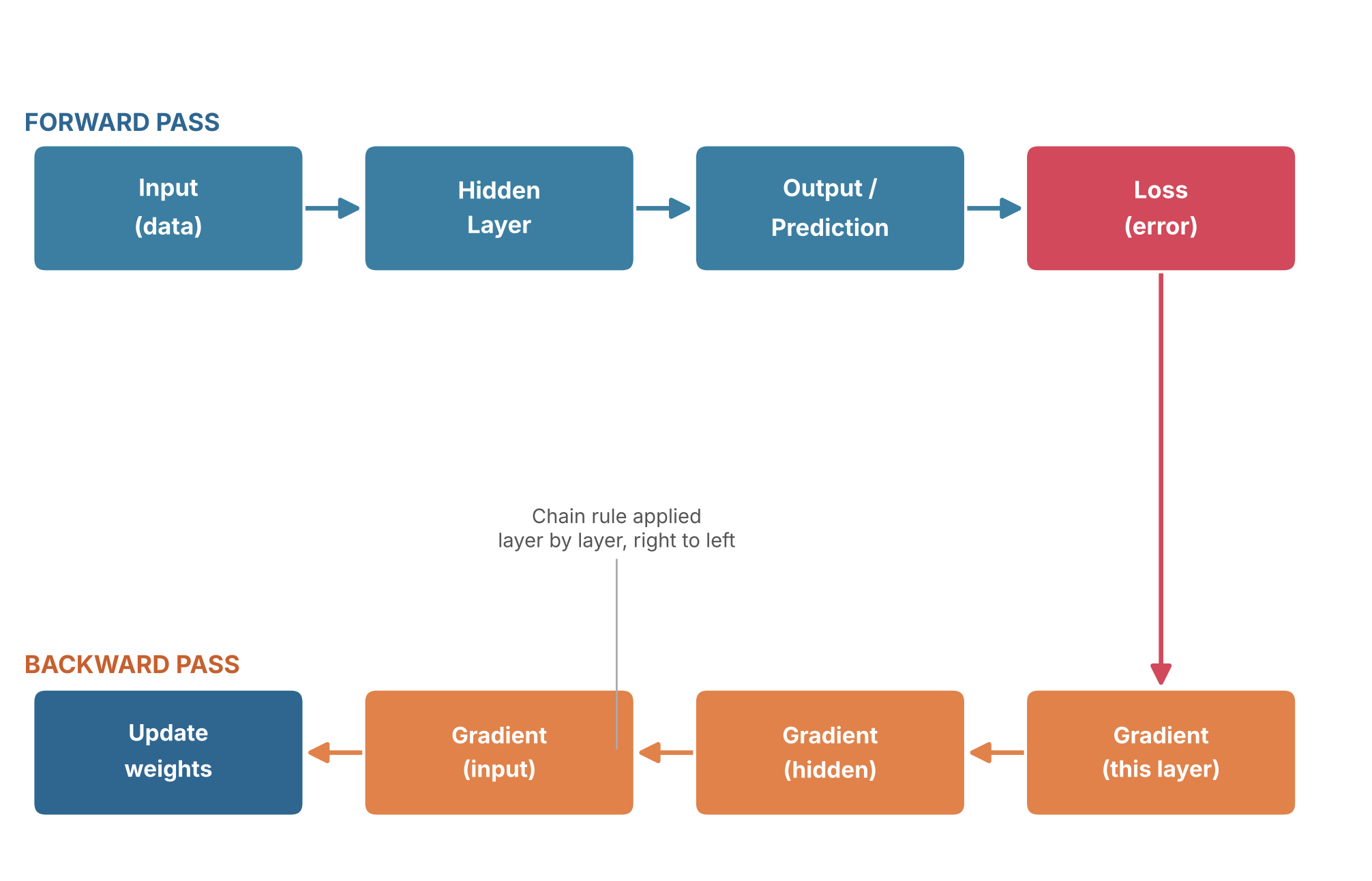
    Diagram of the forward pass and backward pass in backpropagation
    The forward pass produces a prediction and a loss; the backward pass applies the chain rule, layer by layer, to compute gradients and update the weights.

    Once every weight has a gradient, gradient descent uses it to actually update the weights, nudging each one a small amount in the direction that reduces the error. Repeat this forward-pass/backward-pass/update cycle over thousands or millions of examples, and a network that started with randomly initialized connections gradually comes to reflect real structure in the data. The appeal of backpropagation is efficiency: it calculates gradients for every weight in a network in roughly the time needed for a small number of forward and backward passes, rather than requiring a separate experiment for each individual weight.

    Why Backpropagation Is Getting Attention Again

    Backpropagation is not new, and its mathematical core had already been explored before it became famous. Reverse-mode automatic differentiation — the calculus technique at the heart of the algorithm — traces back to Finnish researcher Seppo Linnainmaa’s 1970 master’s thesis, and American researcher Paul Werbos proposed applying a related idea to neural networks in his 1974 doctoral thesis. The method became particularly influential after David Rumelhart, Geoffrey Hinton and Ronald Williams published “Learning representations by back-propagating errors” in Nature in 1986, demonstrating that it could let multilayer networks automatically discover useful internal features rather than relying entirely on engineers to design them by hand.

    For years afterward, backpropagation-trained networks were mostly a research curiosity, limited by available data and computing power. That changed dramatically in 2012, when Alex Krizhevsky and Ilya Sutskever, working with their advisor Geoffrey Hinton, combined backpropagation, the large labeled ImageNet dataset, and graphics-card computing power in a network known as AlexNet. It dramatically outperformed competing approaches in that year’s ImageNet image-recognition competition, a result widely credited with triggering the modern deep learning boom. The large language models behind today’s generative AI chatbots are, at their core, still trained with variations of the same algorithm.
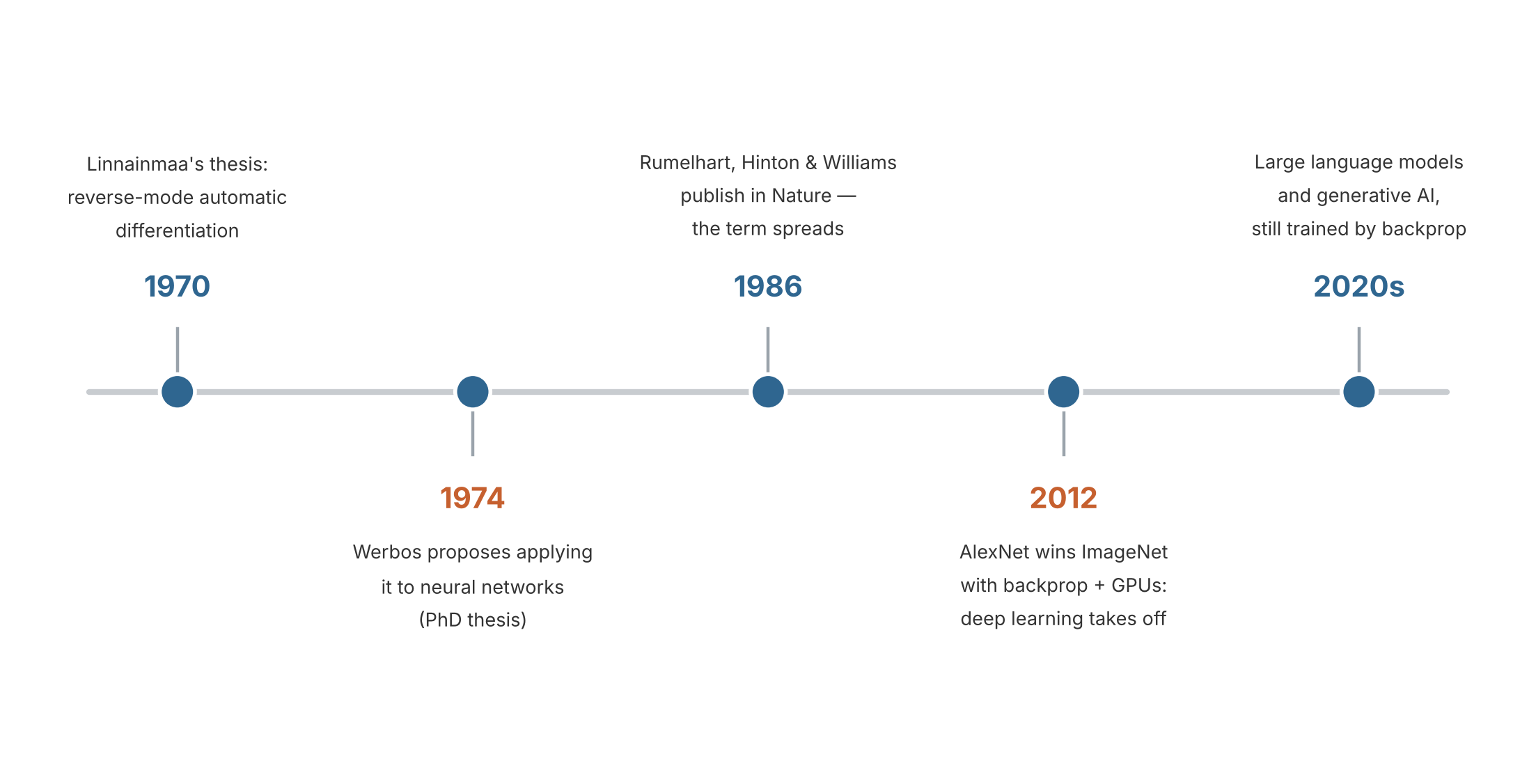
    Timeline of key milestones in the history of backpropagation, from 1970 to the 2020s
    Source: created based on Linnainmaa (1970), Werbos (1974), Rumelhart, Hinton & Williams, Nature (1986), and the AlexNet/ImageNet milestone (2012).

    What has put backpropagation back in the spotlight recently is a different question: does the brain do anything like this? In October 2026, a team at MIT’s McGovern Institute, led by Qianli Liao, Liu Ziyin and Yulu Gan with senior authors Mark Harnett and Tomaso Poggio, published a study in the Proceedings of the National Academy of Sciences proposing a computational model in which randomly connected artificial networks can self-organize their own forward and feedback pathways, using only local learning rules inspired by biological synapses and no global error signal — and still learn nearly as well as backpropagation on the tasks tested. The researchers are careful to frame this as a candidate mechanism and a testable hypothesis, not proof that real brains work this way, but it reopens a question that has nagged neuroscientists for roughly 40 years: backpropagation is clearly powerful enough to drive today’s AI, yet nothing in a biological brain has been shown to do precisely what it requires. (Related article: A Simulated Brain Circuit Builds Its Own AI-Like Learning System, MIT Finds.)

    Where You’ve Already Met Backpropagation

    Even though the math stays behind the scenes, the results of backpropagation-trained networks are part of ordinary life. Many modern face-unlock features and the photo apps that automatically group pictures of the same person run on neural networks trained with backpropagation or related gradient-based methods. Voice assistants that transcribe speech or answer spoken questions generally rely on networks trained the same way. Generative AI chatbots are also built using neural networks trained with backpropagation — during an early stage called pretraining, for example, a language model repeatedly tries to predict the next word in a passage of text, compares its guess with the actual word, and adjusts its weights to reduce the error; later training stages then refine how it follows instructions and responds to feedback.

    It’s worth keeping one distinction in mind: backpropagation mainly happens during training, not every time you use these tools. Once a network has learned, it typically uses its already-adjusted weights to make predictions, without recalculating gradients or updating itself each time — the heavy lifting happened earlier, often across billions of training examples.

    What to Watch Next

    Backpropagation itself is a mature, well-understood technique, so the open questions now sit in its limitations and the alternatives researchers are exploring. One is scientific: whether the MIT team’s self-organizing, locally-plausible learning circuits — or related approaches sometimes called feedback alignment or predictive coding — can be tested directly against real neural tissue, and whether they can match backpropagation’s performance on problems much larger than the ones tested so far. Another is practical: as AI models keep growing, researchers continue to look for training methods that need less computing power than standard backpropagation while keeping its accuracy. The next breakthrough may not come from making backpropagation itself faster, but from discovering how networks can learn without depending on it so completely — which is exactly the question AI researchers and neuroscientists are now asking together.

    Xsciens Editorial Note

    Backpropagation is best understood as a precise bookkeeping trick for calculating how a network should adjust itself, not as a theory of how any brain, artificial or biological, actually “thinks.”

    • A common misconception. “Neural network” learning is often described as though it copies how the brain learns, since artificial “neurons” were loosely inspired by biological ones. In practice, standard backpropagation’s backward calculation relies on precise weight-related information tied to the exact connections used for forward signaling — something no real neuron is known to reproduce or transmit in the same way. (Some alternative methods, such as feedback alignment, relax this requirement, which is itself a sign of how specific the original objection is.) The resemblance between artificial and biological “neurons” is a loose analogy, not a working description of what either one computes.
    • Limits and open questions. A common misreading is that backpropagation always needs a human-provided “correct answer,” like a teacher grading homework. That’s not quite right: it needs a differentiable training objective, which can come from supervised labels, but also from self-supervised tasks (such as predicting the next word in a sentence) or reinforcement-style rewards. What backpropagation does not explain, on its own, is why some network architectures generalize well to new data and others don’t, or how an AI system might decide what is worth learning in the first place — those remain active, only partly answered research questions, not settled ones.
    • What to watch next. The MIT team’s October 2026 study proposes, as a specific and testable hypothesis, that a four-synapse wiring motif linking ascending and descending pathways in the cortex could let real circuits self-organize a similar learning ability. This is a model prediction, not a confirmed feature of brain tissue — whether neuroscientists actually find that wiring pattern, and whether locally-plausible learning rules can match backpropagation’s performance on problems far larger than the ones tested so far, are the two developments worth watching.
    • From the editors — If brain-inspired, locally-learning AI matures the way this MIT team hopes, the assistants people use every day could stop feeling like blank tools that need re-explaining each time and start quietly adapting to how each person actually works. Getting there would likely mean systems that keep adjusting themselves after they leave the lab, learning from ordinary daily use instead of one big retraining cycle. That same ability to keep learning on its own is exactly what to watch: without a way to check what a system has quietly picked up, it could just as easily drift toward learning the wrong lesson from unusual or misleading experience. This is still an early computational demonstration, not a finished product — so if an assistant ever starts to feel like it “gets” you a little faster, it’s worth asking, every so often, what it actually learned to get there.

    References for this note: Quanta Magazine — Artificial Neural Nets Finally Yield Clues to How Brains Learn, arXiv — Brain-Inspired Machine Intelligence: A Survey of Neurobiologically-Plausible Credit Assignment

    Sources: IBM — What Is Backpropagation?, TechTarget — What Is a Backpropagation Algorithm?, Rumelhart, Hinton & Williams, Nature (1986), Seppo Linnainmaa, Computer History Museum — AlexNet Source Code, Xsciens — A Simulated Brain Circuit Builds Its Own AI-Like Learning System, MIT Finds
  • [Science] Hidden Crystal “Patchwork” Could Help Explain Why Superconductors Differ

    [Science] Hidden Crystal “Patchwork” Could Help Explain Why Superconductors Differ

    A copper-oxide superconductor that scientists have studied for about 40 years turns out not to be uniform inside. A University of Warwick team used 3D X-ray imaging to show that one well-known crystal is a patchwork of two slightly different atomic arrangements, divided by boundaries roughly 150 nanometres wide. That matters because most theories of these materials quietly assume a uniform crystal, and the hidden boundaries might help explain why seemingly identical samples can perform differently.

    原論文情報 / Original Paper
    Title: Giant Domain Walls and Intrinsic Heterogeneity in 214 Cuprate Superconductors
    Authors: Ladbrook, E., Wright, J. P., Senn, M. S.
    Journal: Physical Review Letters 137(12), 2026
    DOI: 10.1103/r62x-kt5j

    What the team found

    Copper-oxide superconductors, or cuprates, were discovered in 1986. They carry electricity with zero resistance at temperatures far higher than older superconductors, although still very cold by everyday standards. Four decades on, their behaviour remains only partly understood. Researchers have long known that cuprates can be uneven in their electronic behaviour, but many interpretations have still treated the underlying crystal structure as essentially the same all the way through. How different structural regions are arranged throughout the bulk of a crystal has remained unclear.

    The new study, led by Mark Senn at the University of Warwick with Evie Ladbrook and Jon Wright of the European Synchrotron Radiation Facility (ESRF) in France, tested that assumption directly. The sample was a tiny single crystal with the composition La₁.₆₇₅Eu₀.₂Sr₀.₁₂₅CuO₄. It belongs to the “214” family of copper-oxide compounds and is doped to one-eighth, meaning roughly one added charge carrier for every eight copper atoms in its copper-oxide layers, a level at which superconductivity is known to be fragile. Inside it, the researchers found regions with two closely related atomic arrangements, separated by walls far broader than expected.

    How you photograph the inside of a crystal

    The tool was scanning 3D X-ray diffraction, which works a little like a CT scan. At ESRF’s ID11 beamline, the team focused an X-ray beam to about 120 nanometres and scanned it across the crystal in 50-nanometre steps. The crystal was also rotated so that diffraction data came from many angles, and each scan took about two hours. From the positions of the diffraction spots, the team reconstructed how the crystal lattice is stretched or twisted from place to place, with a strain sensitivity of roughly two parts in ten thousand. Beyond superconductors, the same approach could be used to look for hidden structural variations in other complex materials.

    The Warwick press release credits a recent €150 million upgrade of the ESRF for making this kind of measurement practical. In the paper’s own words, the technique offers a general way to resolve the bulk microstructure of materials, not just superconductors.

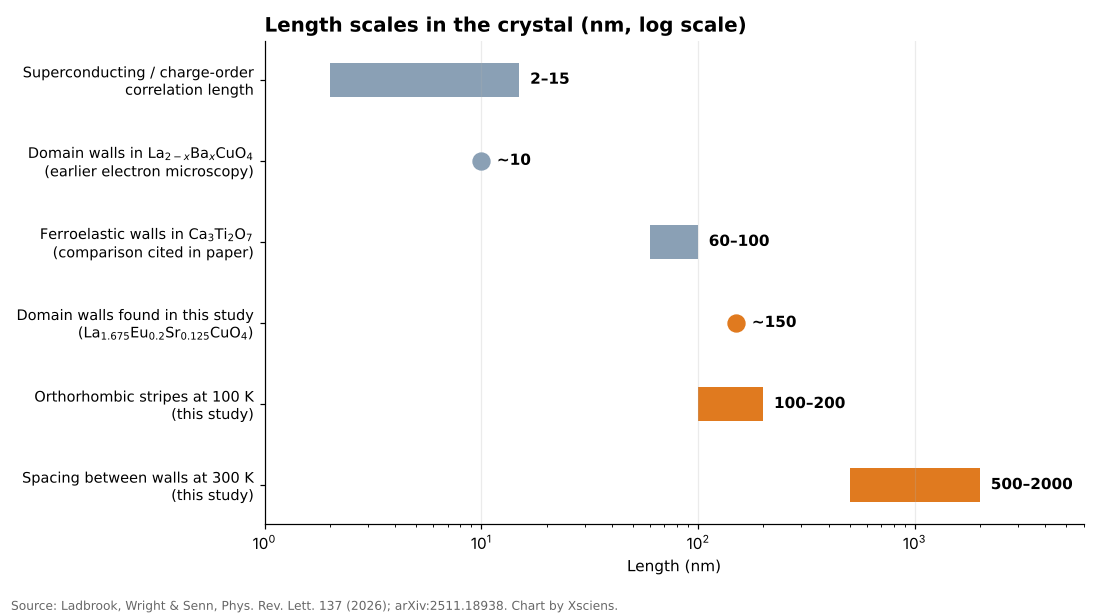
    Bar chart on a log scale comparing the 150 nm domain walls found in this study with other length scales in cuprates
    Source: Ladbrook, Wright and Senn (2026), Physical Review Letters; arXiv:2511.18938. Chart by Xsciens.

    Walls broader than anyone expected

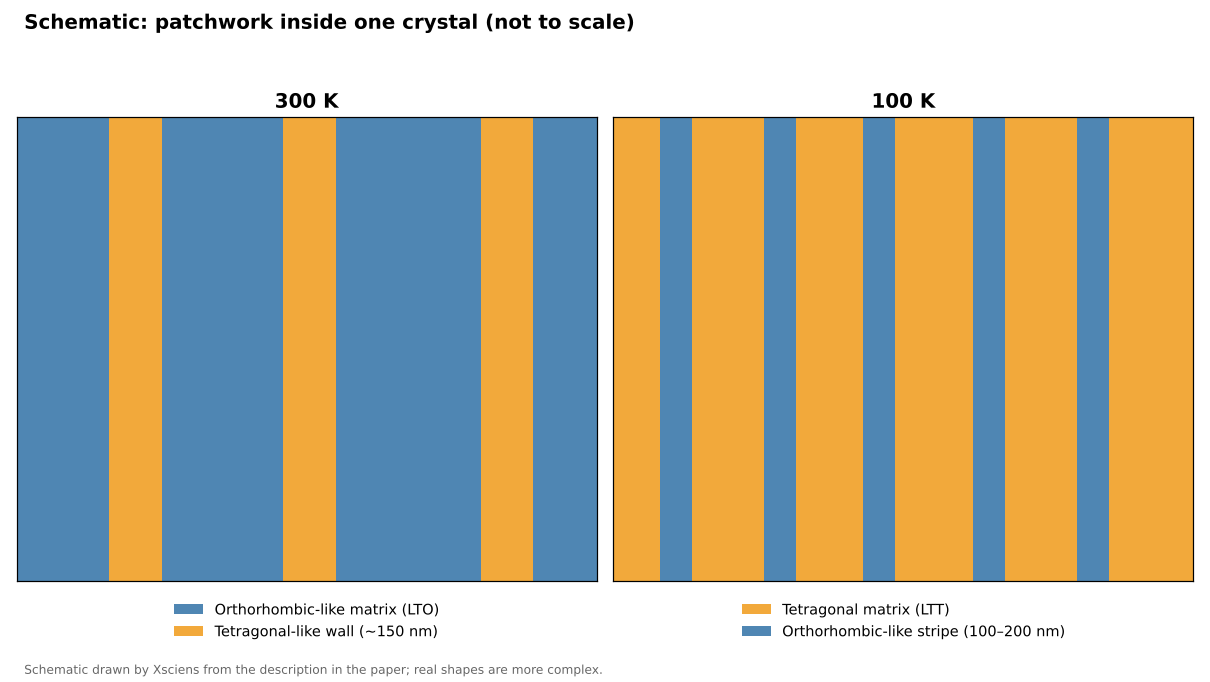
    At room temperature (300 K) the crystal is mostly in a so-called orthorhombic state, in which the lattice is slightly stretched along one in-plane direction, with two orientations of twin domains (regions of the same structure rotated relative to each other) each a micron or more across. Between them the team saw wall regions about 150 nanometres thick, spaced roughly 0.5 to 2 micrometres apart, where the measured orthorhombic strain approaches zero. In other words, the walls look more like a different, tetragonal-like structure, one with equal lengths along both in-plane directions, than like thin seams between two orthorhombic domains.

    For comparison, earlier electron-microscopy work on a related compound, La₂₋ₓBaₓCuO₄, estimated the width of similar regions at only around 10 nanometres, and the correlation lengths of superconducting and charge-density-wave order in cuprates are typically about 2 to 15 nanometres. (Charge order is a pattern in which electrons gather in regularly repeating regions instead of spreading evenly.) The comparison is rough, since the compounds and techniques differ, but it suggests the new walls are not tiny imperfections: they are broad enough to behave almost like a structure in their own right. Professor Senn said that for forty years the working assumption had been that these materials are the same all the way through.

    Cooling reshapes the pattern

    The picture changes as the crystal is cooled. This material is known to switch around 160 K from the orthorhombic state to a low-temperature tetragonal one, and the team measured it at 300, 140, 120 and 100 K. At 100 K they saw the reverse arrangement: fine stripes of orthorhombic-like material, each roughly 100 to 200 nanometres wide, embedded in a tetragonal matrix. So the pattern does not simply become more uniform on cooling; the dominant structure changes while smaller regions of the other one remain embedded in it. Earlier studies have reported that this kind of coexistence persists down to at least 10 K in this material and a related barium compound, but the new X-ray measurements went no lower than 100 K.

    Schematic showing tetragonal-like walls in an orthorhombic matrix at 300 K and orthorhombic-like stripes in a tetragonal matrix at 100 K
    Schematic by Xsciens based on the description in the paper; not to scale.

    Why it matters, and what is not yet shown

    The idea that structure and superconductivity interact in this family is not new. In 1995, a neutron-scattering study on a related compound near one-eighth doping linked a static pattern of alternating spin and charge stripes to the suppression of superconductivity there. What the Warwick work adds is a three-dimensional, micrometre-scale view of how the crystal structure itself is divided up, and the finding that the dividing walls are much wider than the sharp seams people tended to picture.

    The authors suggest the tetragonal-like boundaries could influence the competition between superconductivity and charge order, and Professor Senn says they probably work against superconductivity rather than alongside it. If so, that could help explain why some cuprates outperform others and why bulk measurements sometimes disagree. Understanding why some cuprates superconduct better than others has been a longstanding challenge, so the way structural regions are arranged may be one more factor to consider alongside chemical composition. The authors also expect similar patchwork in the wider 214 family, and possibly in related materials studied under extreme pressure. If so, some past bulk measurements may need reinterpreting.

    Those are hypotheses, not results. The experiment measured crystal structure, not electrical behaviour: superconductivity at the walls was not measured directly, and the paper describes the link as suggestive. Only one micro-crystal was measured, the apparent wall width depends on the instrument’s resolution, and the faint charge-order signals cannot yet be mapped with this method.

    Xsciens Editorial Note

    One carefully imaged crystal shows that the “same all the way through” assumption fails in at least one well-studied cuprate.

    • What was observed versus what was inferred. The observation is a three-dimensional map of structural distortion: tetragonal-like walls about 150 nm thick at 300 K and orthorhombic-like stripes in a tetragonal matrix at 100 K. That the walls suppress superconductivity is an interpretation, not a direct measurement, and the paper calls the evidence suggestive.
    • The sample is tiny and single. The result comes from one crystal about 15 × 20 × 20 micrometres of one composition. The authors state that extending it to other cuprates is a prediction, and measured wall widths depend on the instrument’s resolution (roughly 30–70 nm).
    • What to watch next. The key test is whether superconductivity is weaker inside the walls themselves or whether the walls affect the surrounding crystal. That needs structural imaging combined with local electrical measurements, including charge order, repeated on other cuprates.
    • From the editors — superconductors that are easier to make and work better could one day mean leaner power grids and smaller, cheaper MRI scanners in more hospitals. The route there may run through treating the arrangement of a crystal’s internal regions as a design dial, alongside its chemical recipe, although removing every wall might not even help. But a tidy lab crystal is a long way from an affordable wire. So when a superconductor headline promises a revolution, ask how large the sample was and what was actually measured.

    References for this note: Keimer et al., “From quantum matter to high-temperature superconductivity in copper oxides,” Nature (2015), Tranquada et al., “Evidence for stripe correlations of spins and holes in copper oxide superconductors,” Nature (1995)

    Sources: University of Warwick press release, Physical Review Letters (DOI 10.1103/r62x-kt5j), arXiv:2511.18938

  • [Science] The Brain’s Alertness System Has More Specific Wiring Than Scientists Thought

    [Science] The Brain’s Alertness System Has More Specific Wiring Than Scientists Thought

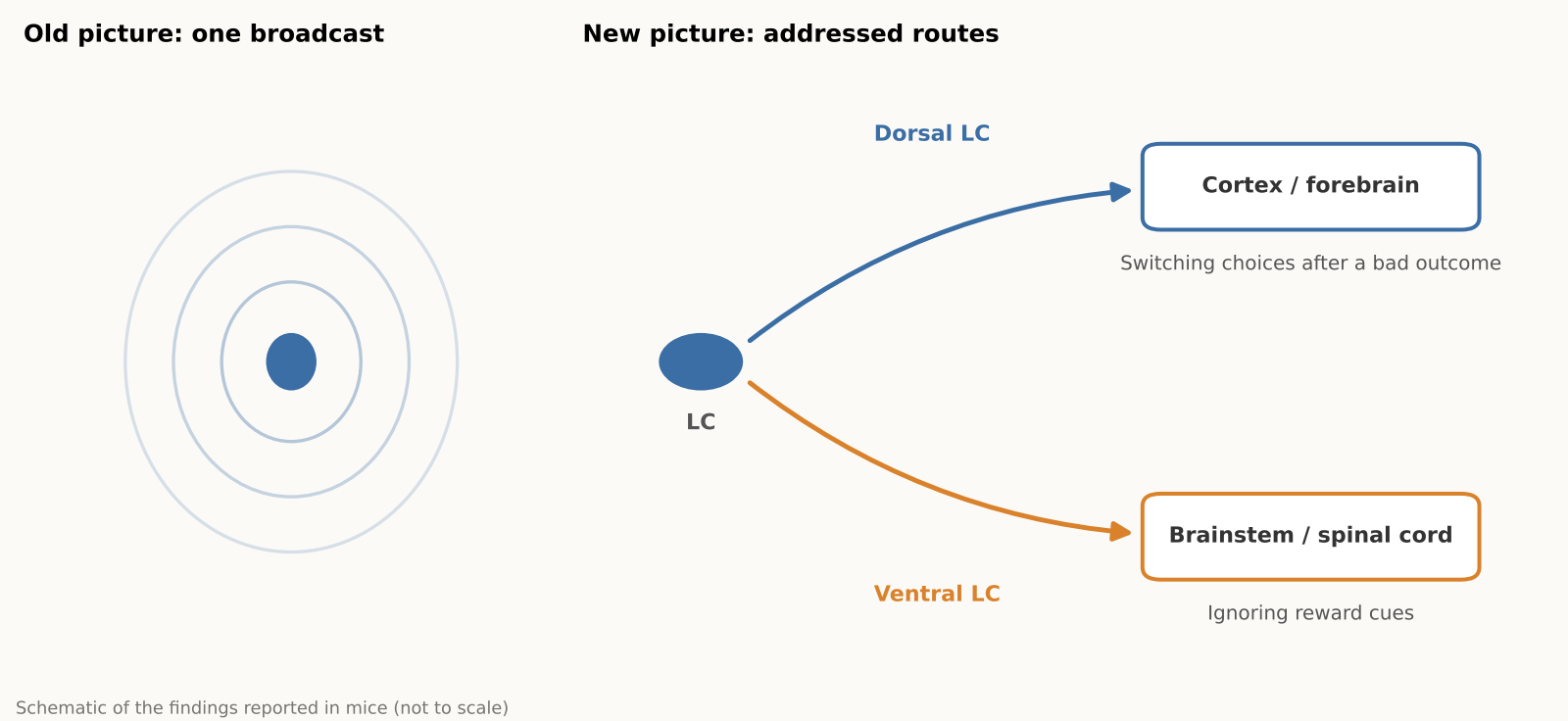
    Norepinephrine, a brain chemical involved in alertness, attention and stress responses, comes largely from a tiny cluster of cells in the brainstem called the locus coeruleus (LC). For decades this system was often pictured as a foghorn, broadcasting much the same signal everywhere. A new Nature study in mice, led by researchers at the Allen Institute, finds a more organized picture, closer to a postal network: different LC neurons tend to send norepinephrine to different destinations and show different activity during behavior. Why it matters: some medications for depression and ADHD influence norepinephrine signaling, and a wiring map is a first step toward understanding how the system could one day be influenced more selectively.

    原論文情報 / Original Paper
    Title: Topographic structure and function of locus coeruleus noradrenaline neurons
    Authors: Zhixiao Su, Polina Kosillo, Kanghoon Jung et al.
    Journal: Nature (2026)
    DOI: 10.1038/s41586-026-11026-0

    What the locus coeruleus does

    The locus coeruleus (LC) is a tiny brainstem nucleus, often nicknamed the “blue spot,” and the main source of norepinephrine, also called noradrenaline, for much of the brain and spinal cord. The chemical helps regulate arousal, attention and mood, and some medications for depression and ADHD act on norepinephrine signaling. Changes in the LC have also been reported early in Alzheimer’s disease, although the timing and significance of that degeneration are still under study.

    The textbook picture often treated the LC as a broadly broadcasting system, rather like a foghorn. Earlier work had already hinted at more structure. A 2020 review in Nature Reviews Neuroscience, for example, concluded that subgroups of LC neurons can encode specific cognitive processes, and a 2023 eLife study found two main electrical and structural cell types in the mouse LC. The new study maps how those differences in wiring, gene expression and activity are organized across the structure.

    Mapping one tiny structure

    Why map a structure this small? Because a nucleus that reaches almost the entire brain is hard to understand from the outside. Unless researchers know which neurons talk to which regions, it is difficult to say whether a drug, a stress response or a behavior is engaging the whole system or only a piece of it. Anatomy comes first, and function can be tested against it.

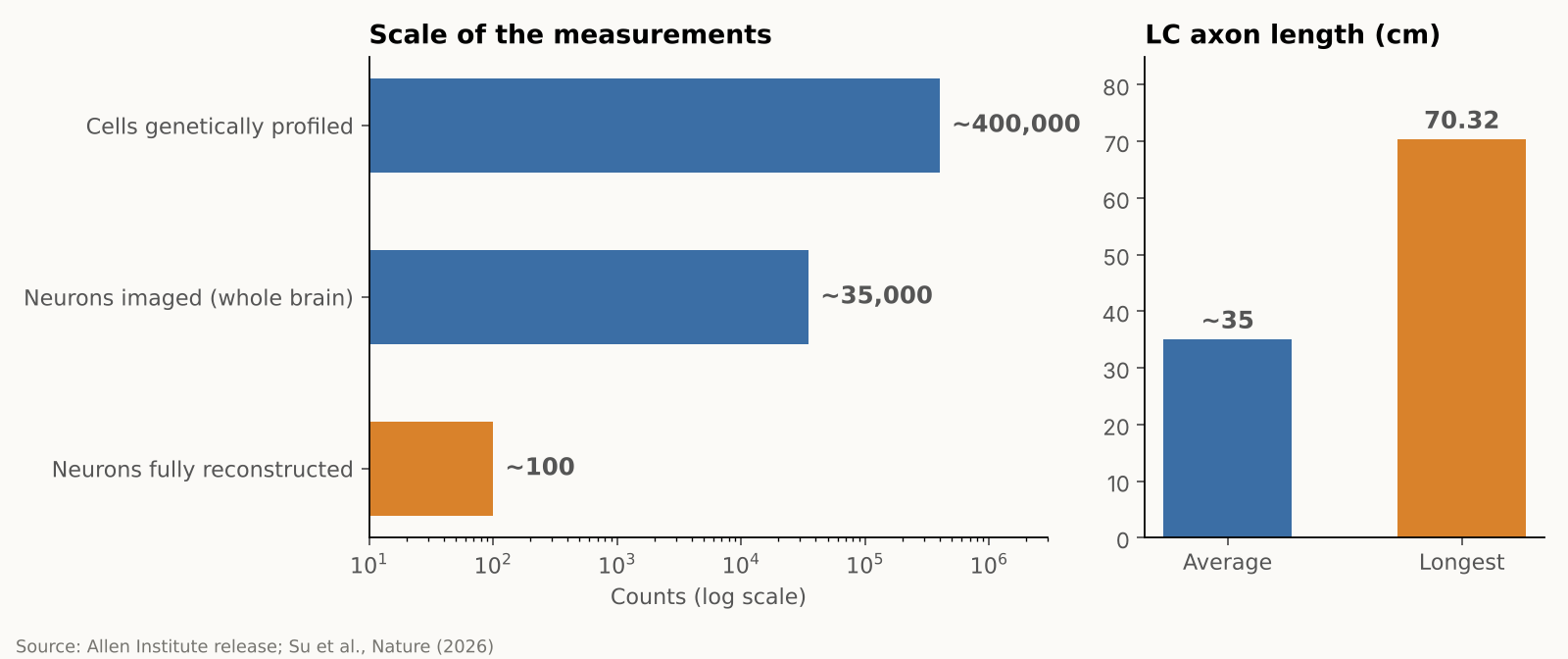
    The team combined several approaches in mice, each answering a different question. Whole-brain imaging showed where LC neurons send their fibers, gene profiling showed which genes they use, and detailed reconstructions traced the branches of individual cells. The researchers then recorded neural activity while mice performed a learning task. In numbers, they imaged almost 35,000 neurons across the whole brain, profiled gene activity in nearly 400,000 cells, and fully reconstructed about 100 individual LC neurons, according to the Allen Institute. These are different measurements from different samples, not 400,000 neurons traced end to end. The research was supported by the NIH BRAIN Initiative.

    Bar charts showing the scale of the measurements and the average and longest LC axon lengths
    Source: Allen Institute news release and Su et al., Nature (2026). Numbers are approximate as reported.

    A map of connections, a gradient of genes

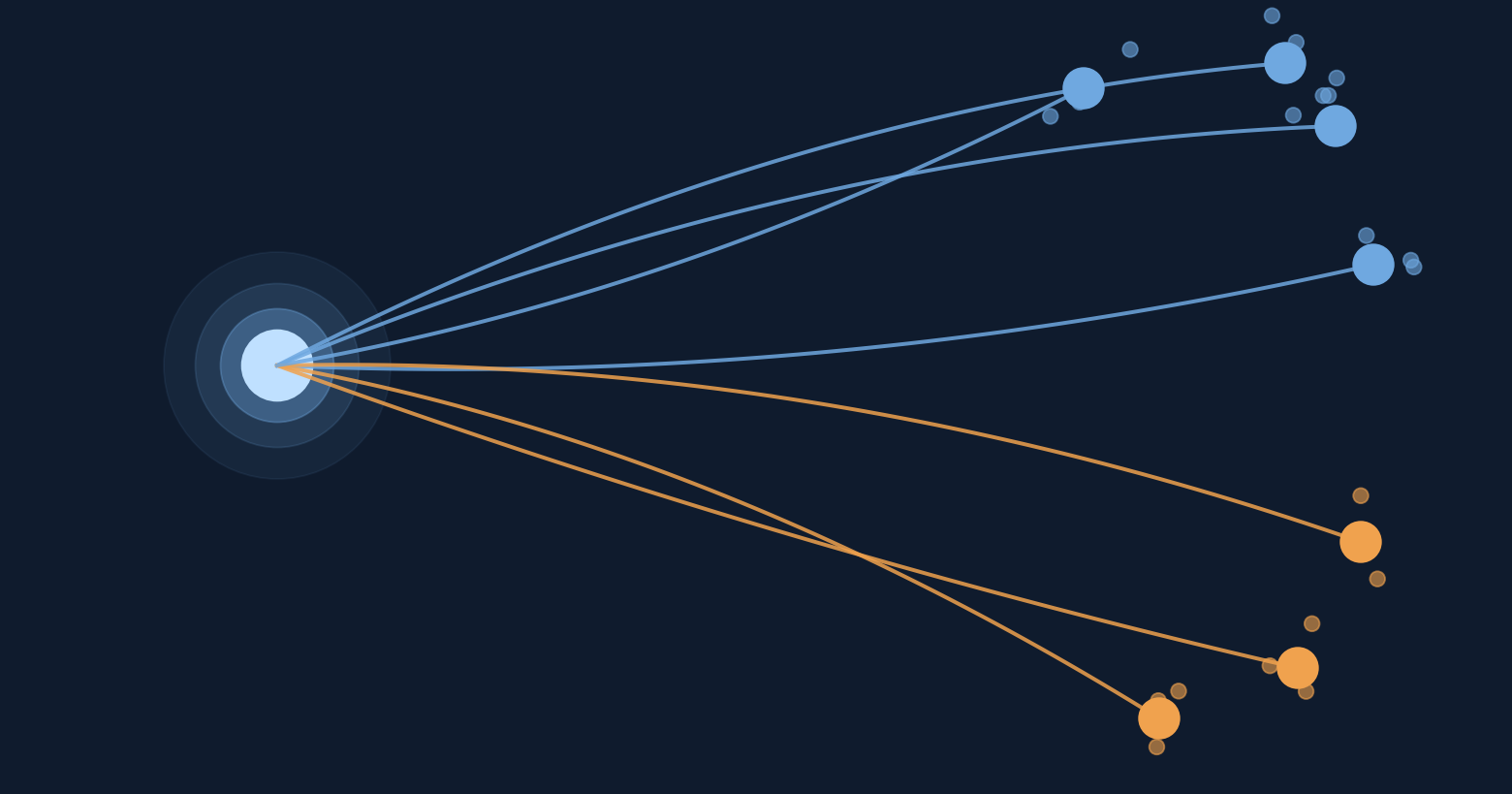
    The reconstructions showed that the LC is organized by position, as a gradient rather than two sealed compartments. Neurons in the upper (dorsal) part mainly send their axons to the cerebral cortex and forebrain, while neurons in the lower (ventral) part mainly project to the brainstem and spinal cord. Gene expression also changes smoothly along that same dorsal-to-ventral axis, matching the projection pattern, according to a summary of the paper’s abstract.

    The striking part is that these patterns line up. A neuron’s position in the LC helps predict where its axon projects and how its gene expression differs from its neighbors, and, in some cases, how it behaves during learning.

    A very long cell, and a selective one

    LC axons, the long fibers that carry signals out of the cell, averaged about 35 centimeters in total length in the mice. The longest one traced measured 70.32 centimeters in total, which the Allen Institute describes as the longest single neuron measured in a mouse. That neuron supplies norepinephrine to a large volume of cortex but does not release it in the cerebellum, brainstem or spinal cord.

    “The findings suggest the brain’s norepinephrine system is far more like a targeted postal network than a foghorn,” said Karel Svoboda of the Allen Institute.

    For readers who follow how the brain learns, this fits a broader theme: learning is not one switch but many coordinated signals. We covered one such idea in our earlier piece on an MIT hypothesis about how the brain might build its own learning circuits.

    Schematic contrasting a single broadcast with two addressed LC routes to cortex and spinal cord
    Schematic based on findings reported in mice. Not to scale.

    Different routes, different jobs

    The activity recordings pointed to different roles. Cortex-projecting dorsal neurons became more active during learning, specifically when mice changed their choice after an unfavorable outcome, and their activity also tracked reward prediction error, the gap between the reward an animal expected and what it actually got, which can guide future choices. Ventral neurons had higher background activity when mice ignored cues indicating that a reward might be available. The authors suggest this may reflect differences in how animals respond to potentially relevant cues.

    A signal that carries that gap is a natural teaching tool. Finding one in a norepinephrine pathway, rather than only in the better-known dopamine system, is why the authors are interested in how the two might work together. They suspect norepinephrine and dopamine may supply complementary learning signals, but that remains a hypothesis. According to The Transmitter, the team plans to study how these chemicals interact next.

    Researchers who were not involved in the work have commented on an earlier preprint version of the study. Nelson Totah of the University of Helsinki called it “bread-and-butter” research for the field that answers basic questions about an evolutionarily ancient structure. Rebecca Jordan of the University of Edinburgh said it suggests the LC could send tailored information to different brain areas, and Robert Froemke of NYU noted that the gene-expression profiling could help researchers record and manipulate specific cell types, according to The Transmitter. The published Nature paper was not evaluated by these experts in that coverage.

    An independent 2025 review adds some context. It summarizes rodent studies in which ventral LC neurons reduced pain through projections to the spinal cord, while activating the LC–prefrontal circuit increased pain and anxiety-like behavior. These results come from separate experiments, but they support the idea that LC pathways can have different effects depending on their destinations.

    Why it matters, and what to keep in mind

    Because norepinephrine-related drugs usually act across the whole brain, a map of separate pathways raises the possibility of more selective ways to influence them that avoid unrelated circuits. The Allen Institute describes this as a possibility for the future, not a demonstrated result. All of the work was done in mice, and nobody has yet shown that human LC neurons are organized the same way. Neither does the study show that any of these pathways can be treated on its own. For now, it is a map, and a good one, rather than a medical advance.

    The practical takeaway for a general reader is modest but real: the brain’s alertness and attention system is more finely organized than the old “one signal for everyone” picture suggested. That kind of basic knowledge tends to pay off slowly, by giving later researchers better targets and better questions.

    Xsciens Editorial Note

    The study suggests that a brain system once treated as a single volume knob is better understood as a network with different destinations. If that view is confirmed in people, treatment for focus and mood, learning support and early detection of brain aging could shift from adjusting the whole brain to targeting only the wires that matter, which may shape the precision of future drugs and diagnostics.

    • What is solid is the map; what is still a hypothesis is the job of each route. Where the axons go, how gene use shifts along the structure, and the recorded activity are direct measurements, so any past interpretation that assumed one broadcast signal now needs revisiting. Reading the dorsal neurons as a “learning signal,” or the ventral ones as tied to responses to reward cues, is an interpretation drawn from how activity lines up with behavior, and the norepinephrine–dopamine partnership remains a hypothesis. These are the claims coming experiments will test.
    • A mouse map is a blueprint; confirming it in people is the next stage. About 100 neurons were reconstructed in full, according to the Allen Institute, and the 35,000 imaged and 400,000 profiled cells are separate measurements. An independent 2025 review also notes that much of the evidence comes from rodents. The flip side is useful: the map tells researchers exactly what to look for in human tissue, which is where the field has to go.
    • Three kinds of study to expect next (our projections). (a) Causal experiments that silence or activate one pathway at a time and see whether behavior changes, a question the study leaves open. (b) Simultaneous recordings of norepinephrine and dopamine to test whether they divide the work of learning, which The Transmitter reports the team plans to study. (c) Studies in human brains, such as post-mortem tissue or imaging, that look for the same dorsal–ventral arrangement.
    • From the editors — the idea of raising or lowering a brain chemical across the board may give way to tuning one wire at a time. This map points to three futures.
      1) Drug design. Today’s norepinephrine-related drugs move the pathway that serves focus and the pathway that drives bodily arousal together. The finding that gene use shifts gradually from dorsal to ventral gives researchers a possible marker for telling routes apart, and an outside expert quoted by The Transmitter noted that gene profiling could help record and manipulate specific cell types. A treatment that nudges the focus-related part without the racing heart and tension is a design goal this map makes more realistic.
      2) Understanding learning. Dorsal neurons responded when mice switched choices and when outcomes missed expectations, which suggests this system may help teach us at the moment we recover from a mistake. If so, the best timing of feedback could become a design question for teaching and rehabilitation. For AI research, the idea of separating a “learn the value” signal from a “change your approach” signal into different wires may be worth borrowing.
      3) Spotting change early. Changes in the LC have been reported early in Alzheimer’s disease. With this map as a ruler, researchers could ask which pathways are damaged first and whether those changes can be caught earlier and in finer detail. This study did not test that.
      These are our projections, and the road from a mouse map to people is still ahead. One way to read the news in the meantime: when you see a headline about a drug that targets a particular brain pathway, check which pathway was tested in humans. That is where a map turns into a treatment, or does not.

    References for this note: McKinney et al., eLife (2023), Hao et al., Int. J. Mol. Sci. (2025), The Transmitter (2026), Poe et al., Nature Reviews Neuroscience (2020)

    Sources: Allen Institute, Su et al., Nature (2026), ScienceDaily

  • [Science] High-Dose Fish-Oil DHA Shifted a Brain Marker but Not Memory, Trial Finds

    [Science] High-Dose Fish-Oil DHA Shifted a Brain Marker but Not Memory, Trial Finds

    A two-year randomized trial found that high-dose DHA, the main omega-3 in fish oil, raised a marker of DHA in the fluid surrounding the brain, yet it did not improve memory-and-thinking scores or slow shrinkage of the memory-related hippocampus compared with placebo. For the many older adults who take fish oil hoping to ward off dementia, the result is a reminder that moving a nutrient into the nervous system is not the same as protecting memory.

    原論文情報 / Original Paper
    Title: CNS target engagement of high-dose DHA supplementation in older adults at risk for dementia: a randomised, double-blind, placebo-controlled trial
    Authors: Yassine HN et al.
    Journal: eBioMedicine 2026;129:106316
    DOI: 10.1016/j.ebiom.2026.106316

    What the researchers tested

    The phase IIa trial, run at the University of Southern California (USC) between September 2018 and May 2024, enrolled 365 adults aged 55 to 80 who did not have dementia, ate little DHA (under 200 mg a day), and had at least one dementia risk factor. About 47% carried APOE ε4, a gene variant that is the strongest common genetic risk factor for late-onset Alzheimer’s disease, although carrying it does not mean a person will inevitably develop the disease.

    Participants were randomly assigned to take either 2 grams of DHA a day or a placebo for 24 months, and neither they nor the staff knew who got which. The work was funded by the U.S. National Institute on Aging and the Alzheimer’s Drug Discovery Foundation, and was published online in June 2026.

    Step one: the marker moved

    The trial’s primary question was whether high-dose DHA could measurably change a biochemical marker of DHA availability in the central nervous system. To check, a subgroup of participants agreed to a lumbar puncture so researchers could sample cerebrospinal fluid (CSF), the liquid that surrounds the brain and spinal cord.

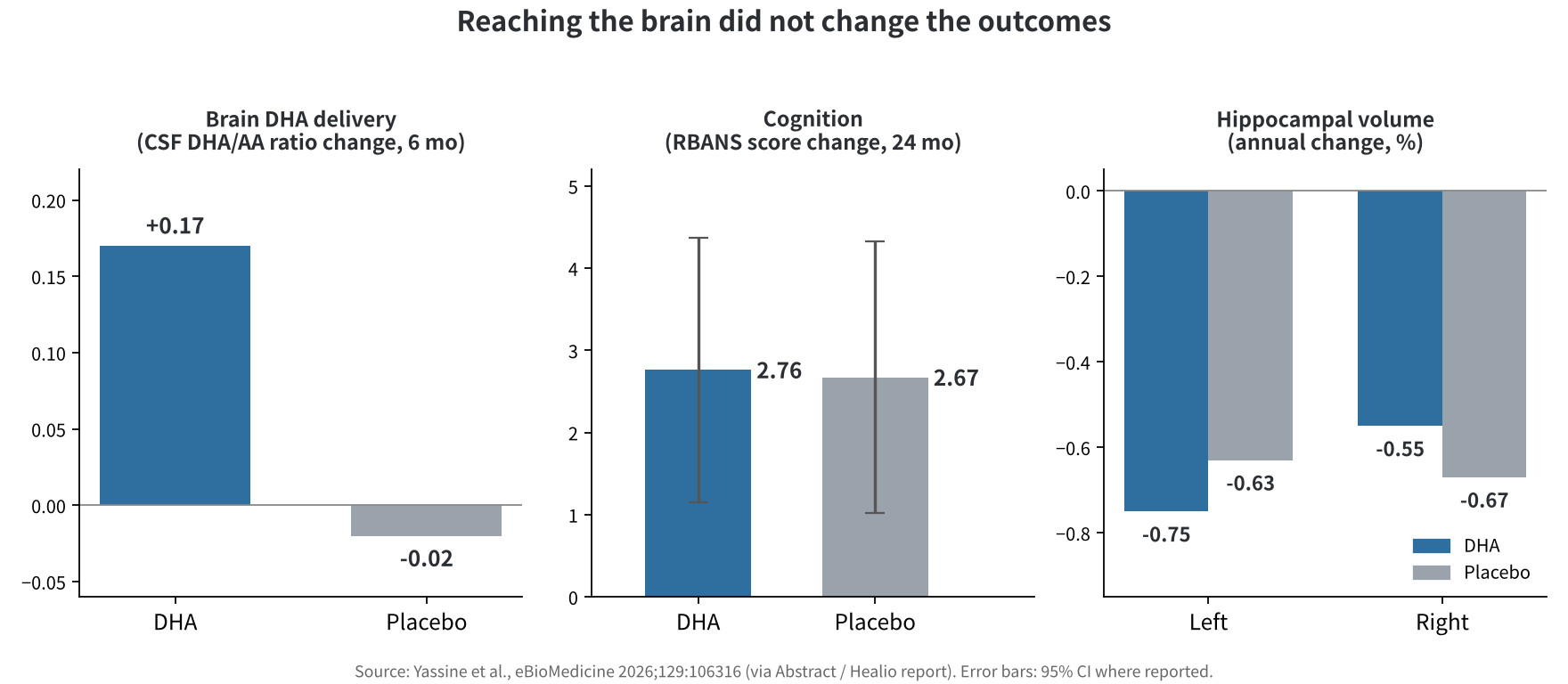
    At six months, the ratio of DHA to arachidonic acid (AA, an omega-6 fat) in CSF had risen by 0.17 in the DHA group and fallen by 0.02 in the placebo group, a difference of 0.19 (95% confidence interval 0.16 to 0.21). The supplement also raised the omega-3 index, a measure of omega-3 fats in red blood cells, from 4.9% to 11%. The CSF increase did not depend on whether participants carried APOE ε4.

    Step two: the outcomes did not

    Cognition and brain structure were secondary outcomes. On a standard memory-and-thinking battery (RBANS), scores rose by 2.76 points in the DHA group and 2.67 in the placebo group. The hippocampus shrank by an estimated 0.75% a year (left) and 0.55% (right) with DHA versus 0.63% and 0.67% with placebo. The authors reported no significant difference between groups for either measure, and side effects were similar, with no serious ones attributed to the supplement.

    Bar charts comparing DHA and placebo: CSF DHA/AA ratio change, RBANS score change and hippocampal volume change
    Figure 1. The brain-fluid marker rose with DHA, but cognition and hippocampal volume looked alike in both groups. Source: Yassine et al., eBioMedicine 2026, and Healio.

    In other words, despite a clear biochemical response, the DHA group did not outperform placebo on the cognitive or structural measures over the two years.

    How to read “no benefit”

    Several caveats matter. About 38% of participants dropped out, mainly because of COVID-19 disruptions. That reduced statistical power and may have introduced bias, because those who left differed from those who stayed, so small effects cannot be ruled out. Participants were also relatively young, well educated and cognitively healthy, so 24 months may be too short to see much decline in anyone. Only one form and dose of omega-3 was tested, and a single supplement may be too little against a disease with many contributing causes.

    The authors argue that future research should prioritize understanding how the brain processes DHA and which people might respond differently. Lead investigator Hussein Yassine said staying active, sleeping well and eating a balanced diet remain the most powerful tools for lowering Alzheimer’s risk. The result also does not say that eating fish is pointless: the study tested a high-dose supplement, not diet.

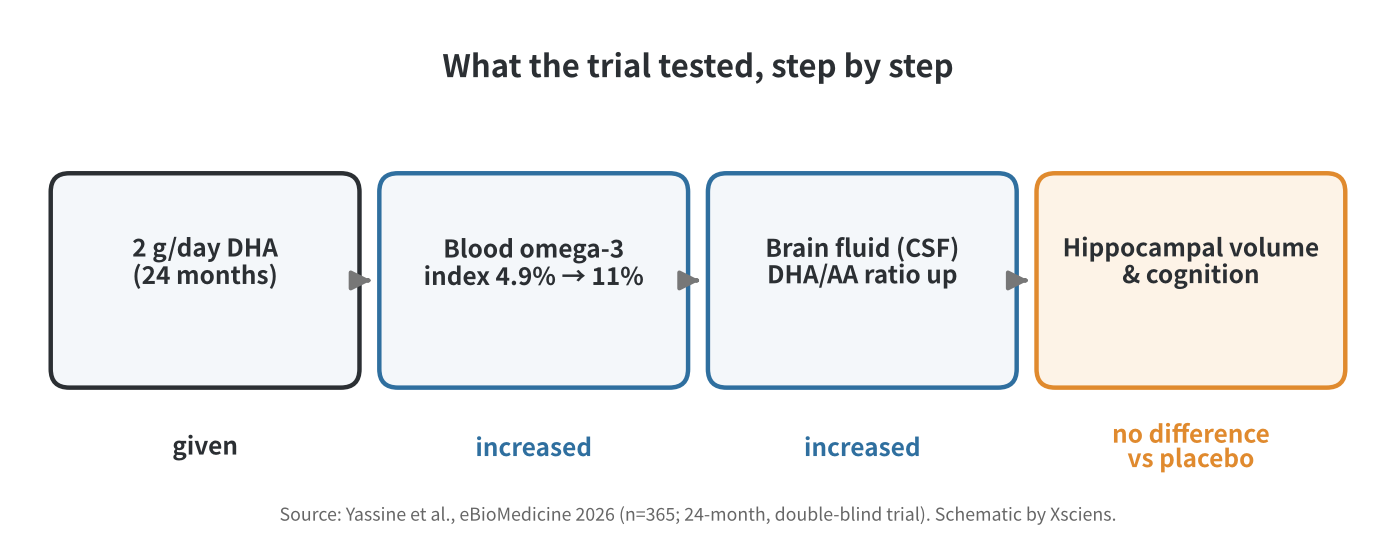
    Flow diagram: DHA given, blood omega-3 index up, brain-fluid DHA/AA ratio up, no difference in hippocampal volume and cognition
    Figure 2. The trial followed the supplement step by step; the chain broke at the last link. Schematic by Xsciens, based on Yassine et al. (2026).

    Where this fits

    Earlier randomized evidence points in the same direction. A 2012 Cochrane review of three trials, with cognitive data from 3,536 cognitively healthy adults aged 60 and over, found no cognitive benefit from omega-3 supplements. The VITAL-Cog analysis, which included 4,218 adults in two cognitive substudies, likewise found no significant effect on global cognition from 1 gram a day of marine omega-3 over about two to three years. Neither establishes whether supplements can prevent dementia itself.

    Observational research, by contrast, has suggested that people who eat more seafood may have a lower risk of cognitive decline, according to the U.S. National Center for Complementary and Integrative Health, which is one reason the question keeps being asked. For now, the evidence does not support taking high-dose DHA specifically to preserve memory in otherwise cognitively healthy older adults.

    Xsciens Editorial Note

    The core of this trial: high-dose DHA raised a brain-fluid marker, but in this group it made no measurable difference to cognition or hippocampal shrinkage.

    • Measured versus interpreted. The rise in the brain-fluid DHA-to-AA ratio was directly measured and was the trial’s primary outcome; cognition and brain volume were secondary outcomes. Both groups’ test scores rose by about 2.7 points, which could partly reflect familiarity with repeated testing, though the study cannot say how much. The finding is the absence of a group difference, not a prevented decline.
    • Limits. Roughly 38% dropout (with completers differing from dropouts), a cognitively healthy and well-educated group, a 24-month window, one dose and a phase IIa design all limit how far the result generalizes. It cannot rule out small effects, and it says nothing about dementia itself, which the trial did not measure.
    • What to watch. Whether particular groups, such as people whose brains handle DHA differently, respond better (a hypothesis, not a finding); longer follow-up with measures sensitive to decline; and replication in other populations.
    • From the editors — if you take fish oil for your memory, this trial gives you less reason to expect a payoff. The upside is a sharper research question: now that DHA is known to shift a brain-fluid marker, the next step is working out why that is not translating into better memory, and for whom. That said, this is one trial in cognitively healthy people; it does not show that omega-3 is harmful or that fish on your plate is pointless, and the lifestyle basics the lead author points to deserve at least as much of your attention as the capsule. If you take fish oil for another reason, such as heart health, talk to your doctor before changing anything.

    References for this note: Sydenham et al., Cochrane review (2012), Kang et al., VITAL-Cog (2022), NCCIH: Omega-3 Supplements

    Sources: eBioMedicine (Yassine et al., 2026), Healio, News-Medical, ScienceDaily (USC release)

  • Enzyme-Laced Plastic Stays Tough in Use, Degrades Fast in the Deep Sea

    Enzyme-Laced Plastic Stays Tough in Use, Degrades Fast in the Deep Sea

    Researchers at Japan’s New Energy and Industrial Technology Development Organization (NEDO), the University of Tokyo, the Japan Agency for Marine-Earth Science and Technology (JAMSTEC), and Gunma University have built a biodegradable plastic that keeps its strength while dry but speeds up its own breakdown once wear and water reach enzymes mixed into the material. In seafloor trials at a depth of 5,503 meters, the enzyme-laced plastic lost weight far faster than the same material without the enzymes. The team sees the work as a potential tool against marine plastic pollution, which research groups worldwide have struggled to tackle largely because so much plastic debris, once lost at sea, is effectively impossible to retrieve.

    原論文情報 / Original Paper
    原題(Title): Enzyme-embedded polyesters for accelerated biodegradation in the deep sea
    著者(Authors): QiuYuan Huang et al.
    掲載誌(Journal): Nature
    DOI: 10.1038/s41586-026-11192-1

    A Plastic Built to Switch On When Wet

    An estimated eight million tons of plastic waste enters the ocean every year, and some of it can take more than 300 years to break down in the natural environment. The same research team had previously shown, for the first time, that biodegradable plastics are broken down by microbes on the seafloor at depths of 757 to 5,552 meters — but even the fastest cases took years to fully degrade. The deep sea is cold and under high pressure, and only a limited population of microbes there is capable of breaking down this particular type of plastic, so degradation tends to be slow.

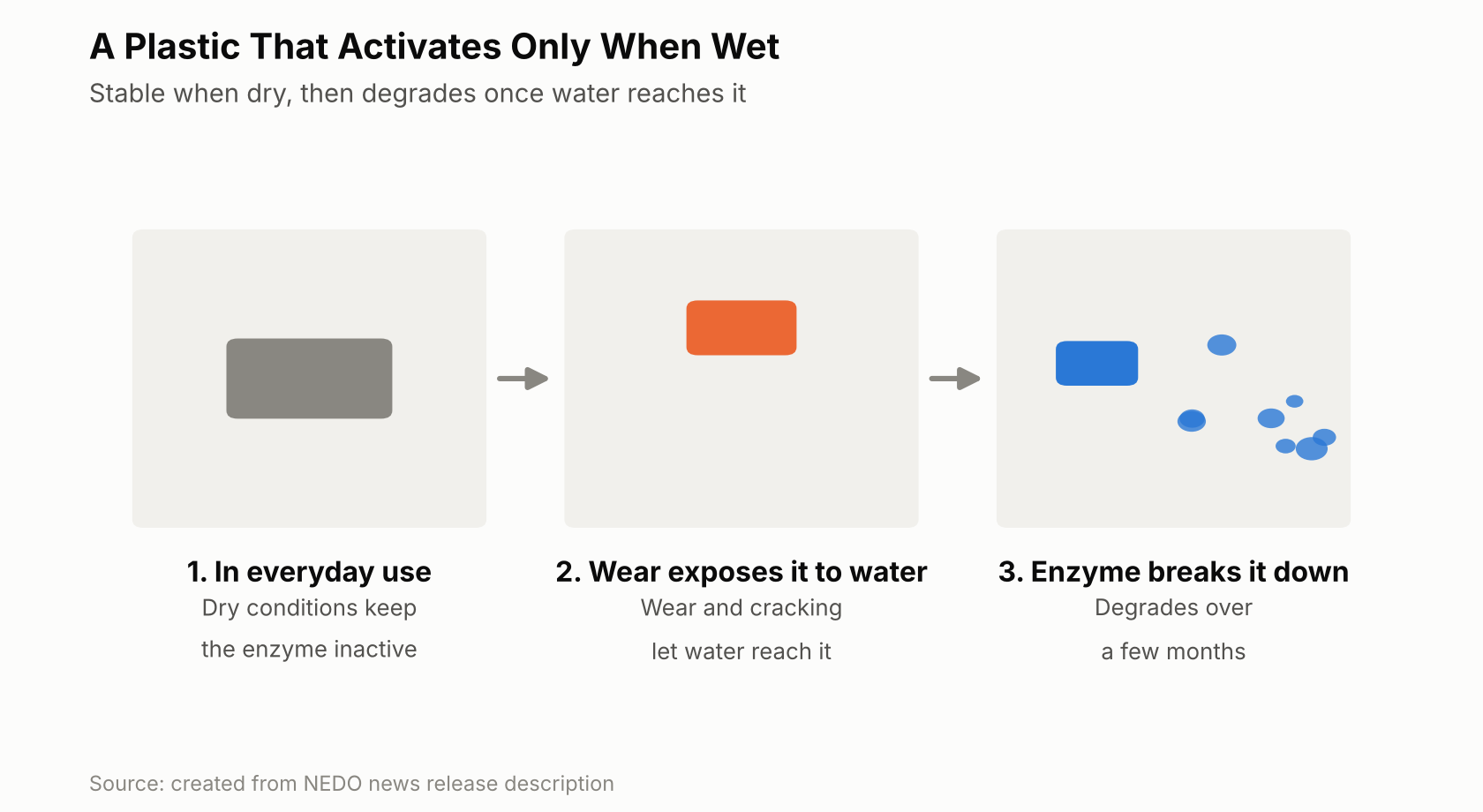
    This time, the team changed the plastic’s mechanism rather than its base material. They melted the plastic and mixed in natural degrading enzymes — HiC cutinase, which cuts polyester bonds and comes from a mold species, and CaLB lipase, an enzyme involved in fat breakdown that here was repurposed for plastic, sourced from an Antarctic yeast. These enzymes stay inactive without water, so the plastic keeps close to its original strength while dry and in use. But once wear or fragmentation in the environment lets water reach the enzymes inside, degradation accelerates from there — in effect, a plastic that switches on once it gets wet.

    It’s worth separating two related but different ideas here: how much weight a sample loses, and how completely it eventually breaks down into simpler compounds through microbial action, a process researchers call mineralization. The paper backs up its weight-loss measurements with both chemical analysis of what the enzymes actually produce and biochemical oxygen demand testing, which tracks how far seawater microbes carry that breakdown — so the result isn’t based on weight loss alone.

    Weight Loss Confirmed Even at 5,503 Meters

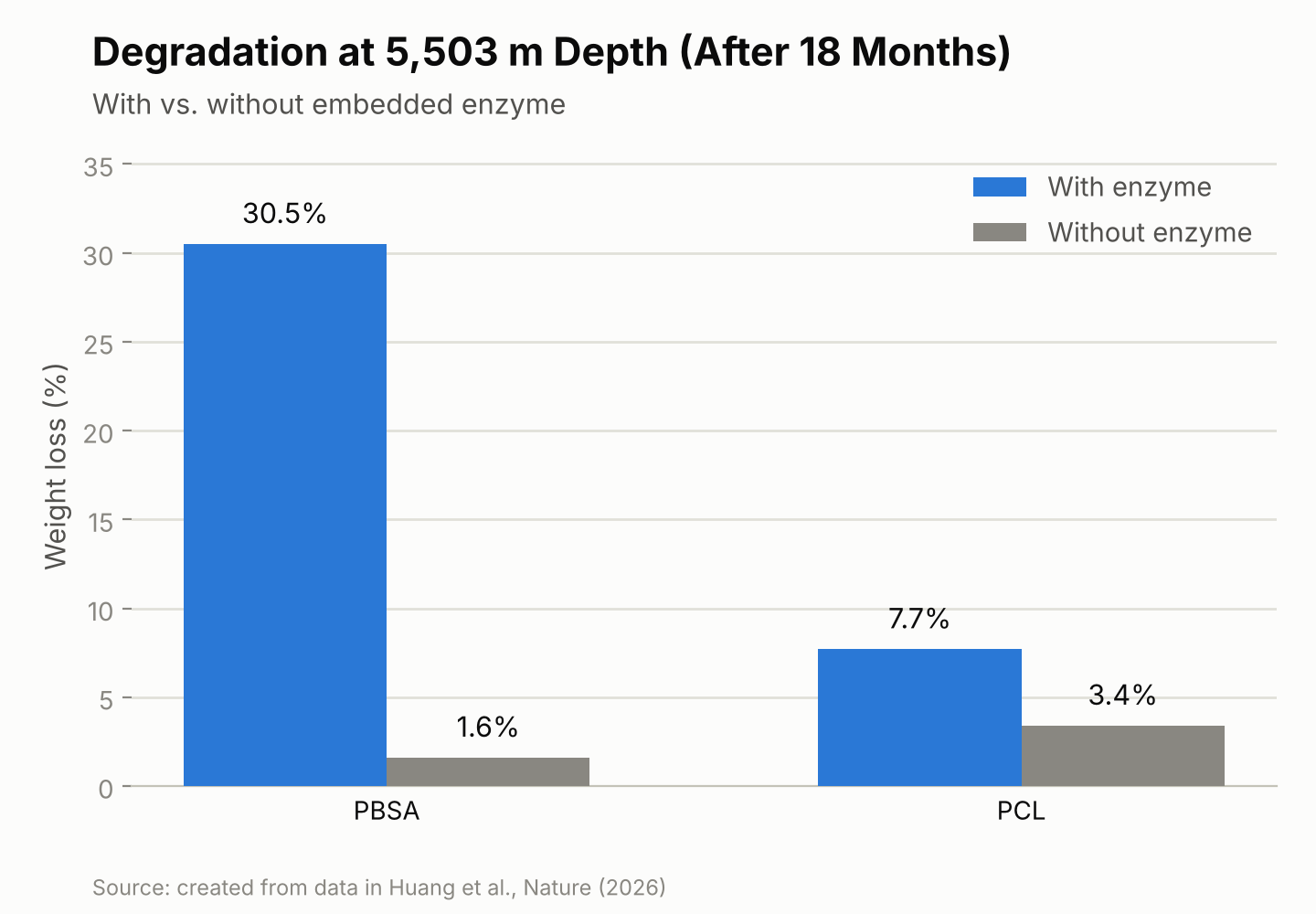
    The team sank plastic films at coastal sites (2 to 6 meters deep) and at several deep-sea locations — 757, 855, 1,292, and 5,503 meters — and compared how their weight changed over time. Even at 757 meters, 4°C, and 7.6 MPa of pressure (about 75 times atmospheric pressure), some of the enzyme-laced materials lost nearly all their weight within five months, versus barely any loss for the enzyme-free material over the same period. At the deepest site, 5,503 meters, enzyme-laced PBSA (polybutylene succinate adipate, hereafter PBSA) lost about 30.5% of its weight after 18 months, far more than the roughly 1.6% lost by the same material without the enzyme. Degradation varied by material, though — not every sample lost weight at the same rate, and PCL, another material in the trial, lost only about 7.7% of its weight over the same 18 months even with the enzyme added.

    Coastal seawater trials, run separately from the deep-sea deployments, told a similar story on a faster timeline: even at a lower enzyme loading of around 0.1 weight percent, several of the materials lost a substantial share of their weight within a single month in the water near shore. That matters for how the result should be read — degradation isn’t an on/off switch that waits until plastic reaches the deep ocean, but a process that speeds up as soon as water reaches the enzyme, in whatever environment that happens.

    Comparison chart of weight-loss rate for plastic with and without embedded enzyme at 5,503 m depth
    Source: created from data in Huang et al., Nature (2026)

    Fast Degradation Without Losing Strength

    A natural question is whether making the plastic easier to break down also weakens it as a product. According to the team, adding the enzyme at around 0.1 weight percent barely affects tensile strength, and even at the roughly 3 weight percent used for the deep-sea trials, the drop in strength and elongation stays within what the researchers describe as a practically usable range. Comparing weight-loss speed at 757 meters, the enzyme-laced material lost about 97 micrograms per square centimeter per day, versus just 0.9 micrograms for the enzyme-free material — a specific comparison in which the difference reached roughly 100-fold. Separately, NEDO describes the project’s overall achievement as roughly a 30-fold increase in degradation speed compared with the enzyme-free version. Both figures are accurate; they simply describe different materials and conditions rather than contradicting each other.

    Embedding the enzyme directly in the material showed that a biodegradable plastic’s weight loss can be sped up substantially, even in the deep sea, where it once degraded only very slowly.

    Micro-Sized Beads Respond Too

    The same approach was also applied to test microbeads 20 to 300 micrometers across, which degraded across a range of coastal and deep-sea conditions. This doesn’t confirm the effect in actual cosmetic-grade microbeads on the market — it’s a result from lab test particles sized to resemble microplastics. Smaller plastic particles are more likely to be taken up by marine life, and once they spread into the environment, recovering them is difficult; microbeads in particular are one of the hardest categories of marine plastic to clean up once released, since conventional filtration and collection methods struggle at that size. Building degradability into a product’s design from the start could become a new way to reduce how much plastic lingers after release. How well this translates to real products, and how much it actually reduces pollution, still needs further testing.

    Schematic showing enzyme-embedded plastic staying stable in use and degrading once it contacts water
    Source: created from NEDO news release description

    What’s Left Before Real-World Use

    The team’s next steps include testing long-term durability and safety under realistic conditions, extending the approach to a wider range of biodegradable plastics, making the enzyme-mixing process more efficient and affordable, and scaling up for mass production. Deep-sea degradation still takes several months to more than a year, so this isn’t a case of plastic vanishing the instant it’s lost. Cost is likely to be a major factor in whether the approach ever reaches store shelves, since biodegradable plastics already tend to cost more to manufacture than conventional ones, and adding a purified enzyme to the mix adds another expense on top of that. Still, compared with the several years existing biodegradable plastics have needed to break down in the deep sea, this result looks like a promising option for tackling marine plastic pollution.

    Xsciens Editorial Note

    What stands out most here is the mechanism itself: a plastic engineered to activate only once it gets wet, rather than a change to the base material.

    • “30x” and “100x” describe different comparisons. NEDO’s “about 30-fold” figure represents the project’s overall result, while the “about 100-fold” figure in this article comes from one specific comparison — weight-loss speed at 757 meters (at 5,503 meters, PBSA lost about 30.5% of its weight with the enzyme versus about 1.6% without it over 18 months; at 757 meters, the daily weight-loss rate was about 97 micrograms with the enzyme versus about 0.9 micrograms without it). Neither number is wrong, but it’s safer not to let a single multiplier stand in for every condition.
    • The materials and timescales involved have limits. The enzymes tested here work on polyester-based biodegradable plastics — PBS, PBSA, PCL, and PBAT — and don’t directly apply to everyday polyethylene or polypropylene, the materials used in most plastic bottles and bags. Deep-sea degradation still takes at least a few months, and sometimes more than a year depending on the material, so this isn’t a case of plastic disappearing the moment it’s lost.
    • Long-term, real-world testing is the next thing to watch. What’s been shown so far comes from experimental deployment trials. The research team itself lists durability and safety testing under real-use conditions, and establishing mass-production methods, as future challenges. How much this technology can actually reduce marine plastic’s buildup, while keeping costs low enough for wide adoption, remains to be seen.
    • From the editors — once this reaches the market, choosing plastic products could come with a little less guilt. Expect more everyday items — food packaging, fishing gear — built with technology like this, cutting into ocean plastic pollution without sacrificing convenience. That said, “it breaks down anyway” shouldn’t become an excuse to get careless about waste. Even as the technology improves, reducing what we throw away is still on us as consumers.

    References for this note: Chamley et al., “Polymer material biodegradation in the deep sea. A review,” Science of The Total Environment (2024), Japan Ministry of the Environment, Eco-Label Database, “Marine Biodegradable Plastics” certification program

    Sources: NEDO news release, Huang et al., “Enzyme-embedded polyesters for accelerated biodegradation in the deep sea,” Nature (2026)

  • [Science] What Is a Supramolecular Polymer? A Simple Guide to How It Works

    [Science] What Is a Supramolecular Polymer? A Simple Guide to How It Works

    A supramolecular polymer is a chain-like material whose building blocks link up through weak, reversible attractions instead of strong, fixed chemical bonds. That “weak but many” design can let these materials repair damage, change shape, and influence how living cells grow — which is why materials scientists have been racing to build bigger, more precisely controlled versions of them.

    What Is a Supramolecular Polymer?

    A conventional polymer — the plastic in a water bottle, for example — is a long chain of small repeating units called monomers, welded together end-to-end by covalent bonds. Covalent bonds are the strong, electron-sharing connections that hold most everyday molecules together, and once formed they generally don’t come apart on their own.

    A supramolecular polymer (a term built from “supra-,” meaning “beyond,” plus “molecular”) swaps those permanent welds for temporary handshakes. Its monomers link up through noncovalent interactions — hydrogen bonds, stacked ring structures, metal-ion bridges, or simple electrical attraction — that are individually weak but, strung together by the thousands along a chain, add up to a stable, functional material. A useful everyday comparison is Velcro: a single hook-and-loop pair peels apart with almost no effort, but a whole strip of them holds a heavy jacket closed. Supramolecular polymers work the same way at the molecular scale — weak links in large numbers behave like a strong, yet reversible, material.

    IUPAC’s 2013 polymer-science recommendations favor the term “supramolecular association” (also called “Lehn association,” after chemist Jean-Marie Lehn) for this self-assembly process, and discourage the related term “supramolecular polymerization.” That is a naming preference for the process, not a rejection of the material-class name: “supramolecular polymer” remains the term used throughout the chemistry and materials literature — including in the title of the 2026 Northwestern University paper described below — so this article uses it in that common sense.

    How the Self-Assembly Works

    Because the bonds holding a supramolecular polymer together are reversible, individual connections continually break and re-form, letting the material adjust to its surroundings without necessarily falling apart. When the damaged surfaces of such a material can come back into contact and the molecules are mobile enough, those reversible interactions can reconnect across the damage — the basis for self-healing in some (not all) supramolecular materials; how well it works depends heavily on the specific design. According to a 2024 overview from the Society of Plastics Engineers, this same dynamic bonding can also let certain supramolecular polymers flow or be reshaped more easily than conventional plastics, though the exact processing temperature and pressure still depend on the molecular design in question.

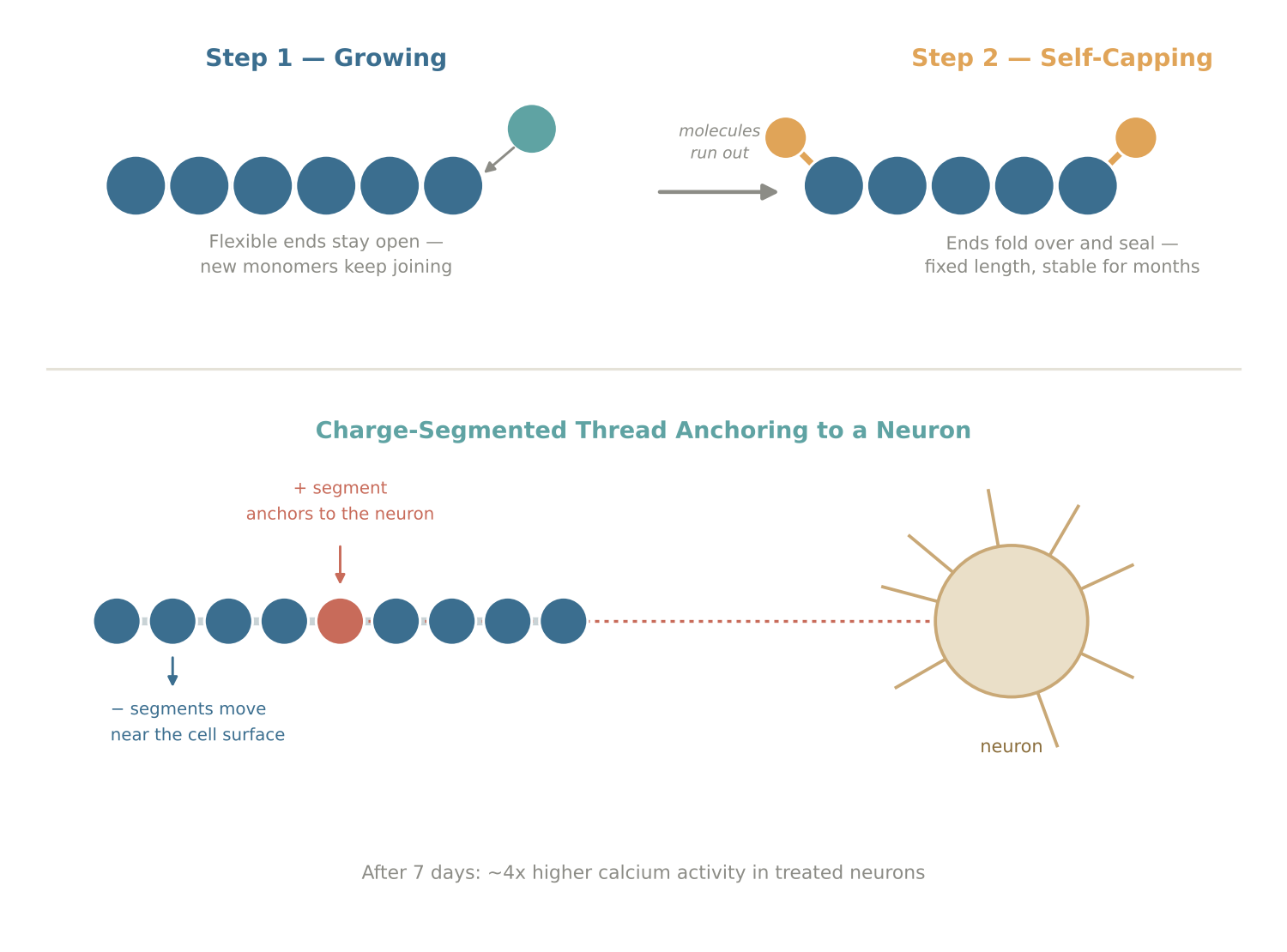
    Chemists have also learned to design chains that grow to a controlled length and then stop. One such strategy, demonstrated in an October 2026 study from Northwestern University, is called self-capping supramolecular polymerization. The molecular design lets a growing thread’s flexible ends keep adding building blocks while conditions allow it, then fold over and form a cap that limits further growth. Introducing a fresh batch of building blocks can restart the process, which lets researchers extend the assembly and arrange distinct segments along its length.

    Getting this right is a balancing act. If the building blocks do not bind to each other strongly enough under the given conditions, only short, unstable clusters form. If the interactions are too strong, the material can lose the ability to rearrange that makes supramolecular polymers useful in the first place. Scientists must also keep growing chains from fusing together unpredictably or slowly falling back apart — failure modes that, together with this binding-strength trade-off, are much of what makes precise supramolecular engineering difficult.

    Why It’s Getting Attention Now

    Supramolecular polymers have been studied since the late 1980s. In 1988, chemist Takuzo Aida and colleagues reported one of the field’s early milestones: disc-shaped porphyrin molecules that stacked face-to-face into one-dimensional assemblies through noncovalent interactions. Chemist Jean Fréchet’s group then used hydrogen bonds to build liquid-crystalline supramolecular structures in 1989, and Nobel laureate Jean-Marie Lehn’s group demonstrated hydrogen-bonded, liquid-crystalline supramolecular polymers in 1990. Chemist Bert Meijer’s widely cited 1997 work on four-point hydrogen-bonded monomers then showed that noncovalent assemblies could behave mechanically like true high-molecular-weight polymers. What has changed since then is precision: for decades, supramolecular polymers tended to form with uneven, hard-to-control lengths, which limited how reliably their properties could be engineered for a specific application.

    That is the gap the Northwestern team, led by materials scientist Samuel I. Stupp with postdoctoral fellow Michael Dore and graduate students Simon Egner and Madison Strong, targeted in a study published October 1, 2026, in the journal Science. Using self-capping, they built threads with molar masses reaching into the billions of daltons — roughly 100 times heavier, by the university’s own comparison, than large conventional polymers or the largest known natural proteins, with the longest threads wider than a single cell. According to the researchers, the threads kept their controlled length for months in a test tube without clumping, merging, or dissolving back apart under the tested conditions, something earlier, less-controlled supramolecular polymers struggled to do.

    “That introduces a very different way of thinking about how materials can communicate with cells,” said Northwestern’s Samuel I. Stupp of the findings.

    Diagram showing self-capping supramolecular polymerization and a charge-segmented thread anchoring to a neuron
    Source: created based on Dore et al., Science (2026) and Northwestern University’s press release.

    Uses: Self-Healing Plastics to Neurons

    The reversible bonding at the heart of supramolecular polymers already points toward several practical uses. Self-healing coatings and parts for construction, automotive, and aerospace use could extend equipment lifespans by letting small cracks mend themselves rather than requiring replacement. Stimuli-responsive versions are being explored as drug-delivery carriers that release their cargo only when they encounter a specific biological trigger, such as a change in pH inside the body, and supramolecular hydrogels — soft, water-swollen networks — are used as scaffolds in tissue engineering to support growing cells. Researchers are also testing supramolecular designs in adaptive coatings that resist corrosion and wear, and in soft robotics, where flexible, responsive materials can mimic the give-and-take of biological tissue.

    The Northwestern study adds a striking new example. The team tested several charge patterns on neurons grown in lab dishes: threads made entirely of positively charged segments harmed the cells, threads made entirely of negative segments had little effect, and randomly mixed charges produced no notable response. Only one design worked well — a short positively charged segment sandwiched between two longer negatively charged segments, which anchored the thread to the negatively charged neuron surface. In that condition, neurons showed roughly four times more measured calcium activity (an indicator of cellular signaling, though not a direct measure of overall neuronal function) after one week, and had formed more synaptic connections by two weeks, without the researchers adding any conventional biological growth factors. The researchers caution that this is cell-culture work only, with no animal or human testing yet, so any medical application for nerve repair remains a long-term prospect rather than a near-term product.

    What to Watch Next

    Market research firm Transparency Market Research estimated the global supramolecular polymer market at roughly $291.5 million in 2024, projecting about 6.5% annual growth through 2031. The more scientifically telling milestone to watch, though, is whether precisely built, billion-dalton threads like Northwestern’s can be scaled up and tested in living animals, not just lab dishes.

    For more on the specific billion-dalton threads discussed above and how they boosted nerve-cell activity in the lab, see our related article: Scientists Build a Billion-Dalton Molecular Thread Longer Than a Cell.

    Sources: Northwestern University (Weinberg College), EurekAlert! press release, IUPAC Gold Book

  • Two Supermassive Black Holes May Be Closing In on a Merger — We Might Watch the Approach

    Two Supermassive Black Holes May Be Closing In on a Merger — We Might Watch the Approach

    Astronomers have found evidence of a second, previously hidden jet at the center of a galaxy called Markarian 501 — a sign, they argue, that the galaxy’s known supermassive black hole has a close companion, locked in an orbit lasting only about four months. If that binary interpretation holds up, the pair would be among the closest candidate supermassive black hole pairs ever identified, and under some assumptions could merge within roughly a century, giving astronomers an unusually good opportunity to track the late stages of a process that shapes how galaxies grow.

    原論文情報 / Original Paper
    Title: Detection of a second jet within the nuclear core of Mrk 501
    Authors: S. Britzen et al.
    Journal: Monthly Notices of the Royal Astronomical Society (MNRAS)
    DOI: 10.1093/mnras/stag291

    A Jet That Shouldn’t Be There

    Markarian 501, a galaxy about 450 million light-years away in the constellation Hercules, has been a familiar target for radio astronomers for decades. It belongs to a class of galaxies called blazars, whose central black hole fires a narrow jet of energetic particles and radiation almost directly at Earth, making the galaxy unusually bright at radio and gamma-ray wavelengths. That single jet is what astronomers had always used to study the galaxy’s core.

    A team led by Silke Britzen at the Max Planck Institute for Radio Astronomy (MPIfR) in Bonn, Germany, re-examined archival radio images and found a second, fainter jet-like feature, appearing on the opposite side of the core from the known jet and curving around it from image to image. Because it was faint and positioned differently from the familiar jet, it had gone unremarked in earlier studies of the galaxy.

    Twelve Years of Radio Snapshots

    To check whether the second jet was real rather than an imaging artifact, the team reanalyzed 83 Very Long Baseline Array (VLBA) observations at 43 gigahertz, taken between September 2011 and July 2023 — a US-wide network of radio dishes that, combined, works like a single extremely high-resolution telescope. They compared these with earlier Mrk 501 observations at 15 and 8 gigahertz, extending the galaxy’s radio monitoring history back further still.

    Across the 83 snapshots, the second feature kept reappearing in a shifted position, tracing a path that looked like it was sweeping around the core. Separately, the brightness of the galaxy’s central core rose and fell in a recurring pattern. Neither behavior is expected from a single, stable jet; both become easier to explain if a second massive object is orbiting the first and periodically disturbing the flow of material near the black hole.

    A Partial Ring in a 2022 Image

    One image, taken on June 24, 2022, offered an especially intriguing clue: a partial ring-like structure around the core, which the researchers interpret as a possible Einstein ring, a pattern that can appear when light from a background source is bent into a circle by the gravity of a massive foreground object. In this case, the proposed explanation is that light from the second jet was briefly bent around the main black hole as the two objects passed close to the same line of sight.

    The team treats the ring as supporting evidence rather than confirmation. The two candidate black holes sit far too close together, as seen from Earth, for any existing telescope — including the Event Horizon Telescope — to resolve them as two separate points of light, so no image has shown them individually side by side.

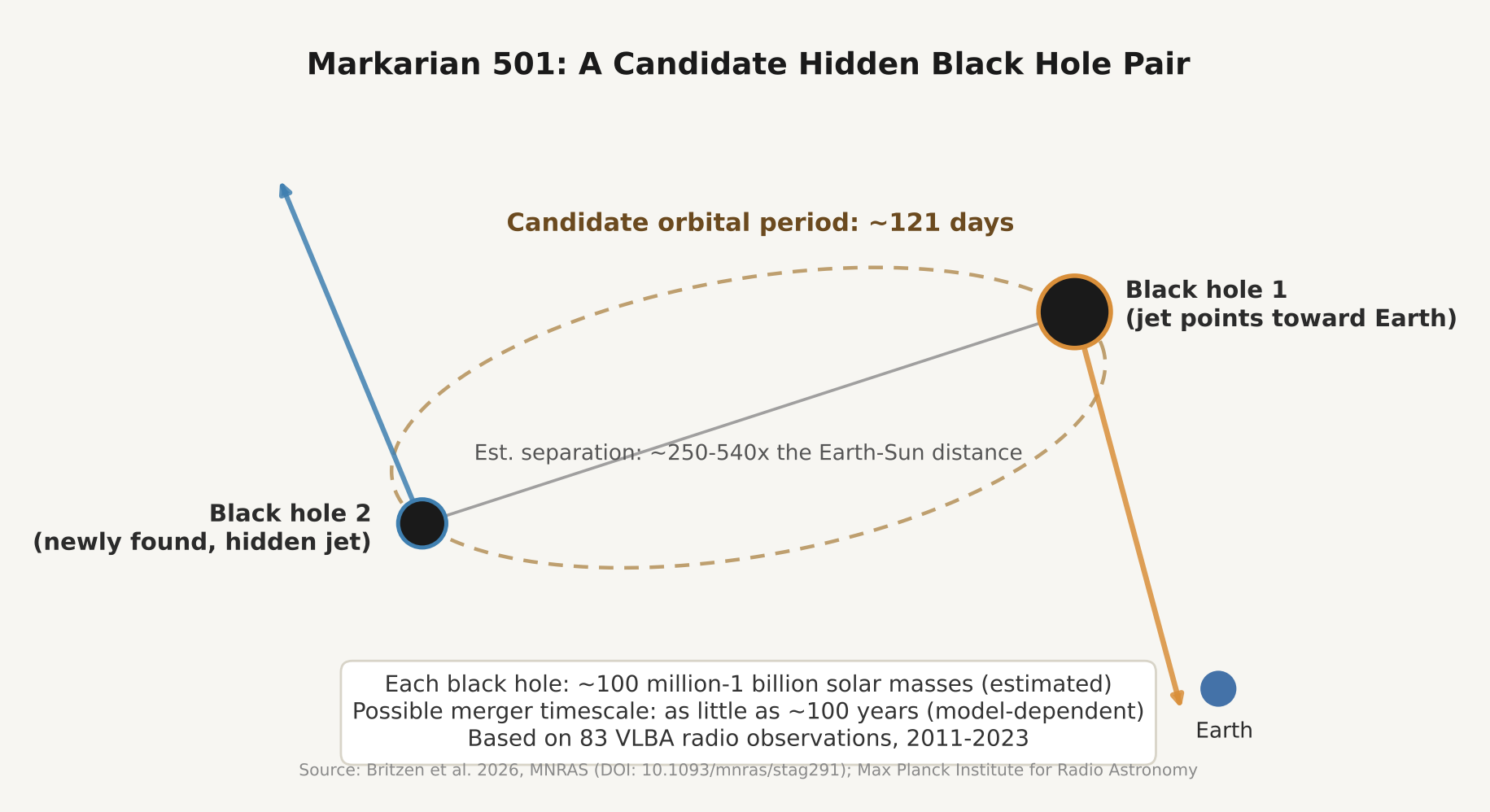
    Diagram of the Markarian 501 black hole pair, showing the roughly 121-day candidate orbit, separation, mass range, and estimated time to merger
    Source: created based on data from Britzen et al. 2026, MNRAS, and the Max Planck Institute for Radio Astronomy.

    A Four-Month Orbit, Not Perfectly Pinned Down

    The two independent clues point to a similar, short rhythm, but not an identical one. Comparing images in which the second feature returned to a similar position gave a recurrence time of about 146 days, with sizeable uncertainty of plus or minus 22 days. The separate pattern in the core’s brightness pointed to a period closer to 121 days, though the researchers describe that figure as less securely measured. The paper adopts roughly 121 days as its working estimate for the orbital period, while noting the two measurements do not perfectly agree.

    For two supermassive black holes to complete an orbit in only about four months, they would have to be extraordinarily close together: for objects with roughly equal mass, the team estimates a separation of only 27 to 128 times the black hole’s own Schwarzschild radius — the characteristic size of a black hole’s event horizon — assuming each black hole weighs somewhere between 100 million and 1 billion times the Sun’s mass. Converted to more familiar units, the Max Planck Institute for Radio Astronomy’s own announcement describes this as roughly 250 to 540 times the distance between Earth and the Sun, depending on the exact masses assumed.

    That is a strikingly small gap for two objects this massive. Many galaxies are thought to harbor black hole pairs left over from earlier galaxy mergers, which sink toward each other over millions of years but then stall at a particular separation — a long-standing puzzle known as the “final-parsec problem,” since theory alone has struggled to explain how such pairs lose enough orbital energy to close that last stretch of distance. A confirmed pair this close together would offer scientists a rare, concrete look at what that advanced stage actually looks like.

    A Possible Merger in About a Century

    Based on that tight separation, the researchers estimate that the binary’s orbit could shrink enough for the two black holes to merge on a timescale as short as roughly 100 years, under certain assumptions about their masses and mass ratio. That is not a firm countdown: it is a model-dependent estimate, and if the true masses sit toward the heavier end of the estimated range, the inferred merger timescale lengthens considerably.

    The researchers are careful to frame the whole result as an interpretation, not a settled fact. The paper’s language throughout is “appears to,” “is consistent with,” and “likely,” rather than “proven,” and it does not resolve the mismatch between the 121-day and 146-day period estimates. What is observed directly is the second jet-like feature, its shifting position, the brightness cycle, and the one-time ring; the orbiting-black-hole picture is the explanation the authors find best fits all of it together.

    A Chance to Track, Not Necessarily Witness

    If the binary interpretation is confirmed, Markarian 501 would become a valuable target for a very different kind of observation: gravitational waves. As two supermassive black holes spiral closer together, they are expected to emit extremely low-frequency gravitational waves — ripples in spacetime far too slow for ground-based detectors like LIGO, but potentially detectable by pulsar timing arrays (PTAs), which track tiny timing shifts in the ultra-regular radio pulses from rapidly spinning dead stars called pulsars.

    In 2023, several PTA collaborations, including the European Pulsar Timing Array, reported the first evidence of a faint background hum of gravitational waves, widely thought to come from the combined signal of many such black hole pairs across the universe, blurred together. Picking out a single, confirmed, well-characterized pair like the one proposed in Markarian 501 from that noisy background would be a demanding task, but the researchers see it as a genuine long-term possibility.

    “We may even see their frequency steadily rise as the two giants spiral toward collision, offering a rare chance to watch a supermassive black hole merger unfold,” said co-author Héctor Olivares.

    That prospect is what makes this finding more than a curiosity about one distant galaxy. Supermassive black hole mergers are thought to be common over cosmic history, but astronomers have never had a well-measured candidate this close to the final stage. Whether or not Markarian 501’s pair turns out to be real, the search for it is already pushing researchers to track changes in its jets, brightness, and possible gravitational-wave signal more closely, over the human-scale years and decades ahead.

    Sources: Max Planck Society, Max Planck Institute for Radio Astronomy, Britzen et al. 2026, Monthly Notices of the Royal Astronomical Society

  • [Science] AI Mostly Avoids Unnecessary Medical Tests — But Stumbles Where Doctors Disagree

    [Science] AI Mostly Avoids Unnecessary Medical Tests — But Stumbles Where Doctors Disagree

    Ask a popular AI chatbot whether you need a thyroid ultrasound for a small nodule your doctor found by accident, and there is a real chance it will tell you to get one anyway — even though medical guidelines say not to bother. A large new benchmark study finds that commercial AI models mostly avoid recommending unnecessary medical tests and treatments when restraint is the right call. But in the small slice of cases where human doctors themselves disagree about what counts as “necessary,” the AI stumbles right alongside them.

    原論文情報 / Original Paper
    Title: Overuse and False Restraint in Large Language Model Recommendations for Choosing Wisely Scenarios
    Authors: Dean Ariel, MD, MPH, et al.
    Journal: Annals of Internal Medicine
    DOI: 10.7326/ANNALS-26-01667

    What the Study Actually Tested

    The research team, led by Dean Ariel, MD, MPH, of Clalit Health Services and Ben-Gurion University of the Negev in Israel, built 225 clinical scenarios from 15 recommendations issued by Choosing Wisely, a long-running U.S. campaign that lists tests and treatments doctors and patients should question because they rarely help and sometimes cause harm. Each scenario described a specific patient situation, such as a healthy adult requesting a routine heart scan or a patient with an incidentally discovered small thyroid nodule.

    For each of the 15 recommendations, the researchers wrote 10 scenarios in which the right move was restraint (skipping the test or treatment) and 5 scenarios in which action was actually warranted. They then put all 225 scenarios to six commercial large language models, with each model answering every scenario three times, for 4,050 responses in total — 2,700 on the restraint scenarios and 1,350 on the action scenarios. That split matters: the 150 restraint scenarios (times six models and three runs) are where “unnecessary care” can be measured, while the 75 action scenarios are where “wrongly withholding care” can be measured. The two error rates below come from those two different slices, not from one shared pool of 4,050 responses.

    Choosing Wisely has been running since 2012, built around a simple idea: ask medical specialty societies themselves to name the tests and treatments their own members order too often. The campaign’s lists now cover hundreds of recommendations, from skipping antibiotics for a simple cold to avoiding imaging for uncomplicated lower-back pain. Using it as the study’s yardstick means the “right answer” for each scenario was not the researchers’ own judgment call — it came from the specialists most familiar with each procedure’s actual value.

    Low Overuse, With Exceptions

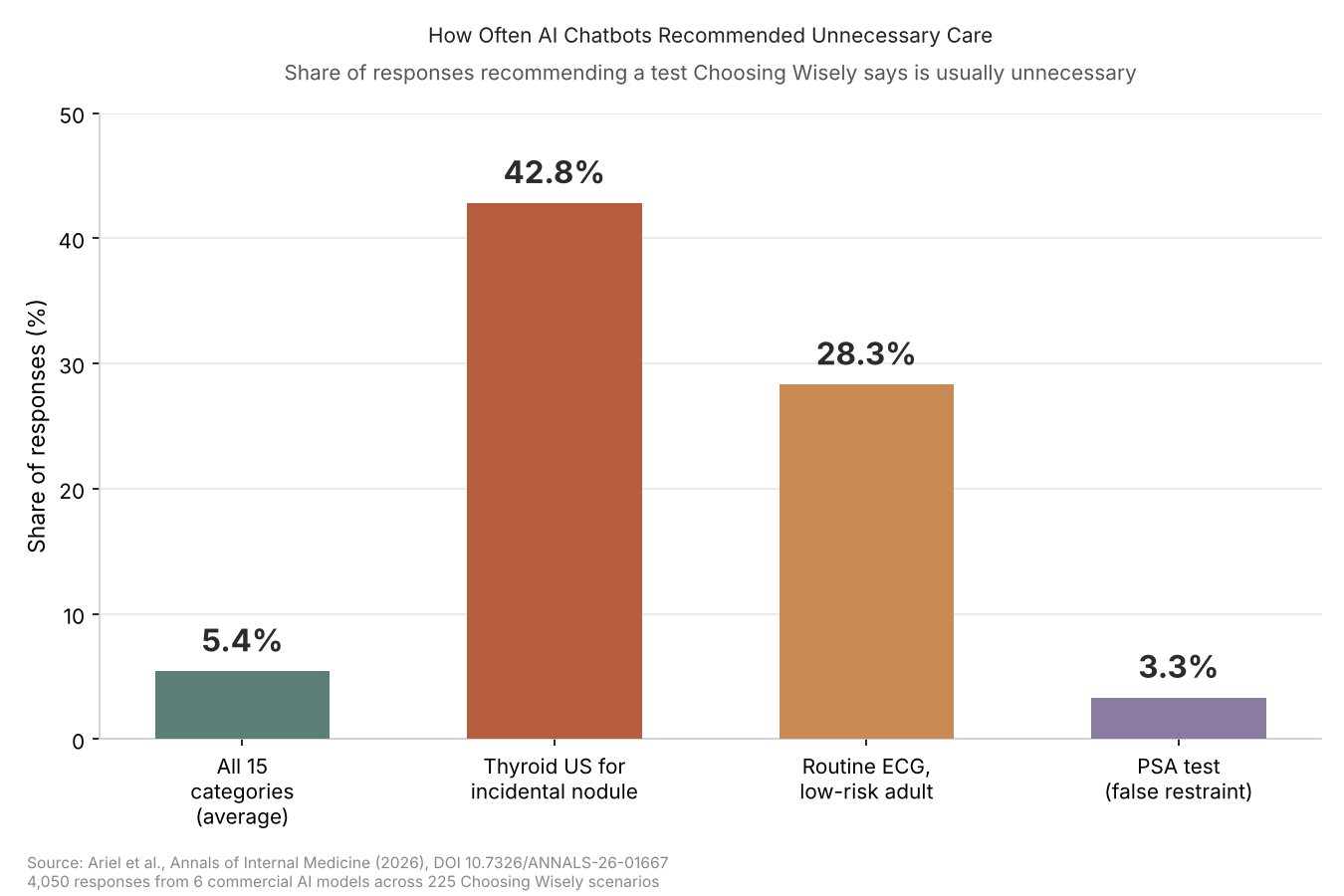
    Across the scenarios where restraint was the right call, the AI models recommended potentially unnecessary care in just 5.4% of responses. For eight of the fifteen Choosing Wisely recommendations tested, the models never once suggested the unnecessary test or treatment — a result that held steady across scenarios involving imaging, lab work, and routine screening alike.

    In scenarios where restraint was the right answer, AI chatbots still recommended unnecessary care 5.4% of the time overall — but that average hid a couple of scenarios where they got it wrong nearly half the time.

    On the other side of the ledger, the models were also cautious about swinging too far toward withholding care altogether. In the scenarios where testing or treatment was actually warranted, they failed to recommend it — a pattern the researchers call “false restraint” — in only 0.6% of responses. In other words, the dominant failure mode by far was ordering too much, not too little, but neither failure was common.

    Where the AI Models Stumbled

    The 5.4% average mask two restraint scenarios where the models struggled far more than usual. The worst was thyroid ultrasound imaging for a small, incidentally discovered nodule with no worrying features: the AI models recommended the unnecessary scan in 42.8% of their responses to that scenario. The second-worst was routine electrocardiogram (ECG) screening for low-risk adults with no symptoms, where models recommended the unneeded test in 28.3% of their responses.

    On the false-restraint side, the single riskiest category was prostate-specific antigen (PSA) testing, where the models wrongly withheld a test that was actually appropriate in 3.3% of their responses to that scenario — still low, but the highest rate among the categories studied.

    Chart showing AI chatbots recommended unnecessary care in 5.4% of responses overall, 42.8% for thyroid ultrasound, 28.3% for routine ECG, and 3.3% false restraint for PSA testing
    Source: Data from Ariel et al., Annals of Internal Medicine (2026)

    Why Doctors Themselves Can’t Agree

    The authors point to a possible explanation that has nothing to do with AI being broken: on thyroid nodules specifically, medical societies themselves do not agree. Different professional guidelines draw the line for “worth scanning” at different nodule sizes and risk profiles, and primary care doctors in the real world follow that same disputed judgment call in different directions. One plausible reading is that large language models, trained heavily on published medical literature and real clinical text, picked up on that same disagreement — though the study itself does not prove which training material caused the errors, only that the errors cluster exactly where human guidance is split.

    That is a notably different story from an AI simply failing to learn the rules. It suggests these models are not making random errors; their mistakes line up with the same contested judgment calls that divide human doctors.

    What This Means for Patients and Doctors

    An editorial published alongside the study, written by Dr. Deborah Korenstein of the Icahn School of Medicine at Mount Sinai and Dr. Daniel Morgan of the VA Maryland Health Care System and University of Maryland, cautions against reading too much into a benchmark built from hypothetical scenarios. Real clinical decisions involve a patient’s full history, a physical exam, and a conversation — not a paragraph of text handed to a chatbot. The editorial argues that any claim about AI’s real clinical value needs to be tested with actual patient encounters, not written vignettes.

    Even so, the stakes are real and rising. Patients increasingly ask AI chatbots for a second opinion before or after seeing a doctor, and some clinicians already lean on AI tools to help triage test requests. If an AI model inherits a human blind spot rather than correcting for it, it can quietly reinforce the same overtesting it was supposed to help reduce — particularly in exactly the gray-area cases where patients most need a clear, confident answer. That risk echoes a broader pattern researchers have flagged elsewhere: a Berkeley study found that leaning on AI for help can quietly erode a person’s own persistence and judgment over time, which is worth keeping in mind any time a difficult, ambiguous decision gets outsourced to a chatbot by default.

    The study did not measure real-world costs, but the shape of the risk is easy to see: if similar errors occur often enough in actual chatbot use, they could add up to unnecessary follow-up scans, biopsies, and patient anxiety over findings that were never going to matter. That remains a hypothesis, not something this benchmark demonstrated.

    The Limits of a Multiple-Choice Test

    Choosing Wisely scenarios are, by design, close to a clean multiple-choice test: a well-defined clinical situation with an established “right” answer from a respected guideline body. Most real medical decisions are messier, shaped by a patient’s anxiety, family history, insurance coverage, and a dozen details a short text prompt cannot capture. The study’s own authors frame their 5.4% overuse rate as reassuring but incomplete — strong evidence that today’s leading AI models have absorbed the broad principle of “don’t test without a reason,” paired with a reminder that they still default to the crowd’s judgment, flaws included, in the cases where the crowd itself is unsure.

    For now, the practical takeaway is less about whether AI chatbots are generally “safe” for medical questions and more about where their blind spots sit. In this benchmark, the models rarely withheld care that was genuinely needed, but unnecessary testing remained a real problem in a handful of gray-area scenarios. Because the study used hypothetical vignettes rather than real patients, more research is needed before anyone can say how these patterns play out in an actual exam room — which is exactly why a chatbot’s answer on a borderline test is worth raising with an actual doctor rather than treating as a final word.

    Sources: American College of Physicians / Newswise press release, AuntMinnie, Annals of Internal Medicine (DOI)

  • A Green Hydrogen Catalyst Lasts Longest at the Freezing Point — RIKEN Finds

    A Green Hydrogen Catalyst Lasts Longest at the Freezing Point — RIKEN Finds

    Cool a chemical reaction down, and it should slow to a crawl — that’s basic chemistry. But for one hydrogen-making catalyst, the story turns out to be more complicated than that. Researchers at Japan’s RIKEN institute have found that a manganese oxide catalyst used to split water into hydrogen degrades the least right around the freezing point of water, and then degrades faster again once the water is chilled further still. The finding offers a new angle on one of green hydrogen’s stubborn cost problems: catalysts that wear out too fast.

    原論文情報 / Original Paper
    Title: Cooling Water to Near Freezing Breaks the Activity-stability Trade-off of Water Oxidation Electrocatalysis
    Authors: Wardhana, A. C. et al.
    Journal: Nature Chemistry
    DOI: 10.1038/s41557-026-02274-8

    The Weak Link in Green Hydrogen

    Splitting water into hydrogen and oxygen using electricity from solar or wind power is the core process behind “green hydrogen,” a carbon-free alternative to fossil fuels for power generation, steelmaking, and transport fuel. Hydrogen produced this way could, in principle, replace fossil fuels across a wide swath of heavy industry, which is why so much research funding is chasing it.

    The catch is cost. At the electrode where oxygen is released, the chemical environment is harshly oxidizing, and over time the catalyst coating that electrode slowly dissolves away. Replacing or maintaining it is a recurring expense, and durability problems like this are a big part of why electrolysis-based hydrogen still costs more than hydrogen made from natural gas. Any discovery that makes catalysts last longer without a complete materials overhaul is worth a closer look.

    Speed Versus Durability: The Old Rule

    Chemical reactions generally speed up as temperature rises — a basic rule of chemistry known as the Arrhenius relationship, named after the 19th-century chemist who first described it. Raise the temperature and a water-splitting reaction goes faster, which sounds like a straightforward way to boost hydrogen output. But raise the temperature too much, and the catalyst itself degrades faster too, since the harsh oxidizing side-reactions that eat away at it also speed up with heat. Cool things down, on the other hand, and the catalyst tends to last longer — but the water-splitting reaction itself slows to match. Engineers have generally treated this as a fixed trade-off: push for speed, and durability suffers; push for durability, and speed suffers.

    A Sweet Spot Right at Freezing

    A team led by Ryuhei Nakamura, team director at RIKEN’s Center for Sustainable Resource Science and a professor at the Earth-Life Science Institute at the Institute of Science Tokyo, decided to test that assumption directly. Using a manganese oxide (MnO2) catalyst, a common and inexpensive choice for this kind of reaction, the team ran the electrolysis across a wide temperature range — from a warm 80°C down to -12°C, well below the normal freezing point — and carefully tracked two things at once: how fast oxygen bubbled off the electrode, and how much manganese leached out of the catalyst as it broke down.

    The results were not what a simple reading of the Arrhenius relationship would predict. As the temperature dropped from 80°C toward 0°C, both the reaction rate and the degradation rate slowed down, as expected. But the degradation rate fell off by far more than the reaction rate did. In practical terms, that means that near 0°C, the catalyst could last substantially longer while giving up comparatively little reaction speed — a sweet spot hiding in plain sight. The team confirmed this wasn’t just a snapshot measurement: in longer-duration tests that ran a steady electric current through the cell and tracked how long the catalyst held up, lifespan peaked right around 0°C and then declined again as the electrolyte was chilled further, tracing out a distinct peak rather than a straight line.

    Why Colder Water Breaks It Faster

    The more surprising twist showed up below 0°C. Instead of continuing to degrade more slowly as temperatures kept dropping — which is what ordinary chemistry would predict — the catalyst flipped and started breaking down faster the colder it got. Chemists call this an “anti-Arrhenius” pattern, because it runs exactly opposite to the usual temperature rule. The effect was visible to the naked eye: an electrolyte solution held at -8°C turned noticeably deeper pink than one held at 2°C, a color change consistent with a buildup of permanganate ions, a telltale marker of the catalyst breaking down.

    Below 0°C, the colder the water got, the faster the catalyst broke down — the exact opposite of what ordinary chemistry would predict.

    The explanation traces back to a strange property of water itself, known as “supercooling.” Below 0°C, the sulfuric-acid electrolyte solution in the experiment didn’t freeze immediately — it stayed liquid in an unstable, supercooled state, confirmed in the study by triggering ice formation with mechanical shock and watching how the liquid behaved beforehand. Using Raman spectroscopy to examine the molecular structure of the water, the researchers found that the network of hydrogen bonds connecting water molecules in this supercooled state looks markedly different from the structure of ordinary water above 0°C. The team’s working hypothesis is that this altered molecular structure is what accelerates manganese loss from the catalyst, driving the faster breakdown seen at sub-zero temperatures.

    Catalyst durability has traditionally been tackled by redesigning the material itself — changing its chemical composition or its microscopic structure to make it more resistant to the oxidizing environment. A sulfur-based material that produces hydrogen from sunlight, developed elsewhere, is one recent example of that materials-first approach to cheaper hydrogen production. What stands out about this study is that it doesn’t touch the catalyst material at all. Instead, it shows that something as simple as tuning the temperature of the reaction environment can shift the balance between how active a catalyst is and how long it survives.

    Conceptual diagram showing catalyst stability peaking near 0C electrolyte temperature
    Based on the description in RIKEN’s press release (Oct 21, 2026)

    From Cold Climates to Icy Worlds

    The researchers see temperature as a new design lever that engineers could use alongside, or even instead of, changes to catalyst chemistry, to balance activity against stability. That has implications that go beyond ordinary industrial electrolyzers. The same principle could inform the design of electrochemical systems built to operate in cold or polar climates, where keeping equipment near room temperature is itself an energy cost. More speculatively, the findings could also help explain electrochemical reactions involving low-temperature water on other planetary bodies, where near-freezing or supercooled water may be common. The research team frames the work as contributing to UN Sustainable Development Goals centered on clean water and clean, affordable energy. The results were published October 21, 2026, in the journal Nature Chemistry, with support from Japan’s GteX program, JSPS KAKENHI, and other funding bodies.

    Not Just the Material, But the Setting

    A catalyst’s performance isn’t dictated by its composition and structure alone — that’s the central insight of this study. Something as simple as the temperature of the surrounding water can shift the balance between how fast a reaction runs and how long the catalyst that drives it survives. This result won’t make green hydrogen cheaper overnight, and plenty of engineering work stands between a laboratory finding and a commercial electrolyzer. But the idea of designing catalysts around the conditions they operate in, rather than focusing solely on the materials they’re made from, gives engineers a new variable to work with — one that costs nothing to install, since it only requires controlling a temperature that already has to be managed anyway.

    Sources: RIKEN press release, “Electrolysis catalyst becomes longer-lived near 0°C”, Nature Chemistry (DOI: 10.1038/s41557-026-02274-8)

  • [Economy] Just 3 in 10 Say They’ve Mastered AI as Job-Loss Fears Spread to Over-40s

    [Economy] Just 3 in 10 Say They’ve Mastered AI as Job-Loss Fears Spread to Over-40s

    Generative AI is everywhere in conversation, yet fewer than 3 in 10 people say they’ve actually mastered using it. According to “Quality of Society Index 2026,” an annual survey released on October 19, 2026 by Dentsu Soken, a large generational gap separates confident AI users from everyone else — and over the past year, anxiety about AI taking people’s jobs has spread beyond young workers to reach people in their 40s, 50s, 60s and 70s as well, narrowing a gap that used to be much wider. Here’s what the numbers show, why the gap between confidence and anxiety matters, and what it suggests about how workplaces should be handling AI training right now.

    原論文情報 / Original Paper
    Title: “Quality of Society Index 2026” (クオリティ・オブ・ソサエティ指標2026)
    Authors: Dentsu Soken Inc., Humanology Innovation Division, Quality of Society Center
    Journal: Dentsu Soken Press Release
    DOI: https://www.dentsusoken.com/news/release/2026/1019.html

    Dentsu Soken’s think-tank arm, the Quality of Society Center, has run this survey every year since 2019 to track how people’s attitudes are reshaping Japanese society — covering everything from views on work and community to broader questions about what a “good society” looks like. The 2026 edition was fielded online from June 23 to 30, 2026, among 12,000 men and women aged 18 to 79 across the country, including high school students, through the research firm Dentsu Macromill Insight. With a sample that large, the margin of error works out to at most ±1.3 percentage points at a 95% confidence level. For the first time since the survey began, this year’s edition added questions about how well people feel they use AI, and how comfortable they are letting AI agents handle everyday tasks on their behalf — a timely addition, given how quickly AI tools have moved from novelty to daily habit for many people over the past two years.

    Confidence in AI Still Lags Behind the Hype

    Asked whether they agreed with the statement “I feel I use AI well,” only 29.8% of respondents said yes. Confidence rose with youth, but even the most confident group — 18-to-29-year-olds — topped out at 46.6%, short of a majority. In other words, even among the demographic that grew up with smartphones and is usually assumed to be most comfortable with new technology, most people still don’t feel they’ve got AI figured out. Dentsu Soken reads this as a sign that while conversational generative AI has become familiar — most people have at least tried a chatbot by now — actually using it well remains a trial-and-error process for the majority. It’s worth being precise about what the 29.8% figure actually measures: it’s self-assessed confidence, gathered by asking people how they feel about their own AI use, not an independent test of how skillfully they actually use it. Someone who rarely uses AI at all and someone who uses it daily but still feels unsure could both end up in the “not confident” category.

    Confident Users Trust AI Agents More

    The survey also asked a more forward-looking question: would people accept letting an AI agent — an automated assistant that acts on a person’s behalf rather than simply answering questions — handle three everyday situations? The scenarios were managing money, such as investment decisions; helping spark a new friendship or romantic connection; and booking restaurants or travel. Across all three, people who said they use AI well were consistently more accepting of handing the task to an AI agent than people who didn’t feel confident. That’s a fairly intuitive result — people who already trust their own ability to work with AI are, unsurprisingly, more willing to extend that trust further — but it’s worth noting precisely what the data can and can’t support. The two measures clearly move together, but a single survey like this can only show that confidence and acceptance are correlated among respondents, not that one causes the other. It’s equally possible that people who are generally early adopters of new technology simply score higher on both measures at once.

    Anxiety Jumps 7.8 Points, Gap Narrows

    Regardless of how confident people felt about using AI themselves, anxiety about losing a job to AI grew across the board. Among currently employed respondents (n=5,734 in 2026, n=5,708 in 2025), 30.9% said they felt anxious about AI or automation taking their job, up 7.8 points from 23.1% the year before — a sizable one-year jump for a tracking survey like this. The shift wasn’t evenly distributed by age, though, and that’s arguably the more interesting part of the finding. A year earlier, anxiety about AI displacing jobs was concentrated among younger workers. In the 2026 wave, that anxiety rose among people in their 40s, 50s, 60s and 70s as well, pulling every age bracket toward roughly 30%, and narrowing what had been a fairly wide generational gap. Dentsu Soken points to a year of expanding AI adoption inside Japanese workplaces as a likely factor behind the broader spread of concern. That’s a reasonable reading of the trend, but it’s the survey organization’s own interpretation of the pattern — this kind of survey can show that anxiety rose and spread across ages, but it can’t, on its own, establish workplace AI adoption as the specific cause.

    30.9% of workers now say they’re anxious about losing their job to AI — up 7.8 points in a year, with the generational gap narrowing as older workers caught up to younger ones.
    Bar charts showing AI confidence by age group and the year-over-year rise in job-loss anxiety
    Source: created from data in Dentsu Soken’s “Quality of Society Index 2026.”

    Echoes of an Earlier AI Persistence Study

    Put the two findings together and a pattern emerges: confidence in actually using AI well remains a minority experience, while anxiety about AI’s effect on jobs has outrun it, spreading across generations faster than comfort with the technology has. That pattern echoes something we covered previously on this site: a set of randomized experiments by researchers at UC Berkeley and several partner institutions, involving 1,222 participants across three separate trials, found that people who leaned on AI assistance to solve math or reading problems performed measurably worse afterward — once the AI was taken away — than people who had worked unaided from the start. In the first experiment, people who had used AI got only 57% of follow-up questions right on their own, versus 73% for the group that never had AI help. It’s important to be precise about what kind of evidence each study offers, though. The Berkeley work was a controlled experiment measuring task performance under lab conditions; the Dentsu Soken survey is a broad measure of public sentiment about jobs and confidence. They’re different kinds of evidence answering different questions, and one doesn’t prove the other. But read side by side, they point toward a broader unease about how people are relating to AI as it becomes more capable and more embedded in daily life and work.

    The Real Risk: A Training Gap

    If AI adoption keeps expanding at work — and the survey’s own data suggests it already has, given how sharply anxiety spread this year — companies will likely need to give employees concrete, hands-on ways to learn how to use AI tools well, along with room to experiment without fear of getting it wrong in front of colleagues or managers. This survey alone can’t say precisely what’s driving the rise in anxiety, or whether workers currently have enough opportunities to build real confidence with these tools. But the combination it does show is hard to ignore: confidence in using AI well remains rare, at well under a third of the population even among the young, while anxiety about AI’s effect on jobs has become common across every age group. That gap points to a practical, near-term challenge for employers: treating AI rollout and workforce training as a single connected problem, rather than assuming that giving people access to AI tools is the same thing as teaching them how to use those tools well.

    Sources: Dentsu Soken, “Quality of Society Index 2026” press release, full survey report (PDF)