
A supramolecular polymer is a chain-like material whose building blocks link up through weak, reversible attractions instead of strong, fixed chemical bonds. That “weak but many” design can let these materials repair damage, change shape, and influence how living cells grow — which is why materials scientists have been racing to build bigger, more precisely controlled versions of them.
What Is a Supramolecular Polymer?
A conventional polymer — the plastic in a water bottle, for example — is a long chain of small repeating units called monomers, welded together end-to-end by covalent bonds. Covalent bonds are the strong, electron-sharing connections that hold most everyday molecules together, and once formed they generally don’t come apart on their own.
A supramolecular polymer (a term built from “supra-,” meaning “beyond,” plus “molecular”) swaps those permanent welds for temporary handshakes. Its monomers link up through noncovalent interactions — hydrogen bonds, stacked ring structures, metal-ion bridges, or simple electrical attraction — that are individually weak but, strung together by the thousands along a chain, add up to a stable, functional material. A useful everyday comparison is Velcro: a single hook-and-loop pair peels apart with almost no effort, but a whole strip of them holds a heavy jacket closed. Supramolecular polymers work the same way at the molecular scale — weak links in large numbers behave like a strong, yet reversible, material.
IUPAC’s 2013 polymer-science recommendations favor the term “supramolecular association” (also called “Lehn association,” after chemist Jean-Marie Lehn) for this self-assembly process, and discourage the related term “supramolecular polymerization.” That is a naming preference for the process, not a rejection of the material-class name: “supramolecular polymer” remains the term used throughout the chemistry and materials literature — including in the title of the 2026 Northwestern University paper described below — so this article uses it in that common sense.
How the Self-Assembly Works
Because the bonds holding a supramolecular polymer together are reversible, individual connections continually break and re-form, letting the material adjust to its surroundings without necessarily falling apart. When the damaged surfaces of such a material can come back into contact and the molecules are mobile enough, those reversible interactions can reconnect across the damage — the basis for self-healing in some (not all) supramolecular materials; how well it works depends heavily on the specific design. According to a 2024 overview from the Society of Plastics Engineers, this same dynamic bonding can also let certain supramolecular polymers flow or be reshaped more easily than conventional plastics, though the exact processing temperature and pressure still depend on the molecular design in question.
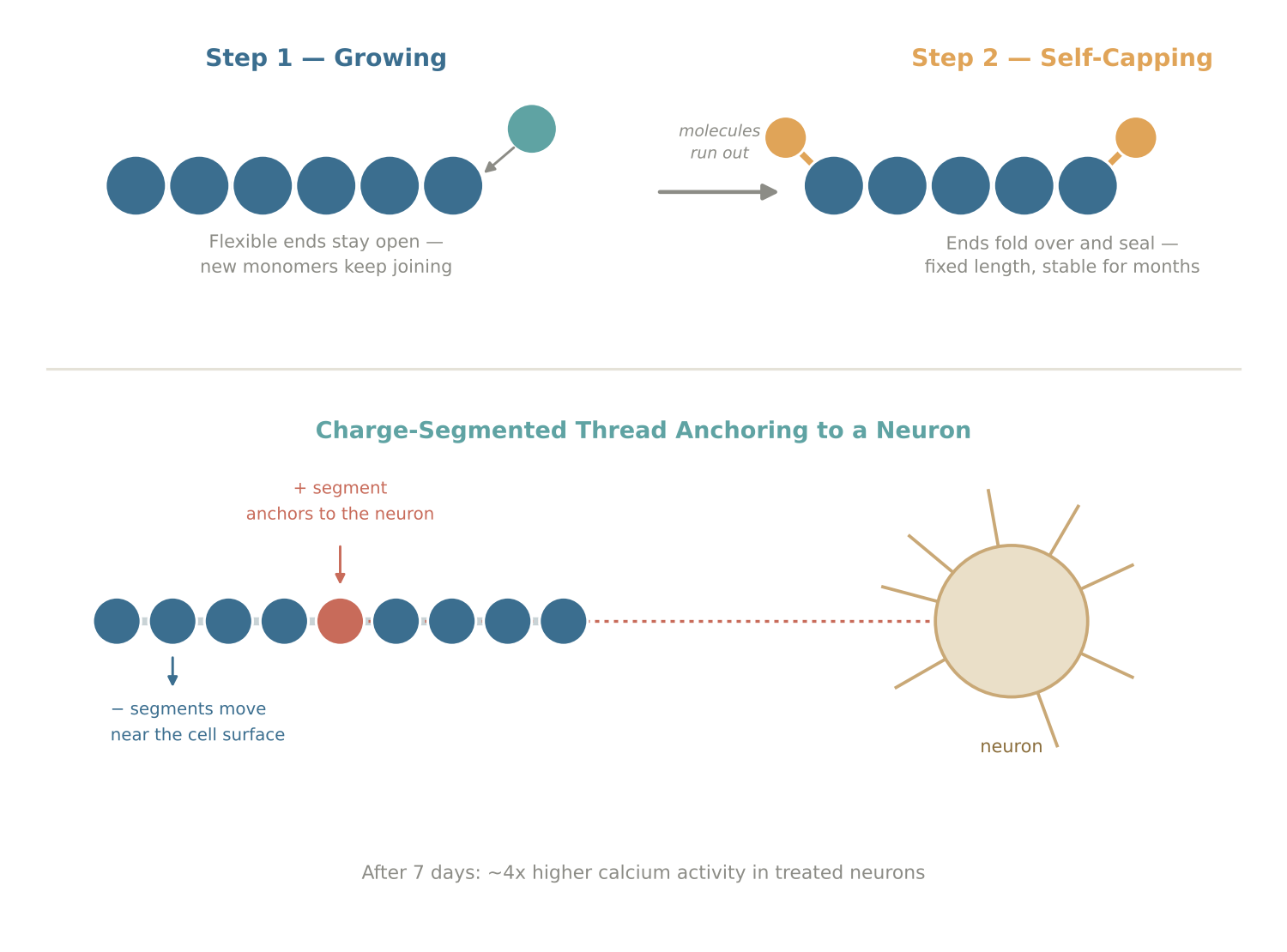
Chemists have also learned to design chains that grow to a controlled length and then stop. One such strategy, demonstrated in an October 2026 study from Northwestern University, is called self-capping supramolecular polymerization. The molecular design lets a growing thread’s flexible ends keep adding building blocks while conditions allow it, then fold over and form a cap that limits further growth. Introducing a fresh batch of building blocks can restart the process, which lets researchers extend the assembly and arrange distinct segments along its length.
Getting this right is a balancing act. If the building blocks do not bind to each other strongly enough under the given conditions, only short, unstable clusters form. If the interactions are too strong, the material can lose the ability to rearrange that makes supramolecular polymers useful in the first place. Scientists must also keep growing chains from fusing together unpredictably or slowly falling back apart — failure modes that, together with this binding-strength trade-off, are much of what makes precise supramolecular engineering difficult.
Why It’s Getting Attention Now
Supramolecular polymers have been studied since the late 1980s. In 1988, chemist Takuzo Aida and colleagues reported one of the field’s early milestones: disc-shaped porphyrin molecules that stacked face-to-face into one-dimensional assemblies through noncovalent interactions. Chemist Jean Fréchet’s group then used hydrogen bonds to build liquid-crystalline supramolecular structures in 1989, and Nobel laureate Jean-Marie Lehn’s group demonstrated hydrogen-bonded, liquid-crystalline supramolecular polymers in 1990. Chemist Bert Meijer’s widely cited 1997 work on four-point hydrogen-bonded monomers then showed that noncovalent assemblies could behave mechanically like true high-molecular-weight polymers. What has changed since then is precision: for decades, supramolecular polymers tended to form with uneven, hard-to-control lengths, which limited how reliably their properties could be engineered for a specific application.
That is the gap the Northwestern team, led by materials scientist Samuel I. Stupp with postdoctoral fellow Michael Dore and graduate students Simon Egner and Madison Strong, targeted in a study published October 1, 2026, in the journal Science. Using self-capping, they built threads with molar masses reaching into the billions of daltons — roughly 100 times heavier, by the university’s own comparison, than large conventional polymers or the largest known natural proteins, with the longest threads wider than a single cell. According to the researchers, the threads kept their controlled length for months in a test tube without clumping, merging, or dissolving back apart under the tested conditions, something earlier, less-controlled supramolecular polymers struggled to do.
“That introduces a very different way of thinking about how materials can communicate with cells,” said Northwestern’s Samuel I. Stupp of the findings.
Uses: Self-Healing Plastics to Neurons
The reversible bonding at the heart of supramolecular polymers already points toward several practical uses. Self-healing coatings and parts for construction, automotive, and aerospace use could extend equipment lifespans by letting small cracks mend themselves rather than requiring replacement. Stimuli-responsive versions are being explored as drug-delivery carriers that release their cargo only when they encounter a specific biological trigger, such as a change in pH inside the body, and supramolecular hydrogels — soft, water-swollen networks — are used as scaffolds in tissue engineering to support growing cells. Researchers are also testing supramolecular designs in adaptive coatings that resist corrosion and wear, and in soft robotics, where flexible, responsive materials can mimic the give-and-take of biological tissue.
The Northwestern study adds a striking new example. The team tested several charge patterns on neurons grown in lab dishes: threads made entirely of positively charged segments harmed the cells, threads made entirely of negative segments had little effect, and randomly mixed charges produced no notable response. Only one design worked well — a short positively charged segment sandwiched between two longer negatively charged segments, which anchored the thread to the negatively charged neuron surface. In that condition, neurons showed roughly four times more measured calcium activity (an indicator of cellular signaling, though not a direct measure of overall neuronal function) after one week, and had formed more synaptic connections by two weeks, without the researchers adding any conventional biological growth factors. The researchers caution that this is cell-culture work only, with no animal or human testing yet, so any medical application for nerve repair remains a long-term prospect rather than a near-term product.
What to Watch Next
Market research firm Transparency Market Research estimated the global supramolecular polymer market at roughly $291.5 million in 2024, projecting about 6.5% annual growth through 2031. The more scientifically telling milestone to watch, though, is whether precisely built, billion-dalton threads like Northwestern’s can be scaled up and tested in living animals, not just lab dishes.
For more on the specific billion-dalton threads discussed above and how they boosted nerve-cell activity in the lab, see our related article: Scientists Build a Billion-Dalton Molecular Thread Longer Than a Cell.
Sources: Northwestern University (Weinberg College), EurekAlert! press release, IUPAC Gold Book
Leave a Reply