For decades, neuroscientists have faced a nagging puzzle. Modern AI owes its power to backpropagation, an algorithm that adjusts a network’s connections by propagating error information backward through precisely coordinated connections — a computation with no clearly established equivalent in biological circuitry. Yet some studies have found that activity patterns in trained artificial networks resemble those recorded in the brain’s own visual system, which only sharpens the question of how biological neurons, using only local signals and changing synapses, might approximate something similar. A new study from MIT’s McGovern Institute for Brain Research, published October 9 in the Proceedings of the National Academy of Sciences (PNAS), offers a candidate answer: when simple neuron-like units are wired randomly and left to follow local, biologically plausible plasticity rules, they can spontaneously self-organize into circuits that learn nearly as well as backpropagation does on the tasks tested — without anyone telling them how.
Title: How Biological Synapses Self-Assemble Gradient Learning
Authors: Qianli Liao, Liu Ziyin, Yulu Gan, et al.
Journal: Proceedings of the National Academy of Sciences (PNAS)
DOI: 10.1073/pnas.2606245123
A 40-Year Mismatch Between Brains and AI
Modern deep learning owes almost all of its success to backpropagation: a network makes a prediction, compares it with the correct answer, and then propagates that error backward, layer by layer, nudging every connection weight in the direction that would have reduced the mistake. It works brilliantly, but standard implementations depend on precise mathematical relationships between forward and backward connections, plus coordinated transmission of error information through the network. There is no established evidence that cortical circuits implement anything equivalent in its conventional form.
The puzzle deepened as deep learning matured. Comparisons between the internal activity of backpropagation-trained networks and recordings from biological visual systems have repeatedly found intriguing similarities — not identical, but notably closer than chance would predict. Such similarities do not prove the brain runs backpropagation, but they raise an obvious question: if it does not, what local process could still produce computations that end up looking so much like it?
Local Rules, No Blueprint
The MIT team, led by Qianli Liao, Liu Ziyin and Yulu Gan with senior authors Mark Harnett and Tomaso Poggio (and co-author Brian Cheung), approached the question differently from most prior attempts to make backpropagation “more biological.” Instead of designing a circuit by hand and checking whether it could plausibly exist in a brain, they started from almost nothing: layers of neuron-like units connected at random, with no predetermined wiring diagram at all.
The system runs on local synaptic plasticity rules, including heterosynaptic mechanisms that let a connection change in response to activity beyond that single synapse — a more specific relative of the familiar Hebbian idea that “cells that fire together wire together.” Critically, these rules only need information available locally, at or near a given synapse (the junction where one neuron signals to the next). No unit needs to know what is happening elsewhere in the network, and no single global error signal is broadcast to the whole system.
Circuits That Wire Themselves
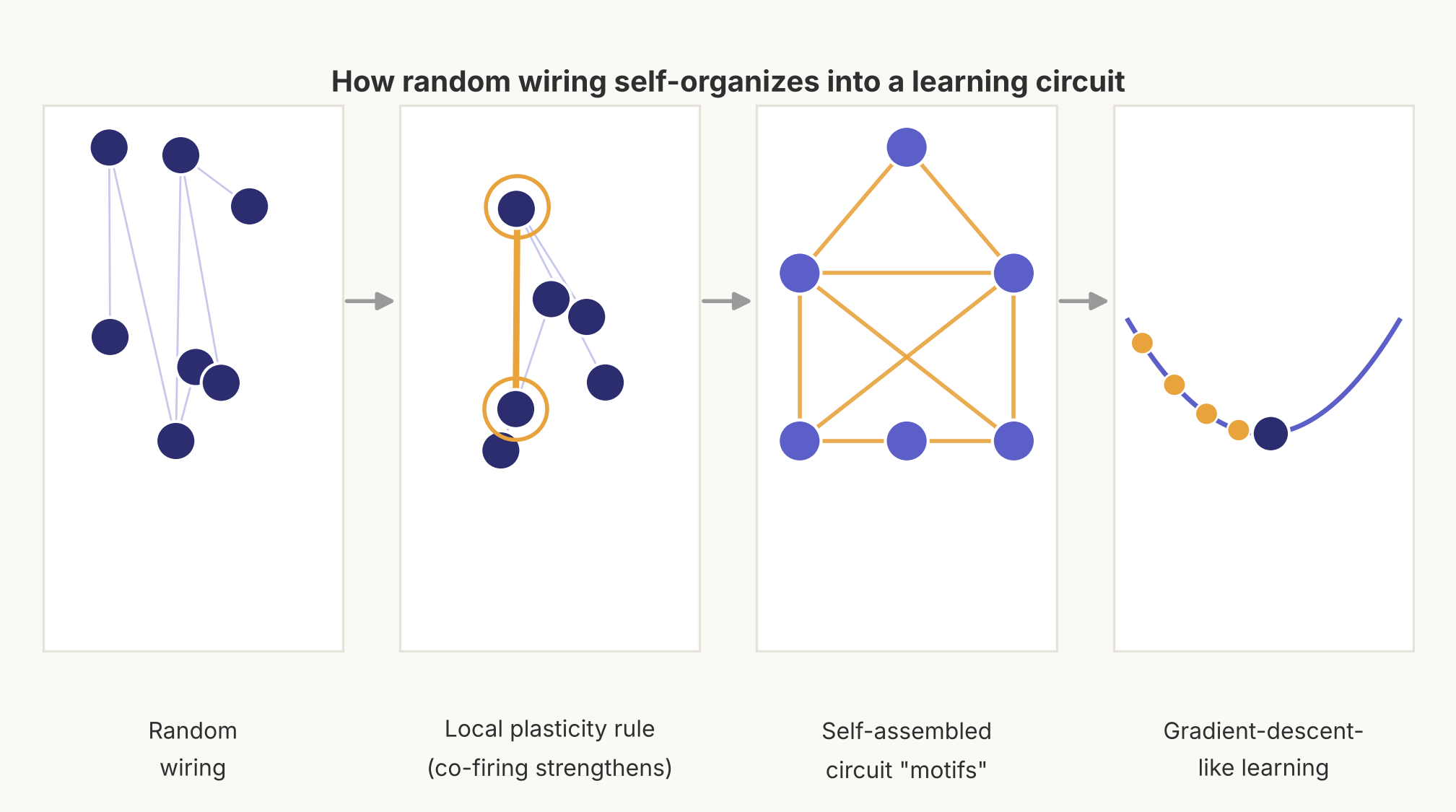
Left to run under those local rules, the randomly connected units did not stay random for long. Over repeated rounds of activity, the network developed small, recurring wiring patterns the researchers call “self-assembling motifs.” The model’s analysis points to a specific four-synapse motif linking the brain’s ascending, bottom-up pathways with its descending, top-down pathways — a concrete structural prediction that experimentalists can now go looking for in real neural tissue, not a pattern already confirmed to exist there.
What these motifs do next is the more remarkable part: networks of them self-organize further, so that their combined dynamics approximate a generalized form of stochastic gradient descent — the family of optimization methods that includes backpropagation — without a hand-designed, globally coordinated algorithm directing them. In other words, before the network learned anything from its training data, it first had to build the machinery that would let it learn.
Starting from random connectivity, local synaptic plasticity rules were enough for the network to assemble circuit motifs whose combined dynamics approximate gradient-descent-style learning.
Holding Its Own Against Backpropagation
A biologically plausible circuit is only interesting if it actually works, so the researchers tested their self-organized networks on image pattern recognition and classification tasks. According to MIT, the self-assembled circuits achieved performance comparable to conventional networks trained directly with backpropagation on the tasks tested. The MIT News announcement does not report specific accuracy figures or benchmark datasets — those details sit in the full PNAS paper — so the result is best read as evidence that self-organization carried no obvious cost on this particular test, not as a claim that it matches backpropagation across deep learning in general.
That matters because it suggests biological plausibility and computational competence are not necessarily in tension. For years, biologically inspired alternatives to backpropagation have often underperformed it on real tasks. A circuit that assembles itself from random wiring and still competes with backpropagation on the tasks it was tried on narrows that gap, at least in this one demonstration.
A Prediction Neuroscientists Can Go Test
The researchers are careful to note that a self-organizing network learning like this does not prove the human brain learns this way — it is a candidate mechanism, not a confirmed one. But unlike many theoretical proposals in computational neuroscience, this one comes with a concrete, falsifiable prediction: if the brain really does something like this, cortical circuits should contain that specific four-synapse motif connecting ascending and descending pathways. Experimental neuroscientists can now search actual brain tissue for exactly that wiring signature, which is what turns an elegant simulation into a testable scientific hypothesis.
Why It Matters Beyond the Lab
If the prediction holds up, the payoff would extend in both directions. For neuroscience, a confirmed biologically plausible learning circuit would help explain how the brain adapts throughout life, and could sharpen our understanding of what goes wrong in conditions involving altered learning or memory, as well as inform the design of future brain-computer interfaces that need to interact with the brain’s own learning rules rather than fight against them.
For AI, the lesson cuts the other way: today’s networks are built top-down, with every connection and training rule specified by engineers before a single example is seen. A system that can bootstrap its own learning machinery from random wiring and local plasticity rules hints at an alternative path — architectures that configure themselves as they encounter data, rather than ones that are handed a finished blueprint. Liao, Ziyin, Gan and their colleagues frame their result as an early step in that direction, not a finished product, but their work gives both neuroscientists and AI researchers a concrete new question to test: not just how networks learn once they are built, but how learning itself can come preinstalled.
For more on where artificial and biological intelligence still diverge, see our earlier coverage of how MIT neuroscientists found the brain re-files information the instant you make a decision, a separate finding that is likewise reshaping how AI researchers think about adaptive, flexible learning.
Sources: MIT News, Proceedings of the National Academy of Sciences (PNAS), arXiv preprint
Leave a Reply