Chemists at Oregon State University have built a new crystalline material that uses sunlight to produce hydrogen from water, without bolting on a separate, expensive metal catalyst to make the reaction run. The work, published in the Journal of the American Chemical Society, does not come with a price tag or a factory timeline yet, but it offers a concrete lead on one of clean hydrogen’s biggest obstacles: catalysts that are too costly to use at the scale the energy system would need.

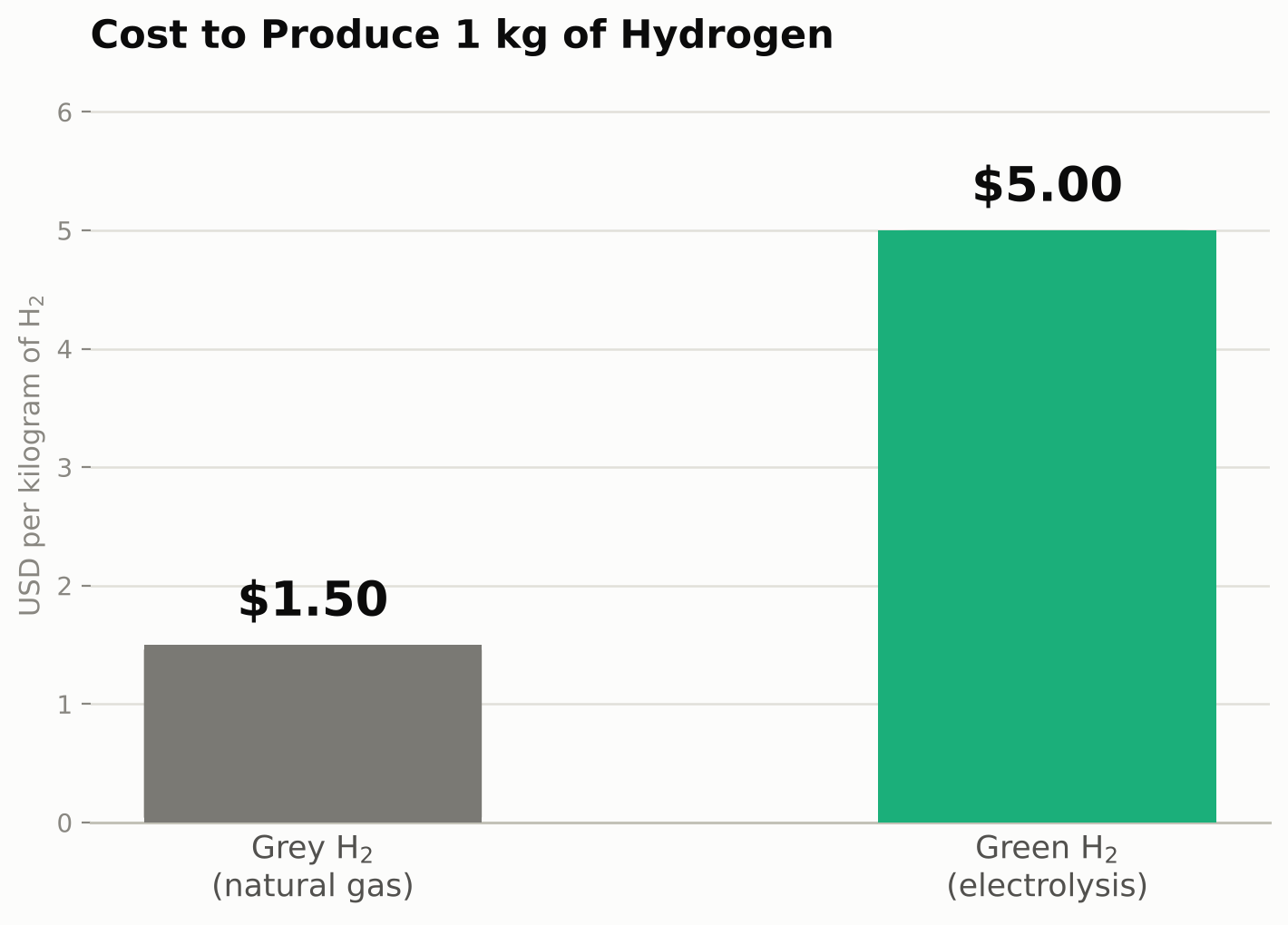
Hydrogen is widely discussed as a fuel for ships, heavy trucks, steelmaking, and chemical plants that are hard to run on batteries alone, since it can generate electricity in a fuel cell with water as the main byproduct. The catch is how the hydrogen gets made. Today, hydrogen production is dominated by fossil fuels, mostly natural gas processed through a method called steam-methane reforming, with coal gasification also contributing a significant share, particularly in parts of Asia. That hydrogen is relatively cheap, on the order of $1.50 per kilogram by Oregon State’s figures, but it releases carbon dioxide in the process, which undercuts much of the climate case for switching to hydrogen in the first place.
Hydrogen made by splitting water with renewable electricity or sunlight, often called green hydrogen, avoids that emissions problem, but it typically costs around $5 per kilogram today by the same estimate, more than three times as much. These are illustrative, broad figures rather than fixed prices; actual costs swing with local energy prices, plant scale, and technology. Still, part of the gap comes down to hardware: some electrolyzers and photocatalytic systems rely on precious-metal catalysts, platinum among them, to drive the reaction fast enough to be practical, and those materials are not cheap.
Catching Light With Sulfur, Not Metal
The Oregon State team, led by chemist Kyriakos Stylianou of the university’s Materials Discovery Laboratory, built a metal-organic framework, a class of crystalline, extremely porous materials assembled from metal ions linked together by organic molecules, that they call BVR-19. It forms spontaneously in water at room temperature, a synthesis route the researchers say avoids the high heat or pressure many materials need, though how that translates into a final production cost has not been established.
The structural feature that matters most sits inside BVR-19’s organic linkers: a bond between two sulfur atoms that briefly breaks apart when struck by light, generating short-lived, highly reactive sulfur species. According to Oregon State’s announcement, it is these organic, sulfur-containing building blocks that help capture light energy and move electrons to where hydrogen is ultimately produced, working alongside the framework’s metal centers rather than leaving the metal to do that job alone.
Metal-organic frameworks have drawn growing interest across chemistry over the past two decades because they are so tunable: change the metal, change the organic linker, and the pore size, surface area, and chemical behavior of the resulting crystal can shift dramatically, all within the same basic scaffold. That tunability is also what let the Oregon State team probe BVR-19’s inner workings, discussed next.
Skipping the Bolted-On Metal Catalyst
Photocatalytic water splitting conventionally needs more than a light-absorbing material: it usually also requires a separate metal co-catalyst, often platinum, physically attached to the structure to help the hydrogen-forming step run efficiently. Oregon State’s announcement describes BVR-19 as needing no additional expensive metal catalyst for that job, since its organic sulfur chemistry already contributes much of the light capture and electron transfer that a bolted-on catalyst would otherwise be doing.
That should not be read as “metal-free.” BVR-19 still contains a metal center as part of its crystalline framework, and the team found that changing which metal sits there measurably changed how well the material performed, meaning the metal is far from irrelevant to the chemistry. The real, narrower claim is that no extra, separately added metal catalyst has to be layered on top of the base material the way platinum often is in other systems. It is a distinction worth keeping straight, because the innovation here is removing an added manufacturing step and its cost, not removing metal chemistry from the picture entirely.
From One Experiment to Design Rules
To understand why some versions of the framework outperformed others, the team systematically swapped out the metal ion at BVR-19’s core while leaving the rest of the structure essentially unchanged, then compared how each version performed under light. That side-by-side comparison let them connect differences in hydrogen output to specific changes in the material’s electronic structure, giving them a mechanistic explanation for why certain versions work better rather than only an empirical ranking of which ones do.
“Our work provides a blueprint for designing better materials that can bring down the cost of green hydrogen,” Stylianou said in the university’s announcement of the findings. The team frames the result as a design principle to test and build on in future materials, rather than a finished, optimized catalyst.
Research groups elsewhere are taking a similar mechanism-first approach to other energy-relevant reactions. A Kyoto University-led team, for instance, recently worked out in detail why a molybdenum molecular catalyst can convert nitrogen from the air into ammonia under comparatively mild laboratory conditions. In both cases, the advance was not a brand-new chemical but a clearer picture of why an existing catalyst behaves the way it does, which is usually what lets chemists improve a material on purpose instead of by trial and error.
What Cheaper Hydrogen Could Unlock
None of this means cheap, catalyst-light green hydrogen is imminent. Oregon State’s announcement and the peer-reviewed paper describe a laboratory-scale material and a design principle, not a measured hydrogen production rate, an efficiency figure, or a path to manufacturing; those numbers were not disclosed publicly alongside the findings. The work has not been tested at anything resembling industrial scale, and getting from a promising crystal in a lab to a working photocatalytic reactor typically requires years of further development, stability testing, and engineering, assuming it clears each step at all.
What the study adds is a mechanistic foothold: evidence that letting an organic, sulfur-based structure share the light-absorbing and electron-transfer work can reduce a material’s dependence on costly bolted-on metal catalysts, at least in this framework, plus a method for figuring out which structural tweaks help and which do not. Whether that translates into cheaper hydrogen depends on factors the current study does not address, including the material’s hydrogen production rate, its durability over repeated use, and the cost of the reactor system built around it. If those later steps go well, incremental advances like this one, chipping away at the cost of individual components rather than reinventing hydrogen production overnight, are generally how energy technologies get cheaper over time. That is also what would let industries that are hard to electrify, such as steelmaking, shipping, and heavy trucking, lean more on low-carbon hydrogen instead of the fossil-derived hydrogen most of them use today.
The project was funded by the Murdock Charitable Trust, the National Science Foundation, and Oregon State’s College of Science. For now, the result lives in a peer-reviewed paper and a university announcement, with the follow-up work, refining BVR-19, measuring its efficiency, and testing its durability, still ahead.
Sources: Oregon State University, Journal of the American Chemical Society (DOI), ScienceDaily, Interesting Engineering
Leave a Reply