Tag: Glossary

  • [Science] What Is Backpropagation? A Simple Guide to How AI Learns

    [Science] What Is Backpropagation? A Simple Guide to How AI Learns

    Backpropagation is the algorithm that lets artificial neural networks learn from their own mistakes, and it quietly powers much of today’s AI — from chatbots that answer your questions to the apps that recognize a face in a photo. Understanding it, even at a basic level, is one of the clearest ways to understand how modern deep-learning systems actually learn.

    Original Paper

    Title: Learning representations by back-propagating errors
    Authors: David E. Rumelhart, Geoffrey E. Hinton, Ronald J. Williams
    Journal: Nature, Vol. 323, pp. 533–536 (1986)
    DOI: 10.1038/323533a0

    What Is Backpropagation, Exactly?

    In plain terms, backpropagation — short for “backward propagation of errors,” also known as error backpropagation — is a method for training a neural network by repeatedly working out how wrong its answer was, and in which direction each connection should adjust. A neural network is built from layers of simple, interconnected units (loosely inspired by neurons) joined by adjustable connection strengths called weights. When a network is first created, its weights are usually set to small, carefully chosen random values, so its first guesses are generally poor. Backpropagation is the procedure that turns that rough starting point into a network that can recognize a cat in a photo, translate a sentence, or predict the next word in a reply.

    There is one important distinction worth keeping straight: backpropagation calculates how much each connection contributed to the error, while a separate step called gradient descent uses that information to actually adjust the connections. People often use “backpropagation” loosely to describe the whole training process, but technically the two are different steps working together.

    How the Algorithm Actually Works

    Training with backpropagation happens in two passes. In the forward pass, an input — a photo, a sentence, a row of sensor data — moves through the network’s layers in order, and the network produces a prediction. That prediction is then compared with the correct answer using a loss function, a numerical measure of how far the prediction was from the desired result.

    Backpropagation doesn’t tell a network what to think. It tells the network how wrong it was, and in which direction each connection should move to be a little less wrong next time.

    A simple analogy helps before the math: imagine a product moving through several stages of a factory line, and the finished item turns out defective. To find the cause, managers work backward from the end of the line, and each stage reports how much it may have contributed to the problem, passing that information to the stage before it. The backward pass in backpropagation does something similar, except it uses calculus to work this out exactly. Starting at the output layer and moving back toward the input, the algorithm applies the chain rule — a technique for tracking how a change at one stage ripples through a chain of dependent calculations. Each layer combines information about how its own calculations affected the next layer with the error information passed back from that layer, producing a gradient: a measure of how sensitive the loss is to a small change in each weight, at its current value.
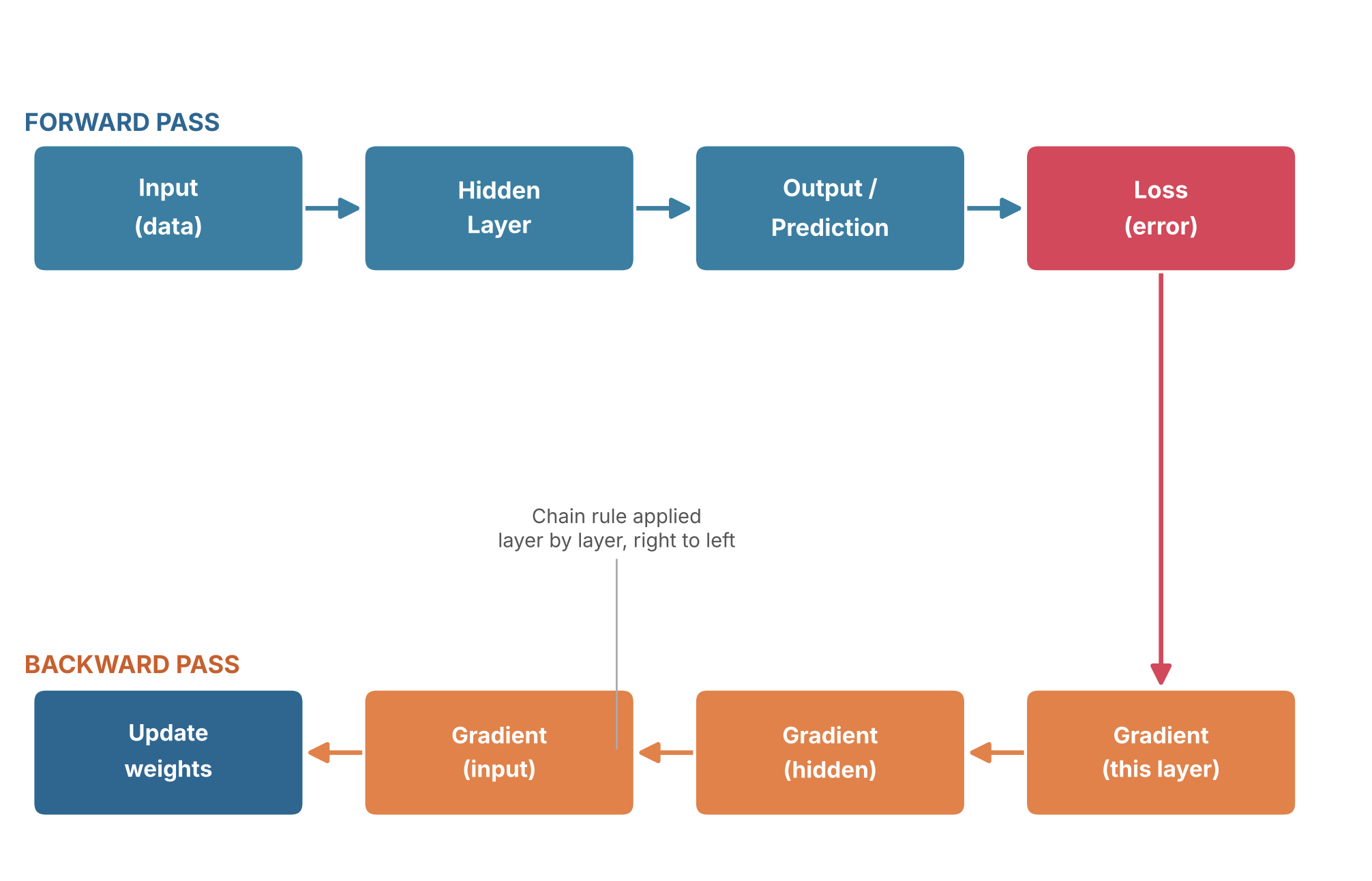
    Diagram of the forward pass and backward pass in backpropagation
    The forward pass produces a prediction and a loss; the backward pass applies the chain rule, layer by layer, to compute gradients and update the weights.

    Once every weight has a gradient, gradient descent uses it to actually update the weights, nudging each one a small amount in the direction that reduces the error. Repeat this forward-pass/backward-pass/update cycle over thousands or millions of examples, and a network that started with randomly initialized connections gradually comes to reflect real structure in the data. The appeal of backpropagation is efficiency: it calculates gradients for every weight in a network in roughly the time needed for a small number of forward and backward passes, rather than requiring a separate experiment for each individual weight.

    Why Backpropagation Is Getting Attention Again

    Backpropagation is not new, and its mathematical core had already been explored before it became famous. Reverse-mode automatic differentiation — the calculus technique at the heart of the algorithm — traces back to Finnish researcher Seppo Linnainmaa’s 1970 master’s thesis, and American researcher Paul Werbos proposed applying a related idea to neural networks in his 1974 doctoral thesis. The method became particularly influential after David Rumelhart, Geoffrey Hinton and Ronald Williams published “Learning representations by back-propagating errors” in Nature in 1986, demonstrating that it could let multilayer networks automatically discover useful internal features rather than relying entirely on engineers to design them by hand.

    For years afterward, backpropagation-trained networks were mostly a research curiosity, limited by available data and computing power. That changed dramatically in 2012, when Alex Krizhevsky and Ilya Sutskever, working with their advisor Geoffrey Hinton, combined backpropagation, the large labeled ImageNet dataset, and graphics-card computing power in a network known as AlexNet. It dramatically outperformed competing approaches in that year’s ImageNet image-recognition competition, a result widely credited with triggering the modern deep learning boom. The large language models behind today’s generative AI chatbots are, at their core, still trained with variations of the same algorithm.
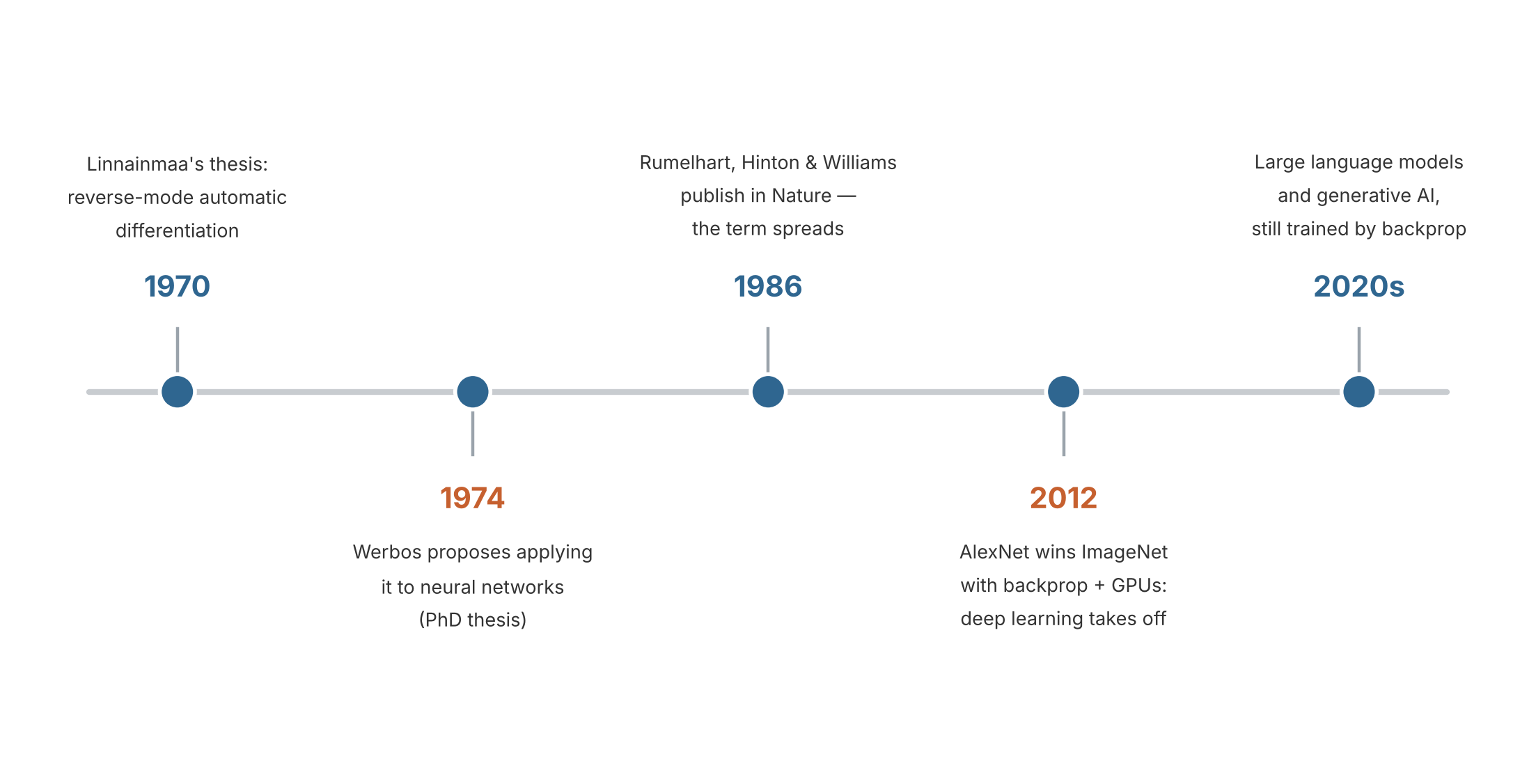
    Timeline of key milestones in the history of backpropagation, from 1970 to the 2020s
    Source: created based on Linnainmaa (1970), Werbos (1974), Rumelhart, Hinton & Williams, Nature (1986), and the AlexNet/ImageNet milestone (2012).

    What has put backpropagation back in the spotlight recently is a different question: does the brain do anything like this? In October 2026, a team at MIT’s McGovern Institute, led by Qianli Liao, Liu Ziyin and Yulu Gan with senior authors Mark Harnett and Tomaso Poggio, published a study in the Proceedings of the National Academy of Sciences proposing a computational model in which randomly connected artificial networks can self-organize their own forward and feedback pathways, using only local learning rules inspired by biological synapses and no global error signal — and still learn nearly as well as backpropagation on the tasks tested. The researchers are careful to frame this as a candidate mechanism and a testable hypothesis, not proof that real brains work this way, but it reopens a question that has nagged neuroscientists for roughly 40 years: backpropagation is clearly powerful enough to drive today’s AI, yet nothing in a biological brain has been shown to do precisely what it requires. (Related article: A Simulated Brain Circuit Builds Its Own AI-Like Learning System, MIT Finds.)

    Where You’ve Already Met Backpropagation

    Even though the math stays behind the scenes, the results of backpropagation-trained networks are part of ordinary life. Many modern face-unlock features and the photo apps that automatically group pictures of the same person run on neural networks trained with backpropagation or related gradient-based methods. Voice assistants that transcribe speech or answer spoken questions generally rely on networks trained the same way. Generative AI chatbots are also built using neural networks trained with backpropagation — during an early stage called pretraining, for example, a language model repeatedly tries to predict the next word in a passage of text, compares its guess with the actual word, and adjusts its weights to reduce the error; later training stages then refine how it follows instructions and responds to feedback.

    It’s worth keeping one distinction in mind: backpropagation mainly happens during training, not every time you use these tools. Once a network has learned, it typically uses its already-adjusted weights to make predictions, without recalculating gradients or updating itself each time — the heavy lifting happened earlier, often across billions of training examples.

    What to Watch Next

    Backpropagation itself is a mature, well-understood technique, so the open questions now sit in its limitations and the alternatives researchers are exploring. One is scientific: whether the MIT team’s self-organizing, locally-plausible learning circuits — or related approaches sometimes called feedback alignment or predictive coding — can be tested directly against real neural tissue, and whether they can match backpropagation’s performance on problems much larger than the ones tested so far. Another is practical: as AI models keep growing, researchers continue to look for training methods that need less computing power than standard backpropagation while keeping its accuracy. The next breakthrough may not come from making backpropagation itself faster, but from discovering how networks can learn without depending on it so completely — which is exactly the question AI researchers and neuroscientists are now asking together.

    Xsciens Editorial Note

    Backpropagation is best understood as a precise bookkeeping trick for calculating how a network should adjust itself, not as a theory of how any brain, artificial or biological, actually “thinks.”

    • A common misconception. “Neural network” learning is often described as though it copies how the brain learns, since artificial “neurons” were loosely inspired by biological ones. In practice, standard backpropagation’s backward calculation relies on precise weight-related information tied to the exact connections used for forward signaling — something no real neuron is known to reproduce or transmit in the same way. (Some alternative methods, such as feedback alignment, relax this requirement, which is itself a sign of how specific the original objection is.) The resemblance between artificial and biological “neurons” is a loose analogy, not a working description of what either one computes.
    • Limits and open questions. A common misreading is that backpropagation always needs a human-provided “correct answer,” like a teacher grading homework. That’s not quite right: it needs a differentiable training objective, which can come from supervised labels, but also from self-supervised tasks (such as predicting the next word in a sentence) or reinforcement-style rewards. What backpropagation does not explain, on its own, is why some network architectures generalize well to new data and others don’t, or how an AI system might decide what is worth learning in the first place — those remain active, only partly answered research questions, not settled ones.
    • What to watch next. The MIT team’s October 2026 study proposes, as a specific and testable hypothesis, that a four-synapse wiring motif linking ascending and descending pathways in the cortex could let real circuits self-organize a similar learning ability. This is a model prediction, not a confirmed feature of brain tissue — whether neuroscientists actually find that wiring pattern, and whether locally-plausible learning rules can match backpropagation’s performance on problems far larger than the ones tested so far, are the two developments worth watching.
    • From the editors — If brain-inspired, locally-learning AI matures the way this MIT team hopes, the assistants people use every day could stop feeling like blank tools that need re-explaining each time and start quietly adapting to how each person actually works. Getting there would likely mean systems that keep adjusting themselves after they leave the lab, learning from ordinary daily use instead of one big retraining cycle. That same ability to keep learning on its own is exactly what to watch: without a way to check what a system has quietly picked up, it could just as easily drift toward learning the wrong lesson from unusual or misleading experience. This is still an early computational demonstration, not a finished product — so if an assistant ever starts to feel like it “gets” you a little faster, it’s worth asking, every so often, what it actually learned to get there.

    References for this note: Quanta Magazine — Artificial Neural Nets Finally Yield Clues to How Brains Learn, arXiv — Brain-Inspired Machine Intelligence: A Survey of Neurobiologically-Plausible Credit Assignment

    Sources: IBM — What Is Backpropagation?, TechTarget — What Is a Backpropagation Algorithm?, Rumelhart, Hinton & Williams, Nature (1986), Seppo Linnainmaa, Computer History Museum — AlexNet Source Code, Xsciens — A Simulated Brain Circuit Builds Its Own AI-Like Learning System, MIT Finds
  • [Science] What Is a Supramolecular Polymer? A Simple Guide to How It Works

    [Science] What Is a Supramolecular Polymer? A Simple Guide to How It Works

    A supramolecular polymer is a chain-like material whose building blocks link up through weak, reversible attractions instead of strong, fixed chemical bonds. That “weak but many” design can let these materials repair damage, change shape, and influence how living cells grow — which is why materials scientists have been racing to build bigger, more precisely controlled versions of them.

    What Is a Supramolecular Polymer?

    A conventional polymer — the plastic in a water bottle, for example — is a long chain of small repeating units called monomers, welded together end-to-end by covalent bonds. Covalent bonds are the strong, electron-sharing connections that hold most everyday molecules together, and once formed they generally don’t come apart on their own.

    A supramolecular polymer (a term built from “supra-,” meaning “beyond,” plus “molecular”) swaps those permanent welds for temporary handshakes. Its monomers link up through noncovalent interactions — hydrogen bonds, stacked ring structures, metal-ion bridges, or simple electrical attraction — that are individually weak but, strung together by the thousands along a chain, add up to a stable, functional material. A useful everyday comparison is Velcro: a single hook-and-loop pair peels apart with almost no effort, but a whole strip of them holds a heavy jacket closed. Supramolecular polymers work the same way at the molecular scale — weak links in large numbers behave like a strong, yet reversible, material.

    IUPAC’s 2013 polymer-science recommendations favor the term “supramolecular association” (also called “Lehn association,” after chemist Jean-Marie Lehn) for this self-assembly process, and discourage the related term “supramolecular polymerization.” That is a naming preference for the process, not a rejection of the material-class name: “supramolecular polymer” remains the term used throughout the chemistry and materials literature — including in the title of the 2026 Northwestern University paper described below — so this article uses it in that common sense.

    How the Self-Assembly Works

    Because the bonds holding a supramolecular polymer together are reversible, individual connections continually break and re-form, letting the material adjust to its surroundings without necessarily falling apart. When the damaged surfaces of such a material can come back into contact and the molecules are mobile enough, those reversible interactions can reconnect across the damage — the basis for self-healing in some (not all) supramolecular materials; how well it works depends heavily on the specific design. According to a 2024 overview from the Society of Plastics Engineers, this same dynamic bonding can also let certain supramolecular polymers flow or be reshaped more easily than conventional plastics, though the exact processing temperature and pressure still depend on the molecular design in question.

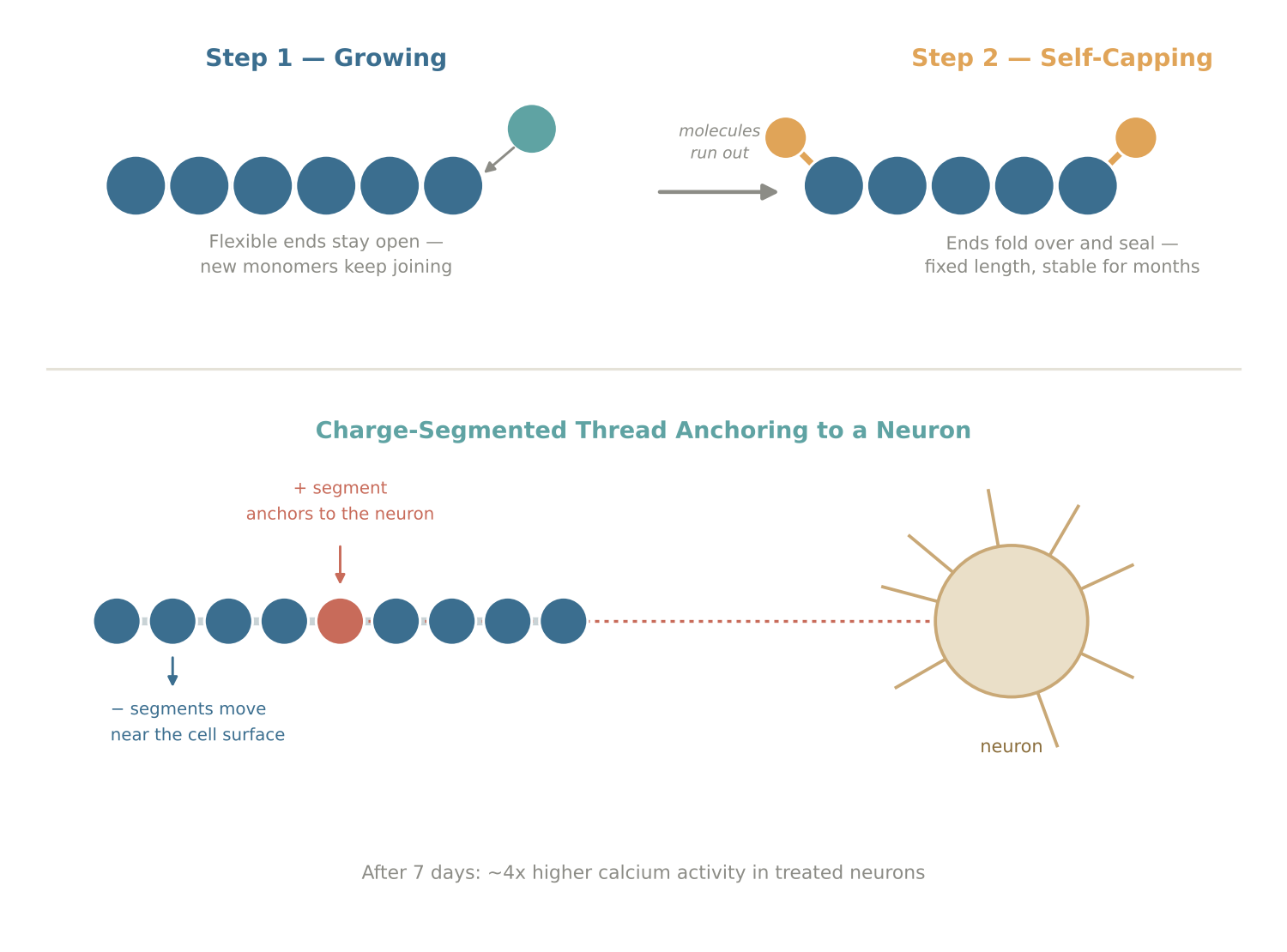
    Chemists have also learned to design chains that grow to a controlled length and then stop. One such strategy, demonstrated in an October 2026 study from Northwestern University, is called self-capping supramolecular polymerization. The molecular design lets a growing thread’s flexible ends keep adding building blocks while conditions allow it, then fold over and form a cap that limits further growth. Introducing a fresh batch of building blocks can restart the process, which lets researchers extend the assembly and arrange distinct segments along its length.

    Getting this right is a balancing act. If the building blocks do not bind to each other strongly enough under the given conditions, only short, unstable clusters form. If the interactions are too strong, the material can lose the ability to rearrange that makes supramolecular polymers useful in the first place. Scientists must also keep growing chains from fusing together unpredictably or slowly falling back apart — failure modes that, together with this binding-strength trade-off, are much of what makes precise supramolecular engineering difficult.

    Why It’s Getting Attention Now

    Supramolecular polymers have been studied since the late 1980s. In 1988, chemist Takuzo Aida and colleagues reported one of the field’s early milestones: disc-shaped porphyrin molecules that stacked face-to-face into one-dimensional assemblies through noncovalent interactions. Chemist Jean Fréchet’s group then used hydrogen bonds to build liquid-crystalline supramolecular structures in 1989, and Nobel laureate Jean-Marie Lehn’s group demonstrated hydrogen-bonded, liquid-crystalline supramolecular polymers in 1990. Chemist Bert Meijer’s widely cited 1997 work on four-point hydrogen-bonded monomers then showed that noncovalent assemblies could behave mechanically like true high-molecular-weight polymers. What has changed since then is precision: for decades, supramolecular polymers tended to form with uneven, hard-to-control lengths, which limited how reliably their properties could be engineered for a specific application.

    That is the gap the Northwestern team, led by materials scientist Samuel I. Stupp with postdoctoral fellow Michael Dore and graduate students Simon Egner and Madison Strong, targeted in a study published October 1, 2026, in the journal Science. Using self-capping, they built threads with molar masses reaching into the billions of daltons — roughly 100 times heavier, by the university’s own comparison, than large conventional polymers or the largest known natural proteins, with the longest threads wider than a single cell. According to the researchers, the threads kept their controlled length for months in a test tube without clumping, merging, or dissolving back apart under the tested conditions, something earlier, less-controlled supramolecular polymers struggled to do.

    “That introduces a very different way of thinking about how materials can communicate with cells,” said Northwestern’s Samuel I. Stupp of the findings.

    Diagram showing self-capping supramolecular polymerization and a charge-segmented thread anchoring to a neuron
    Source: created based on Dore et al., Science (2026) and Northwestern University’s press release.

    Uses: Self-Healing Plastics to Neurons

    The reversible bonding at the heart of supramolecular polymers already points toward several practical uses. Self-healing coatings and parts for construction, automotive, and aerospace use could extend equipment lifespans by letting small cracks mend themselves rather than requiring replacement. Stimuli-responsive versions are being explored as drug-delivery carriers that release their cargo only when they encounter a specific biological trigger, such as a change in pH inside the body, and supramolecular hydrogels — soft, water-swollen networks — are used as scaffolds in tissue engineering to support growing cells. Researchers are also testing supramolecular designs in adaptive coatings that resist corrosion and wear, and in soft robotics, where flexible, responsive materials can mimic the give-and-take of biological tissue.

    The Northwestern study adds a striking new example. The team tested several charge patterns on neurons grown in lab dishes: threads made entirely of positively charged segments harmed the cells, threads made entirely of negative segments had little effect, and randomly mixed charges produced no notable response. Only one design worked well — a short positively charged segment sandwiched between two longer negatively charged segments, which anchored the thread to the negatively charged neuron surface. In that condition, neurons showed roughly four times more measured calcium activity (an indicator of cellular signaling, though not a direct measure of overall neuronal function) after one week, and had formed more synaptic connections by two weeks, without the researchers adding any conventional biological growth factors. The researchers caution that this is cell-culture work only, with no animal or human testing yet, so any medical application for nerve repair remains a long-term prospect rather than a near-term product.

    What to Watch Next

    Market research firm Transparency Market Research estimated the global supramolecular polymer market at roughly $291.5 million in 2024, projecting about 6.5% annual growth through 2031. The more scientifically telling milestone to watch, though, is whether precisely built, billion-dalton threads like Northwestern’s can be scaled up and tested in living animals, not just lab dishes.

    For more on the specific billion-dalton threads discussed above and how they boosted nerve-cell activity in the lab, see our related article: Scientists Build a Billion-Dalton Molecular Thread Longer Than a Cell.

    Sources: Northwestern University (Weinberg College), EurekAlert! press release, IUPAC Gold Book

  • [Science] What Is Cognitive Offloading? A Simple Guide to How It Works

    [Science] What Is Cognitive Offloading? A Simple Guide to How It Works

    Every time you set a phone reminder instead of memorizing an appointment, or ask a chatbot to summarize a report instead of reading it yourself, you are doing something psychologists call cognitive offloading. The habit itself is ancient, but a wave of recent research is asking a sharper question: what happens to our own performance in the moments when the tool isn’t there?

    Source Paper
    Title: Cognitive Offloading
    Authors: Evan F. Risko, Sam J. Gilbert
    Journal: Trends in Cognitive Sciences, Vol. 20, No. 9, pp. 676–688 (2016)
    DOI: 10.1016/j.tics.2016.07.002

    What Is Cognitive Offloading?

    Cognitive offloading is the use of physical action or an external tool to reduce the mental effort a task would otherwise require. Psychologists Evan Risko (University of Waterloo) and Sam Gilbert (University College London) published an influential review of the concept in 2016, in Trends in Cognitive Sciences, which remains the field’s clearest framework for the idea. Rather than solving a problem entirely “in your head,” you shift part of the work onto your body or your environment.

    It’s a far older behavior than smartphones. Tilting your head to read an upside-down sign, counting on your fingers, or jotting a phone number on a scrap of paper are all forms of cognitive offloading. What has changed is the scale and power of the tools available — calculators, GPS, search engines, and now generative AI assistants can take over not just small chores but entire chains of reasoning.

    The idea is closely related to the “extended mind” thesis, proposed by philosophers Andy Clark and David Chalmers in 1998. They argued that a notebook carried everywhere and consulted automatically can function, for practical purposes, as part of a person’s memory system — their famous example involved a man named Otto who used a notebook the way most people use their own recall. Risko and Gilbert’s later work gave this philosophical idea an empirical, testable framework: when exactly do people choose to offload, and what happens to their underlying skills when they do it repeatedly?

    How It Works: A Decision Loop, Not a Switch

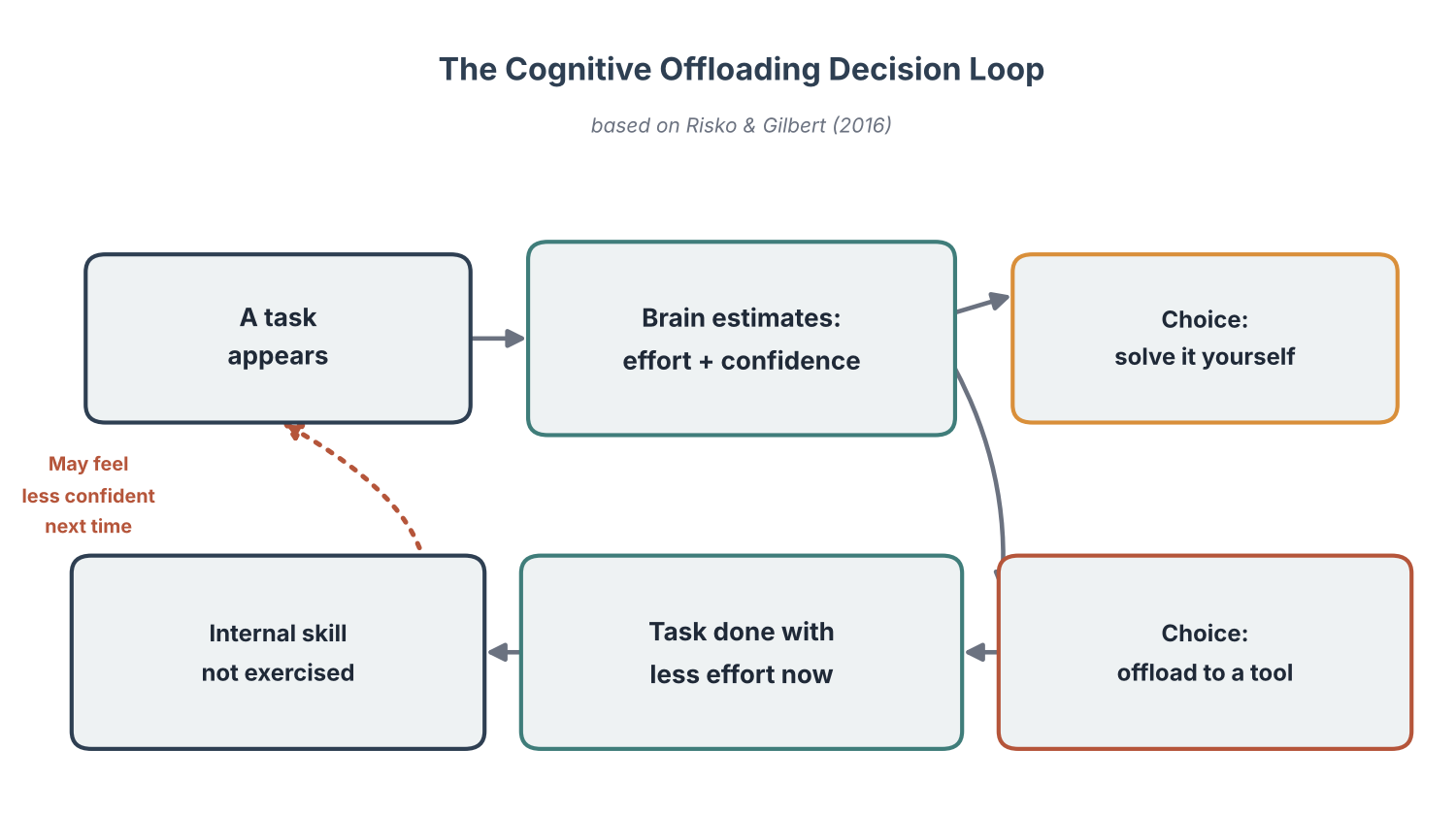
    Imagine being asked to remember five errands on the way home. You could hold them all in mind, or you could write them down. Risko and Gilbert’s framework treats this as a running cost-benefit calculation rather than a one-time choice: the decision depends on how demanding the task feels, how confident you are in your own memory, and how much effort writing the list would save.

    The important detail is that this calculation runs on perceived demand and confidence, not necessarily on actual ability — and people’s self-assessments can be mistaken, so they sometimes reach for an external aid even when they could have managed without it. Whether repeated reliance on a tool gradually changes a person’s confidence or unaided performance over the longer term is a related but separate question, one that is harder to answer than the moment-to-moment decision itself. Offloading isn’t inherently a problem — compensating for a busy week with a written list is a perfectly sensible trade — but it is a trade worth noticing rather than making automatically.

    Diagram of the cognitive offloading decision loop
    Source: created based on Risko & Gilbert (2016), Trends in Cognitive Sciences

    Why It’s Back in the Spotlight Now

    Cognitive offloading has been studied for decades, but generative AI has pushed it from a niche academic topic into a mainstream concern. A widely discussed 2011 study in Science by Betsy Sparrow, Jenny Liu, and Daniel Wegner found that once people believed information would remain accessible online, they remembered where to find it far better than the information itself — a pattern nicknamed the “Google effect.” That study is a useful historical analogy rather than direct proof of what AI chatbots do to the brain: a search engine mainly stores and retrieves information, while an AI assistant can also perform reasoning-like tasks, draft text, and summarize on a person’s behalf, which is a different kind of delegation that researchers are only beginning to study on its own terms.

    The question researchers are now asking is not whether people offload thinking to AI, but how much of their own judgment they lose when the AI isn’t there.

    A 2025 study published in Societies by Michael Gerlich surveyed 666 participants and reported a statistically significant negative correlation between frequent AI tool use and scores on critical-thinking tasks, with younger, more AI-reliant participants scoring lowest. Because the study measured AI use and critical-thinking ability at a single point in time, it cannot determine whether frequent AI use weakens critical thinking, whether people with different existing abilities simply use AI differently, or whether some other factor explains both — but it adds to a growing body of research raising the same question from different angles.

    Everyday Examples You Already Use

    Cognitive offloading shows up in ordinary moments far more often than most people realize. A few familiar examples: writing a shopping list instead of memorizing items, letting a smartphone calendar track every appointment, typing a destination into GPS navigation instead of memorizing the route, and asking a search engine a factual question instead of trying to recall it. In most of these cases the trade is a fair one — a shopping list, for instance, tends to help you finish the errand without costing you much else. The more interesting question researchers are asking is which kinds of offloading are closer to that fair trade, and which carry a greater cost to independent performance later on.

    A 2020 study in Scientific Reports, led by Louisa Dahmani and Véronique Bohbot at McGill University, examined this trade-off directly with GPS. In a sample of 50 regular drivers, heavier GPS use was associated with weaker spatial memory on unaided navigation tasks. A smaller follow-up of 13 of the same participants about three years later found that people whose GPS use had grown the most over that period also showed the steepest declines in spatial memory — a dose-response pattern the authors say is more consistent with GPS use contributing to the decline than the reverse, though they are careful to flag their small sample size and note that the direction of cause and effect is not fully settled.

    Not every example involves memory. Risko and Gilbert’s framework also covers offloading onto the body itself — pointing at an object instead of holding its location in mind, or using a finger to keep a place while reading a long list — and “intention offloading,” where a sticky note or phone alert carries the job of remembering to act later, rather than the job of remembering the information itself. A related but distinct idea is automation, where a system completes part of a task with no decision from the user at all. A GPS app that both tracks your route and reroutes you around traffic without being asked is doing more than simple offloading; it raises its own, separate questions about what happens to a skill when a person is never required to exercise it in the first place.

    What Recent Research Shows

    The clearest recent demonstration comes from a UC Berkeley–led study published in 2026. Researchers ran three randomized trials with 1,222 participants who solved math and reading problems either with or without ChatGPT. Everyone then had to solve a final set of problems entirely unaided. Participants who had previously relied on the AI scored markedly lower on those unaided problems than participants who had worked alone from the start — in one trial, 57% versus 73% correct. Related article: AI Assistance Reduces Persistence and Hurts Independent Performance looks at this study’s full results and the researchers’ own caveats about how far the findings generalize.

    None of this means offloading is simply bad. In a self-reported, non-randomized part of the same study, participants who said they had copied AI-generated answers directly scored the lowest on the unaided follow-up problems (65% correct on average), while participants who said they had used the AI only for hints scored close to those who never used AI at all. Because that comparison is based on what participants reported about their own behavior rather than a randomized condition, it should be read as a suggestive pattern rather than a proven result. Still, it points toward a recurring theme across this research: the question is less whether to offload and more how — leaning on a tool for a finished answer looks different, in its effects, from using it as a scaffold while you still do the thinking yourself.

    Sources: Risko & Gilbert, “Cognitive Offloading,” Trends in Cognitive Sciences (2016), Gerlich, “AI Tools in Society,” Societies (2025), Columbia News on Sparrow et al., Science (2011), American Psychological Association Monitor (2026)

    See also: Why Letting AI Help Can Erode Your Grit and AI Summaries Can Distort Human Memory.