- If low fertility stays lower than some population projections assume, estimates of future workers, taxpayers, and pension contributors may need to be revised — a question that matters for anyone planning decades ahead.
- Economists analyzed more than 70 years of global fertility data, plus detailed regional records from Japan, the United States, and India.
- Across every dataset they checked — including all 47 of Japan’s prefectures — the researchers found no clear evidence of a stable, low fertility level at which decline reliably stopped.
- This is a historical statistical pattern, not a guaranteed future: fertility could still stabilize in particular places, and the researchers themselves stress that this is about the evidence so far, not a prediction.
A Question Buried Inside Every Population Forecast
Long-range population projections produced by international organizations and government agencies sometimes build in a particular assumption: in countries where fertility has fallen very low, it will eventually stop declining and roughly stabilize — often somewhere near the “replacement” level, around 2.1 children per woman in a population with today’s typical mortality rates, the rough rate needed to keep a population steady over the long run without migration. Pension systems and long-term corporate planning often lean on projections like these, which is part of why the assumptions behind them matter.
A new study tests that assumption against the historical record. In a National Bureau of Economic Research (NBER) working paper titled “Does Fertility Stabilize At Low Levels? Evidence from Period, Cohort, and Subnational Data,” economists Diane Coffey, Michael Geruso, Dean Spears, and Sangita Vyas ask a direct question: once fertility drops low, does it actually stop falling anywhere, or does it keep drifting down? Geruso and Spears also present a related analysis in a separate peer-reviewed article in the Journal of Economic Perspectives — a different paper, by two of the four authors, under a different title, rather than a peer-reviewed version of the same NBER study.
Their conclusion: across the historical data, they found no robust evidence of a fertility level at which decline reliably stops or reverses. That holds globally, and it holds in the three countries — Japan, the United States, and India — where they examined the data region by region.
Three Countries, One Shared Pattern
The researchers combined three different kinds of evidence to examine the same question.
First, they used “period” total fertility rate (TFR) data — a snapshot measure based on the fertility rates observed among women of different ages in a given year — for nearly every country in the world from 1950 to 2023, drawing on United Nations figures. Second, they looked at completed “cohort” fertility — the actual average number of children women in a given birth cohort had over their entire reproductive lives — using records for 31 countries, covering women born between 1935 and 1975. Third, they zoomed into regions within three countries: Japan’s 47 prefectures, individual U.S. states, and 351 districts in India.
The same pattern showed up at every level. Worldwide, fertility fell from about five children per woman in 1950 to a little above two by 2023, and roughly two-thirds of the world’s population now lives in a country below the replacement level. Across the range of relatively low starting fertility levels in the data — from about 2.3 down to about 1.3 children per woman — the researchers found no point where fertility reliably flattened out afterward.
In Japan, the median of the 47 prefectures’ fertility rates was 1.53 children per woman in 2015. From that starting point, fertility fell further over the next five years in each of Japan’s 47 prefectures, with no exceptions — not in prefectures that still had comparatively higher rates, and not in the ones that already had Japan’s lowest fertility.
In U.S. states, the researchers found that, looking at data since 2010, fertility declined on average across every starting fertility level they examined. In India, where fertility is generally higher than in Japan or the U.S., the relationship between a district’s starting fertility and its subsequent change was negative across the entire range of 351 districts studied.
A Counterintuitive Pattern: Declines Weren’t Slower Near Replacement
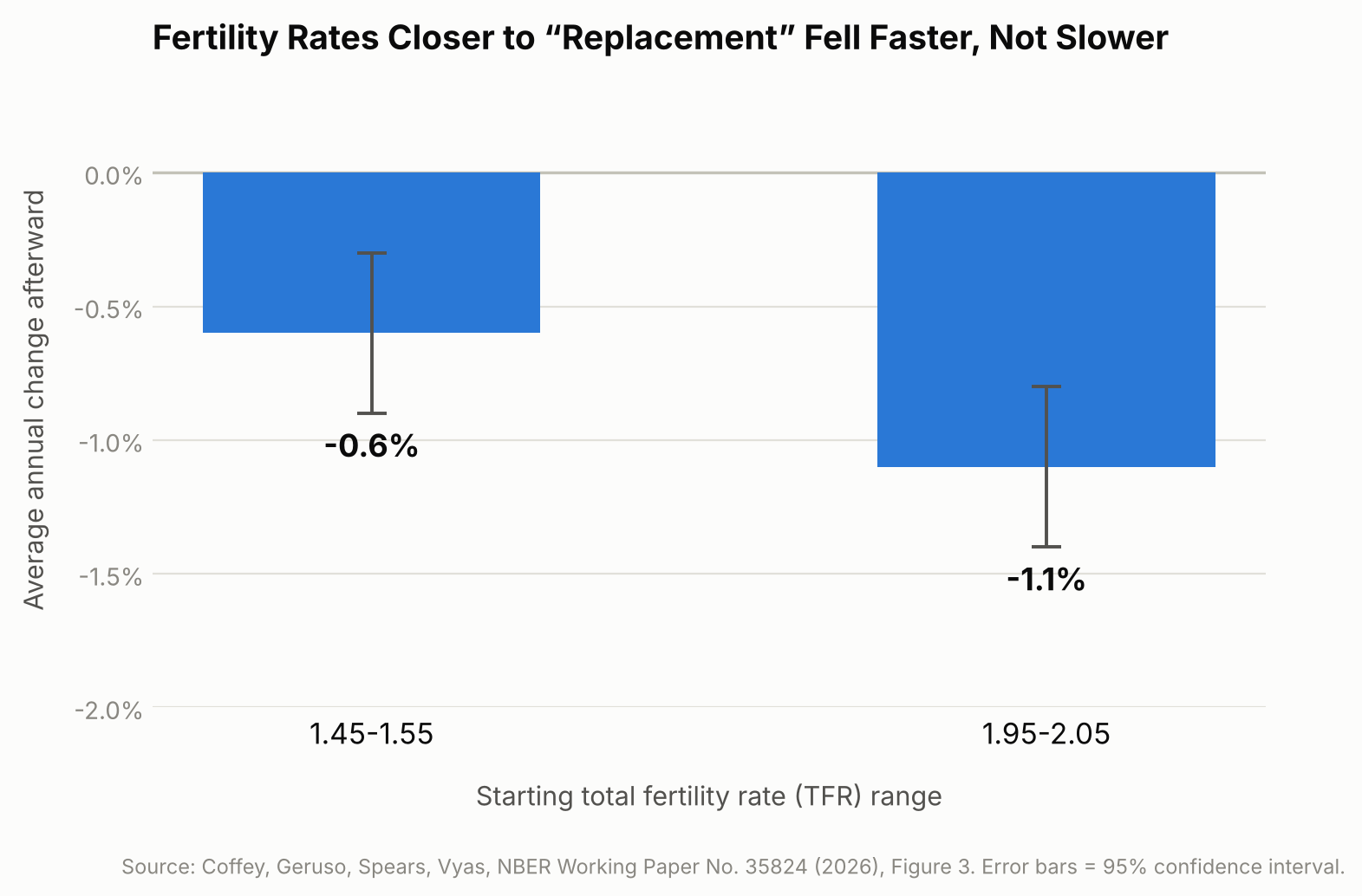
One result stood out. If fertility really did settle near a natural equilibrium close to the replacement level, you might expect fertility sitting right around that level to decline more gently than fertility already well below it — the closer to a “floor,” the gentler the slope should be.
A pattern where declines slow down as fertility approaches a “floor” did not show up. If anything, the opposite did. Looking at all the country-year observations worldwide from 1950 to 2023, the researchers calculated that fertility rates starting between 1.95 and 2.05 — almost exactly the replacement level — fell by an average of 1.1% per year afterward (a percentage change relative to the starting rate, not a drop of 1.1 children). Rates already lower, between 1.45 and 1.55, fell more slowly, by about 0.6% per year. This is a descriptive pattern in the historical data, not evidence that sitting near replacement fertility itself causes a faster decline; mainly, it argues against replacement level acting as a natural resting point for fertility.
Why This Matters Beyond Academic Debate
This isn’t just an academic curiosity — it bears on economic planning. Pension systems, healthcare budgets, housing demand, and labor-force projections all rest on assumptions about how many future workers and taxpayers a country will have, and some population projections used by international and government agencies build in an assumption that fertility eventually stops falling.
The study itself doesn’t forecast Japan’s future workforce, pension finances, or infrastructure needs — those depend on many other factors too, including life expectancy, retirement ages, labor-force participation, and migration. But if the historical pattern the researchers identify continues, projections that assume fertility will automatically stabilize may be worth re-examining in light of that pattern, which is relevant anywhere — Japan included — that is already planning for an aging, shrinking working-age population. The authors suggest that standard population projections are best read as conditional scenarios built on chosen assumptions, not as confident predictions of what will actually happen.
The researchers write: “There is no robust evidence for a systematic fertility rebound, or for a stable equilibrium point at any fertility level conventionally assumed.”
What This Research Doesn’t Tell Us
A few limits matter here. First, this is a study of statistical patterns across the past, not a law of nature — it describes what has generally happened, not what must happen everywhere going forward; fertility could still stabilize or even rise in particular places. Second, the authors note that government programs designed to encourage childbirth can shift short-term “period” fertility statistics without necessarily changing how many children women ultimately have over their lifetimes — so a policy might appear to be working in a given year’s data without reversing the longer-run trend. Third, fertility decline and population decline are not the same thing: because of factors like population age structure and migration, a country’s workforce and total population can keep growing for years even after fertility drops below replacement, so the effects described here play out over decades, not immediately.
Sources: NBER Working Paper No. 35824 (Coffey, Geruso, Spears, Vyas, 2026), Journal of Economic Perspectives, Vol. 40, No. 1 (Geruso & Spears, 2026)
Leave a Reply