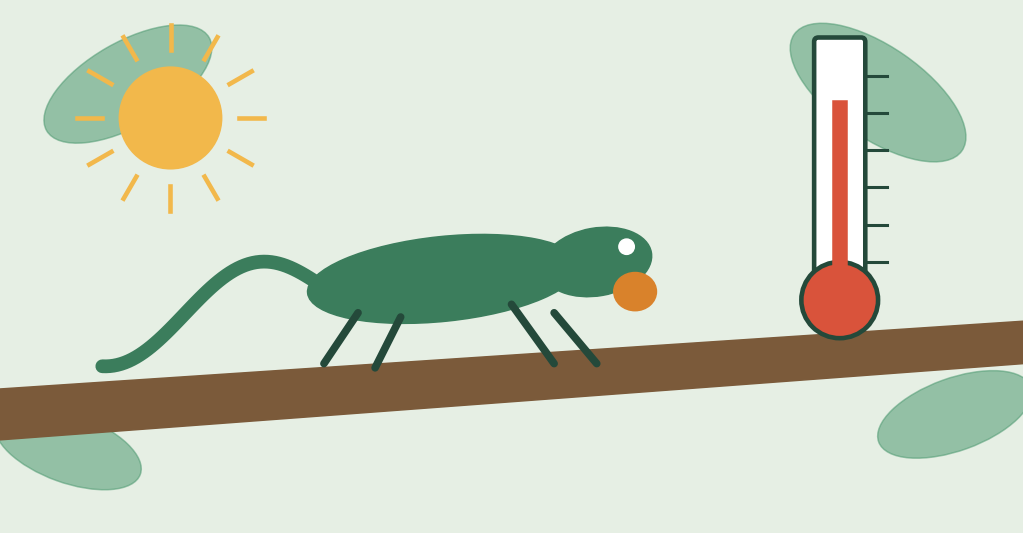
Lizards living deep in Caribbean forests can now tolerate about 2°C more heat than their counterparts a decade ago, while species that can step into cooler spots barely changed. The contrast, reported by a Yale-led team in PNAS, suggests that an animal’s habitat and its ability to regulate body temperature through behavior may influence how quickly its heat tolerance changes in a warming world.
Title: “Thermal ecology drives alternate responses to rising temperatures in Caribbean anoles”
Authors: Saúl F. Domínguez-Guerrero et al.
Journal: Proceedings of the National Academy of Sciences (2026)
DOI: 10.1073/pnas.2537152123
What the team found
Researchers led by Saúl Domínguez-Guerrero and Martha Muñoz at Yale University compared how well 16 species of Caribbean anoles, small tree-dwelling lizards, handle extreme heat. The species live on three islands: Hispaniola, Jamaica and Puerto Rico.
The team did not set out to catch evolution in action. They were studying how behavior shapes physiology, and they expected familiar results. Back in New Haven, though, the temperature data told an unexpected story, and a colleague’s offhand remark that something looked “weird” turned into the paper.
The measure at the center of the study is the critical thermal maximum, or CTmax: roughly, the highest body temperature an animal can tolerate before reaching a defined point of impairment in an experiment. It is a measured threshold, not a prediction of the temperature that would kill the animal. Earlier teams had measured it for the same group of species on the same islands in 2011–2013. The Yale team repeated the work in 2022–2025, giving them a before-and-after comparison across roughly a decade.
Not every species moved the same way
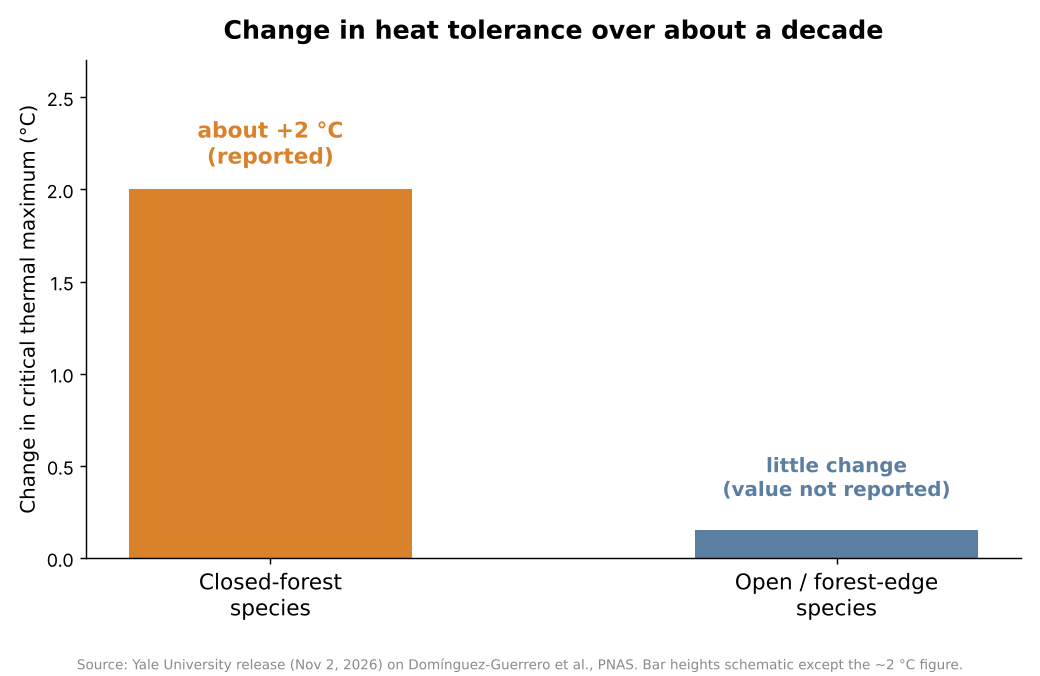
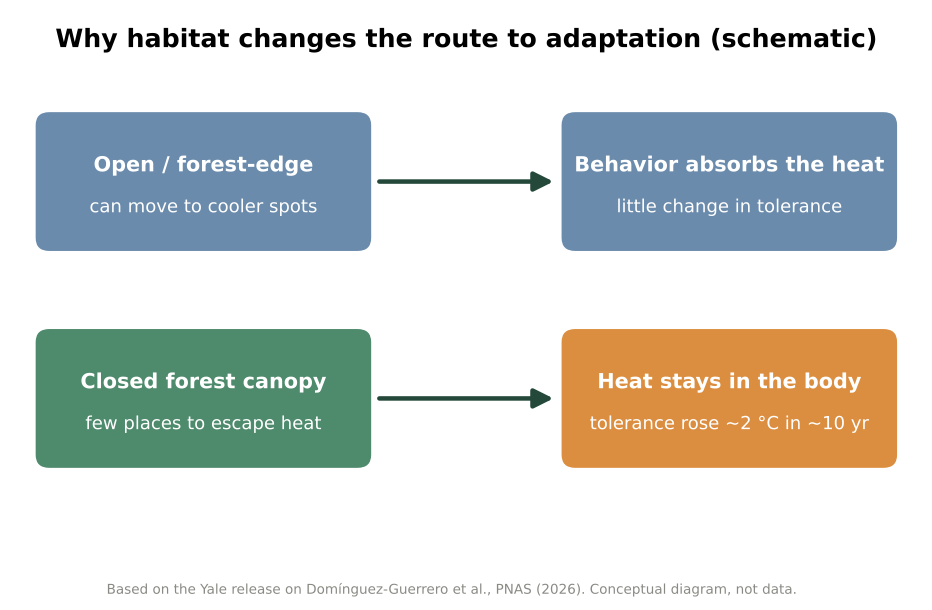
The surprise was that the shifts were not uniform. Species in open or forest-edge habitats showed little change in heat tolerance. These lizards can move into shade or onto cooler perches, which helps keep their body temperatures in a suitable range. This strategy is known as behavioral thermoregulation.
Species deep in closed forest canopy told a different story. With far fewer ways to escape the heat, their heat tolerance rose by about 2°C over the decade. According to the researchers, thermal ecology, meaning how an animal navigates the temperatures available in its environment, predicted these changes better than evolutionary relatedness or geographic closeness did.
Why habitat matters
An animal that can move into cooler surroundings may reduce its exposure to extreme heat, which lessens the pressure on its body to become more heat-tolerant. But when cooler places are scarce or hard to reach, the animal has fewer ways to avoid overheating, and stronger pressure for physiological change may follow. In the researchers’ words, behavior may help determine not only how animals respond to environmental change, but also how quickly they evolve.
Behavior as a buffer and a brake
This logic echoes older work. In a 2003 paper in The American Naturalist, Raymond Huey and colleagues described how thermoregulatory behavior can reduce the selection pressure for changes in thermal physiology, an effect they called the Bogert effect. A 2014 PNAS study led by Jennifer Sunday, covering 296 species of cold-blooded animals, found that heat-tolerance limits are broadly similar across latitude and elevation, that tropical species lean more on behavior such as seeking shade, and that few species have much spare heat tolerance.
Against that background, the Yale study adds a before-and-after comparison, over a decade, of closely related lizards that differ in their opportunities for behavioral thermoregulation.
The team also tested lizard offspring to see whether the higher heat tolerance can be inherited. The Yale release does not detail the outcome, so readers who want the answer should consult the paper itself. In follow-up work mentioned by the researchers, similar patterns appear in lizard populations in Mexico, and frog tadpoles in temperature-stable ponds also seem to be gaining heat tolerance. Those observations were described only briefly.
Not an escape hatch
Lead author Domínguez-Guerrero cautions that both behavioral and physiological responses have limits. “These lizards may be racing to keep up,” he said, but they may eventually hit an “evolutionary ceiling,” a point beyond which their bodies can no longer adapt. The study did not establish where such a ceiling lies; the term is the researcher’s warning rather than a measured result.
Rapid increases in heat tolerance in some species do not mean climate warming is harmless for reptiles. They show that different species respond in different ways, and that some may be better placed to cope than others.
Xsciens Editorial Note
Core point: lizards that cannot escape heat gained about 2°C of heat tolerance in ten years, while species with cooler hiding places changed little.
- Observation versus interpretation. What was measured is the upper heat limit of 16 species at two points in time, 2011–2013 and 2022–2025. A before-and-after comparison alone cannot separate genetic evolution from flexible adjustment within an animal’s lifetime, so calling the change “adaptation” is the researchers’ interpretation. The roughly 2°C figure is for closed-forest species as a group, not every species.
- Limits. The study compares two measurement periods rather than tracking the lizards continuously, and covers 16 species on three islands, so the pattern may not hold for all animals. We worked from the university release and news coverage because the full paper was not accessible to us, so details such as sample sizes per species were not available. The Mexico lizard and tadpole findings were mentioned only briefly.
- What to watch next. How much of the change is heritable, whether other regions and animal groups show the same split, and how far heat tolerance can rise before physiological limits are reached. The 2014 survey of 296 species found few with much spare heat tolerance.
- From the editors — a shady patch of forest may be worth as much to wildlife as any technological fix. If the pattern holds, planners could use it to spot species with few cool places to retreat to and protect the shade, dense vegetation and cool refuges around them first, though this study did not test such measures. The warning is built in: the researchers themselves expect an upper limit, so this is no reason to relax about warming. For the rest of us, even a tree, some shade and a water dish in a backyard count as habitat for the small animals nearby.
References for this note: Huey, Hertz & Sinervo (2003), The American Naturalist, Sunday et al. (2014), PNAS
Sources: Yale News, Phys.org, PNAS (Domínguez-Guerrero et al., 2026)