A diet designed around brain health may actually be protecting it. A 12-year study of nearly 1,650 American adults found that people who more closely followed the MIND diet — a hybrid of the Mediterranean and DASH diets — showed significantly slower shrinkage in brain regions tied to memory and thinking. Researchers calculate the effect as equivalent to roughly 2.5 years of delayed brain aging. The findings, published in the Journal of Neurology, Neurosurgery & Psychiatry, offer some of the strongest long-term evidence yet that everyday food choices in midlife may shape how the brain ages decades later.
Inside the MIND Diet Study
The MIND diet (Mediterranean-DASH Intervention for Neurodegenerative Delay) scores people from 0 to 15 based on how often they eat foods linked to brain health, such as leafy greens, berries, nuts, whole grains, fish, and olive oil, while subtracting points for red meat, fried food, sweets, cheese, and butter. For the new study, researchers from Zhejiang University, Harvard T.H. Chan School of Public Health, and the long-running Framingham Heart Study followed 1,647 adults from the Framingham Offspring Cohort, who were around 60 years old on average when the study began.
Starting in the early 1990s, participants filled out detailed food-frequency questionnaires to calculate their MIND diet scores, with an average score of just under 7 out of 15 — meaning most people in the study were eating a moderately, not perfectly, brain-healthy diet. From 1999 onward, each participant underwent brain MRI scans roughly every few years — three scans on average — allowing researchers to track real changes in brain volume over a median follow-up of 12.3 years, rather than relying on a single snapshot. This repeated-measurement design is part of what makes the study notable: most diet-and-brain research relies on a single MRI scan compared against a single diet survey, which can only show a correlation at one point in time. Tracking the same people’s brains over more than a decade let the researchers instead measure the pace of change itself.
Years of “Younger” Brain Structure
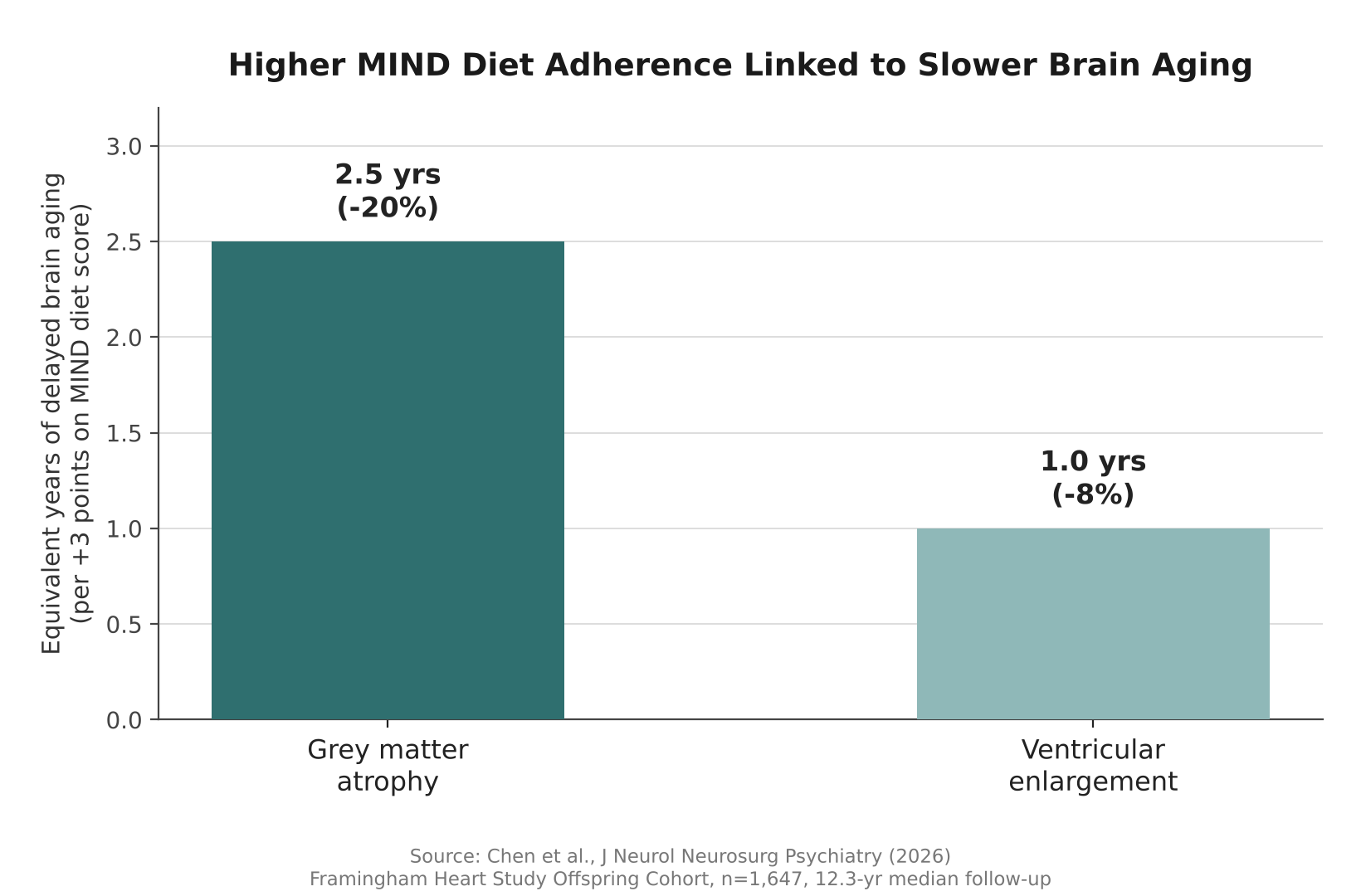
The results were striking for an observational study. For every 3-point increase in MIND diet score, participants’ grey matter — the brain tissue that handles memory, decision-making, and sensory processing — shrank 0.279 cubic centimeters less per year, about 20% less age-related loss than would otherwise be expected. Researchers translated that gap into real-world terms: roughly 2.5 fewer years of brain aging.
A 3-point higher MIND diet score was linked to about 2.5 fewer years of brain aging in grey matter volume — one of the clearest signals yet connecting everyday diet to long-term brain structure.
Higher MIND scores were also linked to slower enlargement of the brain’s ventricles, fluid-filled spaces that expand as surrounding tissue is lost with age. That slower expansion — about 8% less than expected — translated to roughly one additional year of more youthful brain structure. Because all participants’ brains shrank somewhat over the study period, as is normal with aging, the real finding is about the pace of that decline, not whether it happened at all.
Foods That Helped, and Surprised
Not every food in the MIND diet scoring system behaved as expected once researchers looked food by food. Berries were linked to slower enlargement of the ventricles, and poultry was linked to both slower ventricular enlargement and slower grey matter loss — consistent with berries’ high antioxidant content and poultry’s role as a lean protein source, both of which may reduce oxidative stress that damages neurons over time.
On the other end, sweets and fried fast food were linked to faster ventricular expansion and greater shrinkage of the hippocampus, the brain region most closely tied to memory formation. The researchers pointed to inflammation, unhealthy fats, and advanced glycation end-products — compounds that form when sugar reacts with proteins or fats in food, and which have been separately linked to tissue aging throughout the body — as possible mechanisms.
Two results, however, ran against expectations. Whole grains, which earn positive points in the standard MIND scoring system, were associated with several unfavorable brain changes in this particular cohort, while cheese, which typically loses points, was linked to favorable ones. The study’s authors flagged both findings as unexpected and said they would need further research to explain, rather than drawing firm conclusions from them. One possibility researchers did not rule out is that people’s reasons for eating more or less of a given food — a doctor’s recommendation to cut dairy after a cardiovascular diagnosis, for instance — could confound a simple food-by-food analysis in ways a single study cannot fully untangle.
Who Benefited Most
The association between MIND diet adherence and slower brain aging was not uniform across the group. It was strongest among older participants, who face a faster baseline pace of brain aging and may have more to gain from protective factors. It was also stronger among people who were physically active and those who were not living with obesity, hinting that diet may work alongside — rather than instead of — other healthy habits.
Participants who ate closer to the MIND pattern also tended to share other characteristics: they were more likely to be women and college-educated, and less likely to smoke or to have type 2 diabetes, high blood pressure, or cardiovascular disease. The researchers statistically accounted for these differences in their analysis, but they illustrate how diet quality tends to travel alongside a broader set of health behaviors.
What This Study Can’t Prove
Because this is an observational study, it cannot prove that the MIND diet alone causes slower brain aging. People who eat more healthily in general also tend to differ from others in exercise habits, education, and underlying health conditions, and some of the measured benefit may reflect those overlapping factors rather than diet in isolation. The food data also relied on questionnaires completed in the 1990s, which depend on participants’ memory and are vulnerable to reporting error, and the study could not fully rule out mild cognitive impairment at participants’ first brain scan or track how their diets may have changed over the following two decades.
The study population was also overwhelmingly White, drawn from a single long-running cohort in Massachusetts, so it remains unclear how well the findings would generalize to more diverse populations. Still, the researchers conclude that their results “reinforce the potential of the MIND diet as a brain-healthy dietary pattern.” Diet is only one piece of the brain-aging puzzle — other recent work, including a study on how the Alzheimer’s risk gene APOE4 scars brain blood vessels, points to genetic and vascular factors working alongside everyday habits. Taken together, the evidence suggests that what people eat in midlife is worth taking seriously as a long-term investment in cognitive health, even before a formal clinical trial settles the question of cause and effect.
Sources: BMJ Group, Journal of Neurology, Neurosurgery & Psychiatry (PMC)
Leave a Reply