Do you think of patents as “the IP department’s job” or “something for patent attorneys”? In reality, an engineer who doesn’t understand the patent system can end up missing out on compensation and career credit they’re legally entitled to — often without ever realizing it. The good news is that a few small habits are enough to turn your own technical work into fair compensation and a career asset. This guide covers the patent basics, then four things you can start practicing tomorrow, plus a daily checklist.
0. The Patent Basics to Know First
To be patentable, an invention generally needs three things: novelty (it doesn’t already exist in the world), an inventive step (a specialist in the field wouldn’t easily come up with it), and industrial applicability.
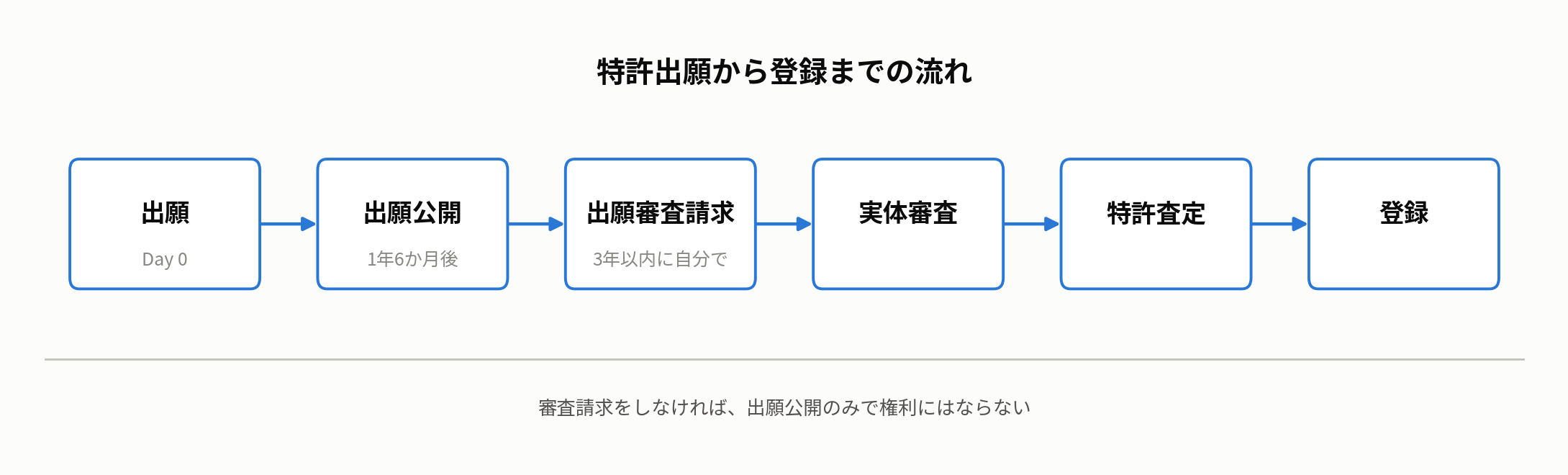
The path from filing to a granted right runs: file the application → publication (automatically, 18 months after filing) → request for examination (you must request this yourself within 3 years of filing, or it’s never examined) → substantive examination → decision to grant → registration. If you never request examination, the invention’s contents simply become public — it never becomes an enforceable right.
The single most important part of a patent is its “claims” — the scope of what’s legally protected. This is where the breadth and strength of the right is decided. No matter how detailed the written description is, any technology not captured in the claims isn’t protected.
1. Make Prior-Art Search Step One of Any New Project
Running a patent search before starting a new project heads off two problems at once:
- Reinventing the wheel: you avoid spending time building something that already exists, simply because you didn’t know about it.
- Freedom-to-Operate (FTO) risk: discovering that a competitor already holds a patent on your approach, after the fact, can force a costly redesign or expose you to infringement risk.
Japanese patent data can be searched for free, with no registration required, through J-PlatPat (the Japan Platform for Patent Information). As a beginner, three kinds of search will get you most of the way:
- Keyword search — technical terms have multiple names, so connect synonyms with OR (e.g., “artificial intelligence OR AI OR machine learning”).
- Applicant search — search by the name of a competitor or a related research institution to see which technologies they’re investing in.
- FI/F-term (patent classification) search — use the classification codes the Japan Patent Office assigns to narrow down technical fields that keywords alone can’t capture.
2. Read Patent Gazettes as a “Catalog of the Latest Technology”
A patent gazette — especially the “published unexamined application” that comes out 18 months after filing — is a primary source packed with cutting-edge technical information that hasn’t made it into papers yet. You don’t need to read it cover to cover; reading in this order is efficient:
- Abstract — grasp the gist of the invention in a few hundred characters.
- Claims — check the scope the patent actually protects. Comparing this against your own design is the basis of an FTO check.
- Description and drawings — for patents you’re genuinely interested in, dig into implementation details and examples.
Even just tracking how filing volume in a given field is trending, or which companies are filing heavily on which technologies, tells you a lot about where the industry’s effort is going.
3. Turn Ideas Into an “Invention Proposal” as Soon as They Come to You
Even a great idea, if it’s only ever spoken aloud, leaves no record and never becomes a patent. Many companies follow an internal process like this:
- The moment an idea occurs to you, jot down the date, the problem, the solution, and the effect — a notebook or an internal system is fine.
- Propose it to your manager or IP staff using the company’s “invention proposal” format.
- An internal invention review board judges whether it’s worth filing.
- If it moves forward, you work with a patent attorney to build out the claims and description — and this is where it matters that the engineer conveys the technical content accurately.
This is where Japan’s “employee invention system” (Article 35 of the Patent Act) comes in. Under the 2015 revision, if a company has specified in advance — through a contract or work rules — that it will acquire the right to obtain a patent, that right belongs to the company from the moment the invention is made. In exchange, the inventing employee is entitled to receive “reasonable benefit.” This isn’t limited to money — it can include other economic benefits under the company’s own programs, such as opportunities to study abroad or a promotion or award.
Even when the right to a patent defaults to the company, Article 35 of Japan’s Patent Act guarantees the inventing employee “reasonable benefit” in return. Proposing an invention isn’t unpaid labor — it’s something the law entitles you to be compensated for.
4. Turn Patents Into a Career Asset
- Being named as an inventor is an objective credential that carries weight outside your company too. Patent gazettes list inventors by name, giving you concrete material to point to — “here’s what I created” — when changing jobs or during internal reviews.
- Many companies run internal invention-recognition programs, rewarding inventions that contribute to commercialization with awards or bonuses.
- The experience of writing a patent is also training in putting your own technology into words a third party can understand — a skill that raises the quality of your technical writing generally.
A Practical Checklist
- Before starting a new project, I’ve run at least one keyword search on J-PlatPat.
- When an idea occurs to me, I jot down the date, the problem, and the solution on the spot.
- I check the claims of competitors’ patents in technology close to our own products, and I’m aware of the infringement risk.
- I know my company’s invention-proposal format and where to submit it.
- I’ve at least once read through my company’s employee-invention rules (what counts as “reasonable benefit”).
The essence of using patents well comes down to three unglamorous habits: record your ideas, search first, and read the claims. None of these require special skill — you can start today with nothing more than a notebook and a browser. Building patents into your own development process, rather than leaving them entirely to the IP department, looks like the long way around but is actually the shortest path.
Japan Patent Office, “Overview of the Employee Invention System”
Japan Patent Office, J-PlatPat (Patent Information Platform)
Leave a Reply