- Earth’s magnetic field acts like an invisible shield, deflecting much of the charged-particle wind that streams from the Sun — but the Moon and Mars both lost a global magnetic field like this billions of years ago, and scientists still do not fully agree on why.
- Researchers studying soil that China’s Chang’e-6 mission brought back from the Moon’s far side found a rare, naturally magnetic form of iron that had never before been confirmed in real Moon rock.
- Using a specialized microscope, they showed that this iron can hold a stable magnetic swirl pattern — the kind of structure that can, in principle, lock in a trace of the magnetic field present when it formed.
- This is an early-stage finding: it does not by itself settle the long-running debate about the Moon’s lost magnetic field, but it gives scientists a new kind of physical evidence to test their ideas against.
A missing magnetic shield, and a Moon that might hold a clue
Right now, a layer of invisible magnetism generated deep inside Earth is quietly doing one of the most important jobs for life on this planet: deflecting much of the charged-particle wind that streams from the Sun, known as the solar wind, so it does not gradually strip away our atmosphere. Mars does not have this shield anymore. Neither does the Moon. Both are thought to have had one billions of years ago, generated by a “dynamo” — a churning flow of molten or partly molten metal inside the planet that behaves like a natural electric generator. Figuring out when and why each dynamo switched off is one of the open questions in planetary science, partly because it is also a preview of how a rocky world’s interior can change over very long timescales.
The Moon is a convenient place to study this, because unlike Mars, it is close enough that spacecraft have brought real samples home. In 2024, China’s Chang’e-6 mission did something no previous mission had: it collected soil from the Moon’s far side, from the Apollo basin inside the giant South Pole–Aitken impact basin. A team at the Hefei Institutes of Physical Science (HFIPS), part of the Chinese Academy of Sciences, has now reported a new discovery hiding inside that soil, published online September 16, 2026, in the Proceedings of the National Academy of Sciences (PNAS).
An iron that “shouldn’t” exist — until an asteroid hit made it
The team, led by Prof. Haifeng Du, was looking at tiny beads of impact glass: droplets of rock that melted and then froze solid within moments after an asteroid or other object slammed into the Moon’s surface. Scattered through that glass, they found nanometer-scale particles — far smaller than a speck of dust, ranging from under 10 nanometers to about 140 nanometers across — made of a form of iron called gamma-iron, or γ-Fe for short.
Gamma-iron is not exotic chemistry; it is simply metallic iron arranged in a different crystal structure than the form most people picture. At ordinary pressure, pure iron normally settles into a structure called alpha-iron as it cools, and that is the arrangement found in most familiar iron-rich rocks. Gamma-iron is normally only stable over a high-temperature range, roughly 912°C to 1,394°C, and should flip back into the ordinary form well before reaching room temperature. Finding it “frozen” in place at room temperature, inside real Moon soil, was unexpected. The researchers propose that the extremely rapid cooling that follows a high-speed impact — far faster than rock cools under ordinary conditions — combined with the small amount of trace elements in the particles, trapped the iron in this unusual structure before it had a chance to transform.
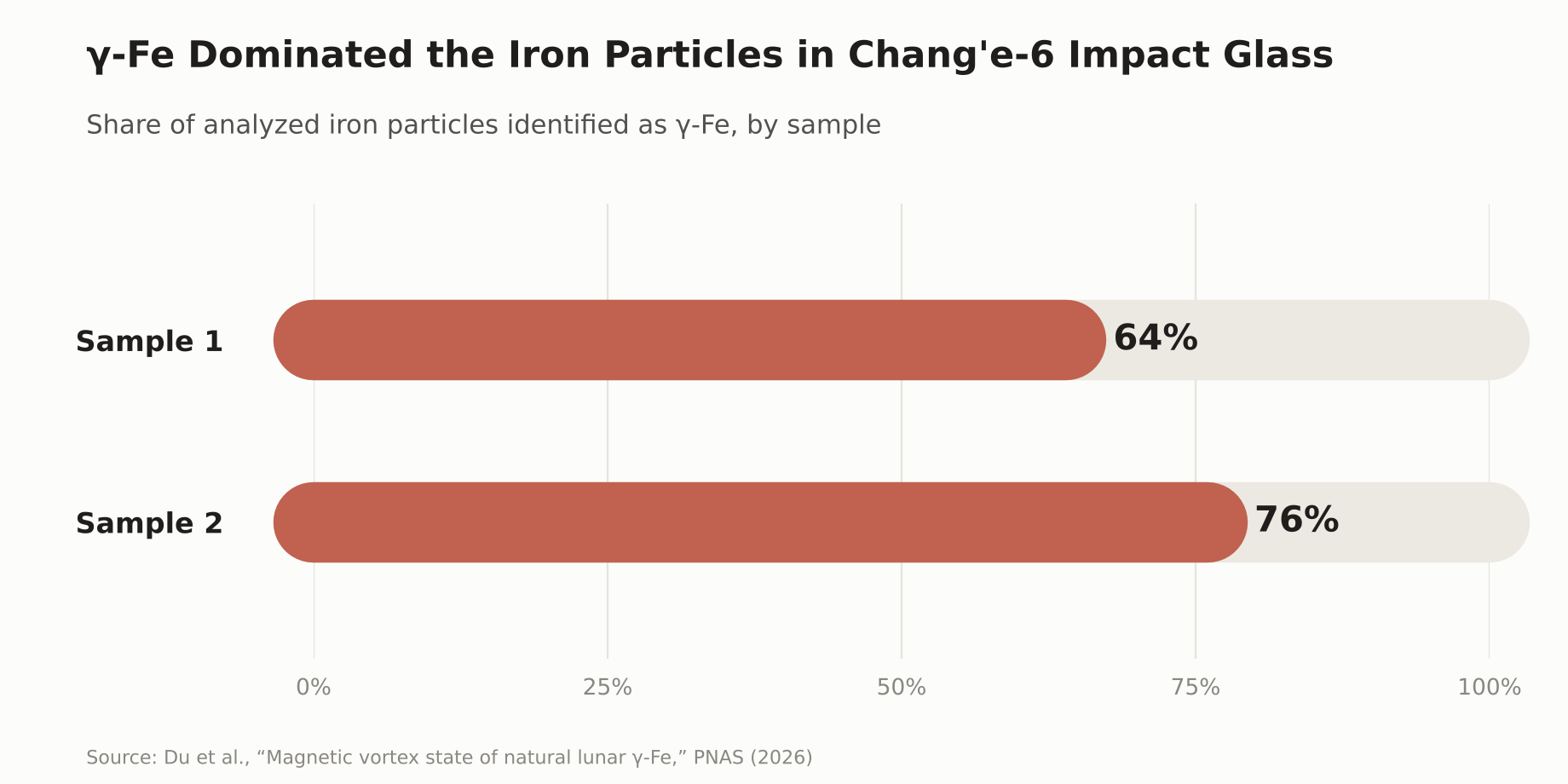
Among 50 iron particles the team examined across two impact-glass samples, γ-Fe was the dominant crystal phase: it accounted for roughly 64% of the particles analyzed in one sample and 76% in the other. The particles also contained very little nickel, below 0.8% by weight, which helps distinguish them from the iron-nickel alloys already known from meteorites and other Moon rocks.
Reading a magnetic memory under the microscope
Finding an unusual mineral is interesting on its own, but the more important part of the discovery is what the iron does magnetically. Using a specialized imaging technique called off-axis electron holography — a way of directly visualizing magnetic structure at a scale of billionths of a meter, inside an electron microscope — the team found that γ-Fe particles larger than about 100 nanometers settle into a stable “single-vortex” magnetic state: the magnetization inside the particle curls around in a stable loop, rather than pointing in one simple direction.
That stability matters. A magnetic structure that holds its shape reliably, and responds in a predictable way to outside magnetic fields, is the kind of structure that can carry what scientists call remanent magnetization — a lasting trace of the magnetic field present when the material formed and cooled. In principle, that makes it somewhat like certain magnetic minerals in Earth’s own rocks, which preserve a record of our planet’s past magnetic field. Dr. Long Li, one of the researchers on the team, put it this way:
“This tiny magnetic fossil may help us better understand the Moon’s ancient magnetic history.” — Dr. Long Li, Hefei Institutes of Physical Science
It is worth being precise about what has, and has not, been shown so far. The team has demonstrated that γ-Fe exists in real lunar material, that it forms a stable magnetic vortex state, and that this state is capable of recording magnetization. What is not yet established is which magnetic field any particular particle actually recorded — the Moon’s ancient, planet-wide dynamo field, or a brief, local field generated by the heat and shock of the very impact that formed the glass bead around it. Telling those two signals apart is exactly the next step the researchers say this discovery opens up.
A genuinely unsettled debate about the Moon’s lost magnetism
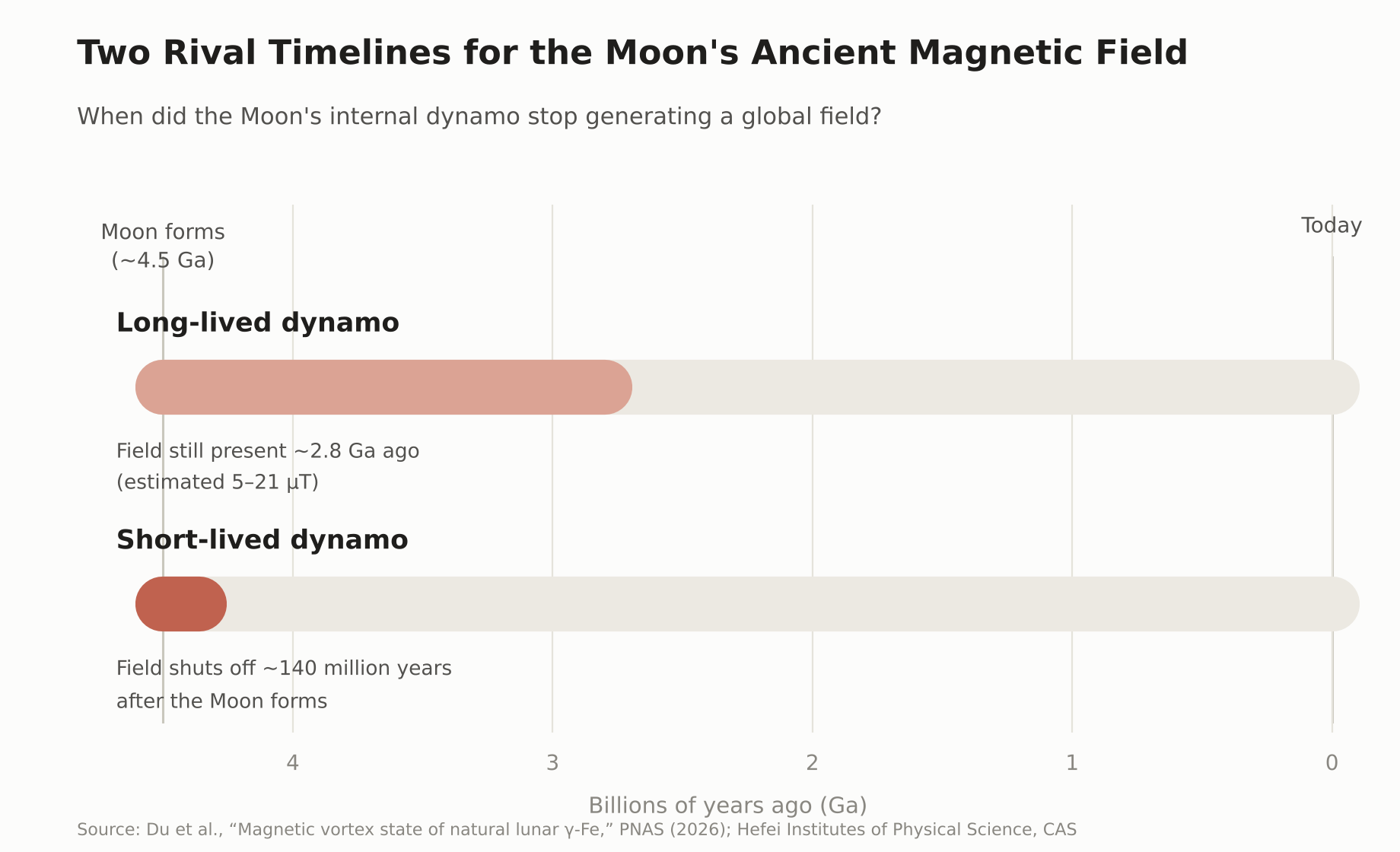
Scientists already have evidence the Moon once had a working dynamo, because older Moon rocks brought back decades ago by the Apollo missions carry their own trace of ancient magnetism. Exactly how strong that field was, and especially how long it lasted, is still disputed — and this is a real, ongoing scientific disagreement rather than a settled fact with one outlier view. Paleomagnetic measurements of Chang’e-6 basalt reported a field of roughly 5 to 21 microtesla as recently as about 2.8 billion years ago, a result some researchers read as pointing toward a longer-lived dynamo. Other researchers, using different measurement methods on Apollo-era samples, have argued that the evidence for a long-lived global field is weaker than it first appeared, and that the core dynamo may have been largely confined to the Moon’s first 140 million years or so, with anything recorded afterward reflecting brief, impact-generated fields rather than a steady, planet-wide one.
This is where γ-Fe could eventually contribute. Because it forms under different conditions than the more common alpha-iron, and appears specifically in impact-formed glass, comparing what it and other magnetic minerals “remember,” across many more samples, may eventually help researchers test whether a given signal reflects the Moon’s global dynamo, an impact-generated field, or some mixture of the two.
Still early days: what comes next
The team has not announced a new, confirmed timeline for when the Moon’s dynamo turned off, and γ-Fe on its own cannot provide a precise date for that event. What they have shown is that this magnetic mineral exists in real lunar material, that it can hold a stable magnetic state at the nanometer scale, and that it is a promising new tool for a field that has had to work with a frustratingly small and ambiguous set of physical clues. More broadly, understanding how a rocky world like the Moon or Mars generates, and eventually loses, its own internal magnetic field is part of a wider effort to understand what shapes a planet’s long-term climate and atmosphere — knowledge that also feeds into how scientists assess the conditions on rocky planets orbiting other stars. A small, newly identified mineral will not settle that larger question by itself, but it gives researchers one more concrete thread to pull on.
Sources: Du, H. et al., “Magnetic vortex state of natural lunar γ-Fe,” PNAS (2026) · Hefei Institutes of Physical Science, CAS · ScienceDaily · The Brighter Side of News
Leave a Reply