Tag: Planetary Science

  • [Science] Possible New Dwarf Planet Beyond Pluto Found in Rubin Observatory Data

    [Science] Possible New Dwarf Planet Beyond Pluto Found in Rubin Observatory Data

    Astronomers using data from the Vera C. Rubin Observatory have identified an object called 2026 ED138, currently about 46 times farther from the Sun than Earth is and perhaps 600 to 1,500 kilometers across — large enough that it may qualify as the solar system’s sixth dwarf planet. It matters because it shows that sizable worlds can still hide in the outer solar system, and that new survey data and search software are now able to dig them out.

    原論文情報 / Original Paper
    Announcement: Possible new dwarf planet 2026 ED138 (provisional designation)
    Announced by: NSF–DOE Vera C. Rubin Observatory / NOIRLab, October 27, 2026
    Discoverer: Matthew Holman, Center for Astrophysics | Harvard & Smithsonian
    Peer-reviewed paper: none cited in the coverage we checked. Source: University of Washington News

    What the team found

    The object carries the provisional name 2026 ED138. It was first identified on the evening of October 13, 2026, by astronomer Matthew Holman of the Center for Astrophysics | Harvard & Smithsonian, who was sifting through images that the NSF–DOE Vera C. Rubin Observatory had collected earlier this year; the University of Washington describes that data as preliminary. The object had been photographed before, but never recognized as a single moving body. Holman developed the search code together with colleague Kevin Napier. It links billions of detections of moving objects to work out which ones belong to the same body. Holman has described his first reaction as “excited disbelief,” and he immediately checked whether he or the code had made a mistake.

    Once the candidate was in hand, more data fell into place. According to Space.com and Universe Today, Rubin’s telescope recorded it 30 times on 20 nights between March 4 and July 11, 2026. Mario Jurić of the University of Washington, who leads Rubin’s solar system team, turned up additional detections in the catalog. Archival images from other surveys, including the Dark Energy Camera on a 4-meter telescope in Chile, extend the record back to 2016. That gives the team more than a decade of positions from which to calculate the orbit.

    Where it was hiding

    ED138 is currently about 46 astronomical units from the Sun (one astronomical unit is the Earth–Sun distance), compared with about 40 for Pluto on average. Its orbit is tilted roughly 25 degrees from the plane in which the planets travel, a tilt Space.com says likely stems from a gravitational interaction with Neptune. Universe Today describes it as a “hot classical” object, a label for icy Kuiper belt bodies on more tilted, disturbed orbits.

    The location also helps explain why it was missed. ED138 lies in a region near the plane of our own galaxy, where the Milky Way’s dense star field makes faint, slowly moving dots hard to pick out. The University of Washington’s write-up says this likely hid it from most other telescopes. Finding it took both Rubin’s repeated imaging and software built to link scattered faint detections. We covered a similar story of patient, data-driven discovery in our earlier piece on a possible hidden pair of supermassive black holes.

    How big is it, really?

    The headline estimate is 600 to 1,500 kilometers across. That would put ED138 anywhere from a modest icy world, smaller than Ceres, up to one comparable to the dwarf planet Makemake, which is about 1,430 km wide according to The Planetary Society. Jurić has put the best guess near 1,000 km and, as Gizmodo reports, called it the largest trans-Neptunian object found in about 20 years. Those figures remain estimates.
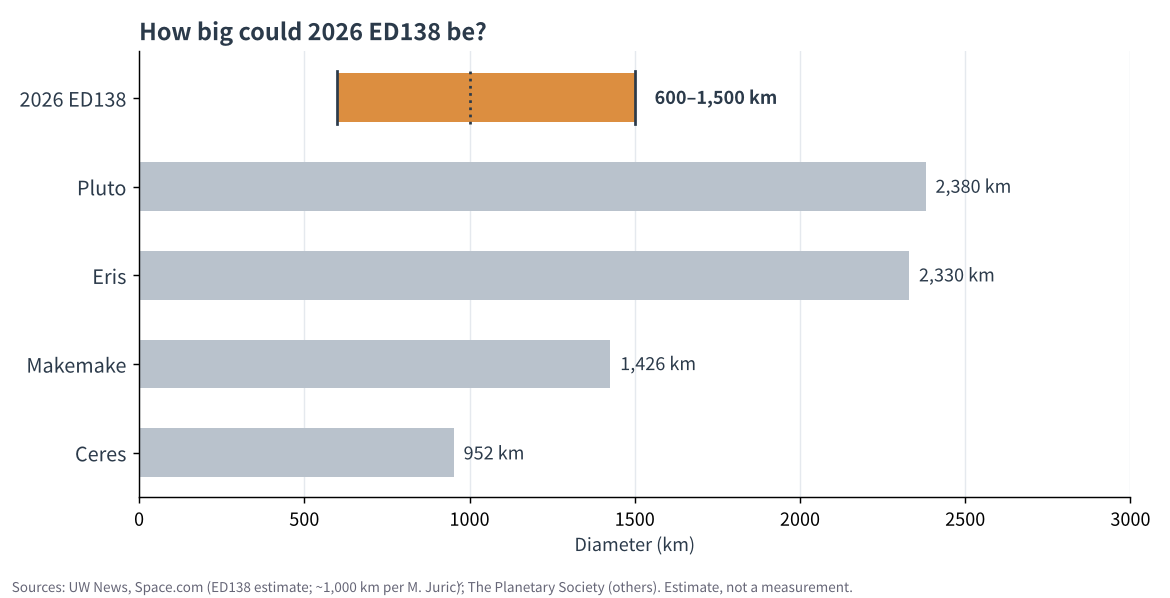
    Bar chart comparing the estimated 600 to 1,500 km size of 2026 ED138 with Ceres, Makemake, Eris and Pluto
    Estimated size of 2026 ED138 compared with known dwarf planets. Sources: UW News, Space.com, Gizmodo (ED138 estimate); The Planetary Society (others).

    Why such a wide range? Telescopes see reflected sunlight, and how much light arrives depends on two things at once: how big the object is and how reflective its surface is (its albedo). A small, shiny body and a large, dark body can look equally bright from far away. The team estimated size from distance, brightness and an assumed surface reflectivity, so the range mostly reflects uncertainty about that reflectivity. A 2.5-fold gap in diameter corresponds to roughly a six-fold gap in albedo.
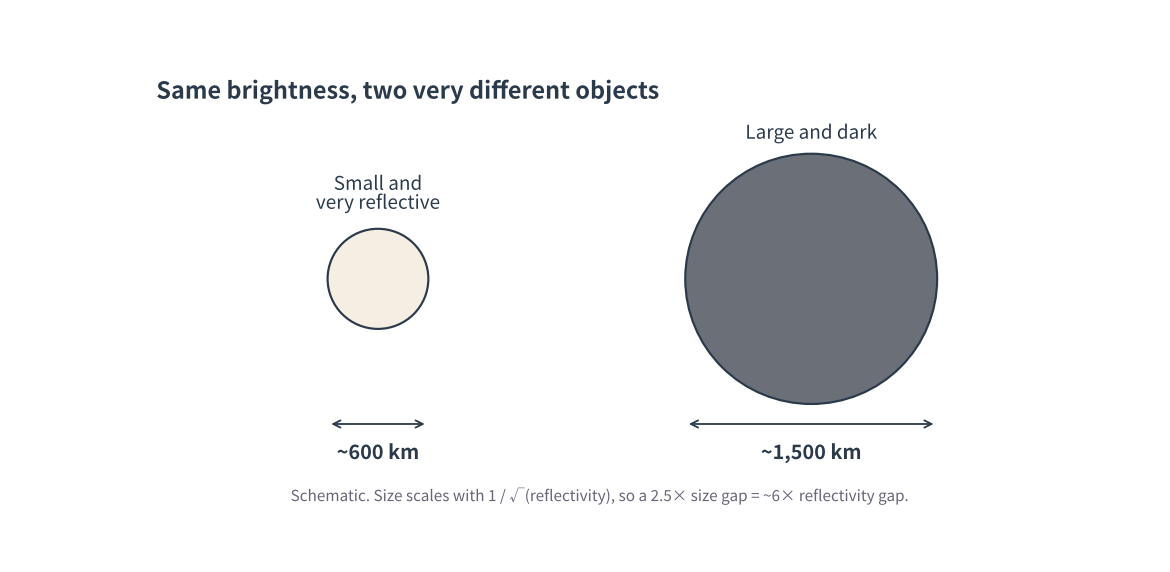
    Schematic of a small reflective body and a large dark body appearing equally bright
    Schematic: the same brightness can come from a small, reflective object or a large, dark one. Created by Xsciens.

    What counts as a dwarf planet

    NASA summarizes the International Astronomical Union’s definition: a dwarf planet orbits the Sun, is massive enough for its own gravity to pull it into a nearly round shape, has not cleared the neighborhood around its orbit, and is not a moon. Five objects are recognized today: Ceres, Pluto, Eris, Haumea and Makemake. If ED138 is confirmed to meet the criteria and is formally recognized, it would be the sixth.

    Roundness is why size matters so much. The University of Washington’s write-up notes that icy bodies of this scale are expected to be round, but nobody has yet observed ED138 well enough to see its shape. Until its diameter and shape are measured, “candidate” is the accurate word.

    What happens next

    Follow-up work will aim to pin down the size. Space.com reports that this requires infrared observations, naming the James Webb Space Telescope, because an object’s heat emission helps separate its size from its reflectivity. Meanwhile, Rubin’s ten-year survey of the southern sky, which began in June 2026, continues, and searches of older images — “precovery,” in Jurić’s term, meaning finding an object in images taken before anyone recognized it — may turn up more objects earlier surveys missed.

    In the coverage we checked, no peer-reviewed paper accompanies the announcement, so the numbers above should be read as the team’s preliminary estimates.

    Xsciens Editorial Note

    This is a candidate, not a confirmed dwarf planet: its orbit is calculated from about a decade of positions, but its size is still an estimate.

    • Observed versus calculated. What astronomers recorded directly were positions and brightness in many images. The distance (about 46 au) and the orbital tilt (about 25°) are calculated from them, and the 600–1,500 km diameter is a further estimate that also assumes how reflective the surface is, which is why the range spans a factor of 2.5.
    • Limits. Roundness has not been observed, and the coverage we reviewed cites no peer-reviewed paper. This note rests on the announcement and secondary coverage; we could not open the NOIRLab release itself. “Hot classical” is Universe Today’s description, for a category of Kuiper belt objects defined by widely tilted orbits.
    • What to watch. Infrared measurements of its size, for which Space.com points to the James Webb Space Telescope, and whether the object is formally recognized as a dwarf planet.
    • From the editors — the solar-system poster on a classroom wall may soon need a new line. If Rubin keeps scanning the southern sky for ten years, more faint worlds could plausibly turn up, ones that hid in crowded star fields or slipped between older surveys. The catch is that “candidate” is the operative word, and until the size is measured the headline number could move a lot. So treat 1,000 km as a placeholder, and look again when the infrared measurements arrive.

    References for this note: NASA, What is a planet?, Müller et al., Trans-Neptunian objects and Centaurs at thermal wavelengths (arXiv), Petit et al., Canada-France Ecliptic Plane Survey (arXiv)

    Sources: University of Washington News, Space.com, Universe Today, Gizmodo, The Planetary Society
  • [Science] China’s Chang’e-6 Moon Samples Reveal a Rare Magnetic Mineral — A New Lead in the Mystery of the Moon’s Lost Protective Field

    [Science] China’s Chang’e-6 Moon Samples Reveal a Rare Magnetic Mineral — A New Lead in the Mystery of the Moon’s Lost Protective Field

    • Earth’s magnetic field acts like an invisible shield, deflecting much of the charged-particle wind that streams from the Sun — but the Moon and Mars both lost a global magnetic field like this billions of years ago, and scientists still do not fully agree on why.
    • Researchers studying soil that China’s Chang’e-6 mission brought back from the Moon’s far side found a rare, naturally magnetic form of iron that had never before been confirmed in real Moon rock.
    • Using a specialized microscope, they showed that this iron can hold a stable magnetic swirl pattern — the kind of structure that can, in principle, lock in a trace of the magnetic field present when it formed.
    • This is an early-stage finding: it does not by itself settle the long-running debate about the Moon’s lost magnetic field, but it gives scientists a new kind of physical evidence to test their ideas against.

    A missing magnetic shield, and a Moon that might hold a clue

    Right now, a layer of invisible magnetism generated deep inside Earth is quietly doing one of the most important jobs for life on this planet: deflecting much of the charged-particle wind that streams from the Sun, known as the solar wind, so it does not gradually strip away our atmosphere. Mars does not have this shield anymore. Neither does the Moon. Both are thought to have had one billions of years ago, generated by a “dynamo” — a churning flow of molten or partly molten metal inside the planet that behaves like a natural electric generator. Figuring out when and why each dynamo switched off is one of the open questions in planetary science, partly because it is also a preview of how a rocky world’s interior can change over very long timescales.

    The Moon is a convenient place to study this, because unlike Mars, it is close enough that spacecraft have brought real samples home. In 2024, China’s Chang’e-6 mission did something no previous mission had: it collected soil from the Moon’s far side, from the Apollo basin inside the giant South Pole–Aitken impact basin. A team at the Hefei Institutes of Physical Science (HFIPS), part of the Chinese Academy of Sciences, has now reported a new discovery hiding inside that soil, published online September 16, 2026, in the Proceedings of the National Academy of Sciences (PNAS).

    An iron that “shouldn’t” exist — until an asteroid hit made it

    The team, led by Prof. Haifeng Du, was looking at tiny beads of impact glass: droplets of rock that melted and then froze solid within moments after an asteroid or other object slammed into the Moon’s surface. Scattered through that glass, they found nanometer-scale particles — far smaller than a speck of dust, ranging from under 10 nanometers to about 140 nanometers across — made of a form of iron called gamma-iron, or γ-Fe for short.

    Gamma-iron is not exotic chemistry; it is simply metallic iron arranged in a different crystal structure than the form most people picture. At ordinary pressure, pure iron normally settles into a structure called alpha-iron as it cools, and that is the arrangement found in most familiar iron-rich rocks. Gamma-iron is normally only stable over a high-temperature range, roughly 912°C to 1,394°C, and should flip back into the ordinary form well before reaching room temperature. Finding it “frozen” in place at room temperature, inside real Moon soil, was unexpected. The researchers propose that the extremely rapid cooling that follows a high-speed impact — far faster than rock cools under ordinary conditions — combined with the small amount of trace elements in the particles, trapped the iron in this unusual structure before it had a chance to transform.

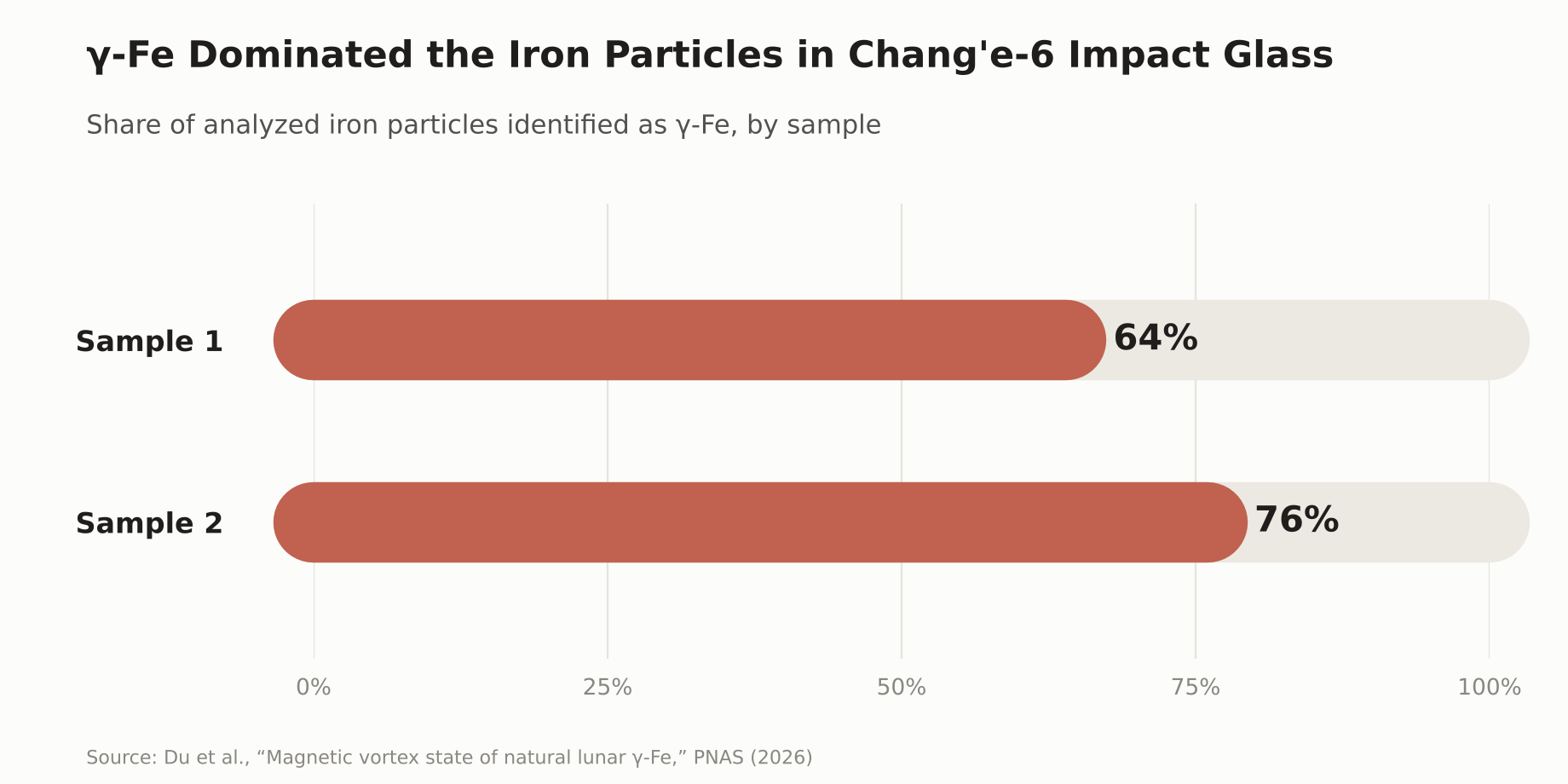
    Among 50 iron particles the team examined across two impact-glass samples, γ-Fe was the dominant crystal phase: it accounted for roughly 64% of the particles analyzed in one sample and 76% in the other. The particles also contained very little nickel, below 0.8% by weight, which helps distinguish them from the iron-nickel alloys already known from meteorites and other Moon rocks.

    Bar chart showing the share of analyzed iron particles identified as gamma-iron in two Chang’e-6 impact-glass samples: 64% and 76%.
    γ-Fe was the dominant iron phase in both impact-glass samples the team analyzed in detail.

    Reading a magnetic memory under the microscope

    Finding an unusual mineral is interesting on its own, but the more important part of the discovery is what the iron does magnetically. Using a specialized imaging technique called off-axis electron holography — a way of directly visualizing magnetic structure at a scale of billionths of a meter, inside an electron microscope — the team found that γ-Fe particles larger than about 100 nanometers settle into a stable “single-vortex” magnetic state: the magnetization inside the particle curls around in a stable loop, rather than pointing in one simple direction.

    That stability matters. A magnetic structure that holds its shape reliably, and responds in a predictable way to outside magnetic fields, is the kind of structure that can carry what scientists call remanent magnetization — a lasting trace of the magnetic field present when the material formed and cooled. In principle, that makes it somewhat like certain magnetic minerals in Earth’s own rocks, which preserve a record of our planet’s past magnetic field. Dr. Long Li, one of the researchers on the team, put it this way:

    “This tiny magnetic fossil may help us better understand the Moon’s ancient magnetic history.” — Dr. Long Li, Hefei Institutes of Physical Science

    It is worth being precise about what has, and has not, been shown so far. The team has demonstrated that γ-Fe exists in real lunar material, that it forms a stable magnetic vortex state, and that this state is capable of recording magnetization. What is not yet established is which magnetic field any particular particle actually recorded — the Moon’s ancient, planet-wide dynamo field, or a brief, local field generated by the heat and shock of the very impact that formed the glass bead around it. Telling those two signals apart is exactly the next step the researchers say this discovery opens up.

    A genuinely unsettled debate about the Moon’s lost magnetism

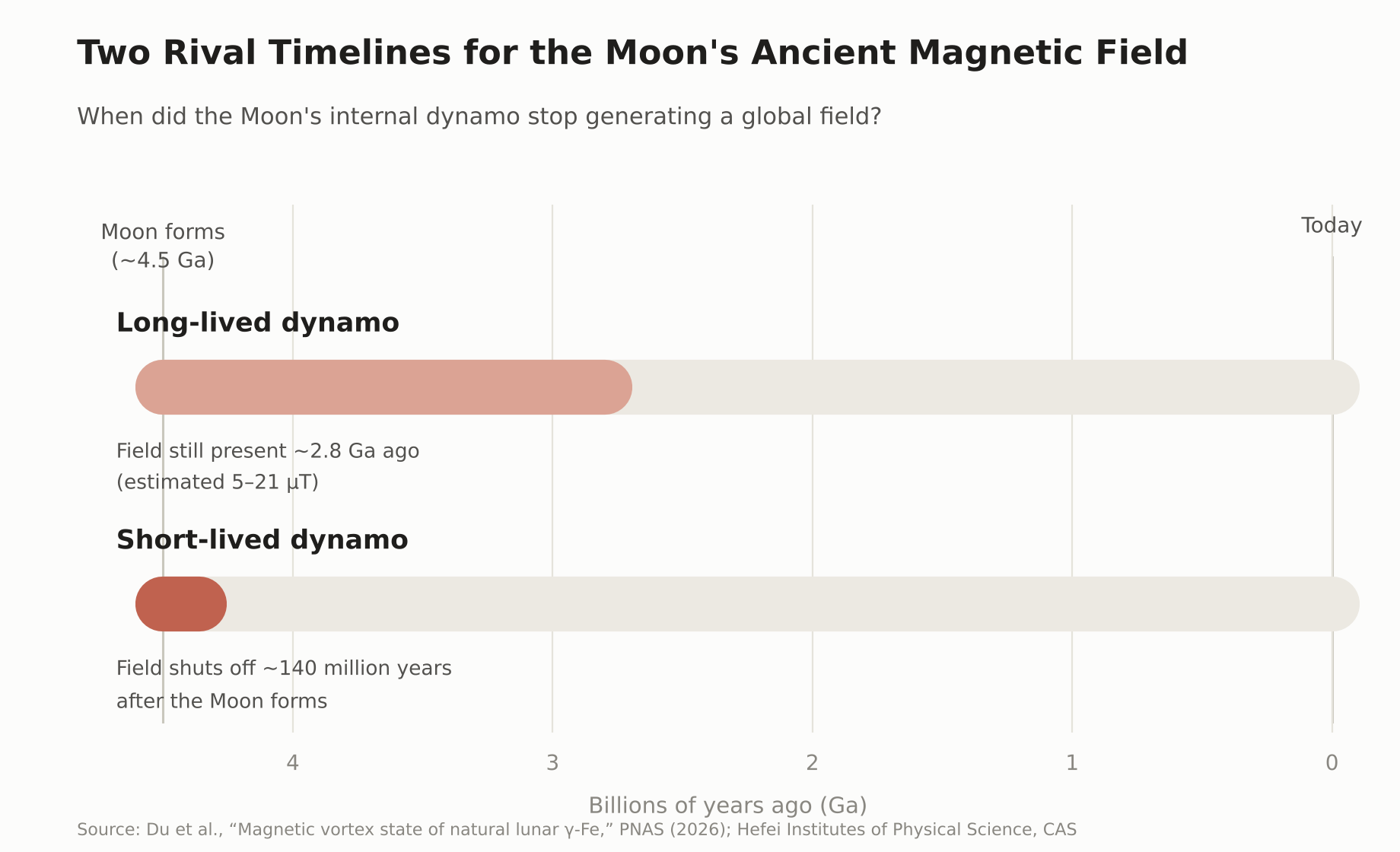
    Scientists already have evidence the Moon once had a working dynamo, because older Moon rocks brought back decades ago by the Apollo missions carry their own trace of ancient magnetism. Exactly how strong that field was, and especially how long it lasted, is still disputed — and this is a real, ongoing scientific disagreement rather than a settled fact with one outlier view. Paleomagnetic measurements of Chang’e-6 basalt reported a field of roughly 5 to 21 microtesla as recently as about 2.8 billion years ago, a result some researchers read as pointing toward a longer-lived dynamo. Other researchers, using different measurement methods on Apollo-era samples, have argued that the evidence for a long-lived global field is weaker than it first appeared, and that the core dynamo may have been largely confined to the Moon’s first 140 million years or so, with anything recorded afterward reflecting brief, impact-generated fields rather than a steady, planet-wide one.

    Timeline diagram comparing two rival hypotheses for when the Moon’s internal dynamo stopped generating a global magnetic field.
    Two competing timelines for when the Moon’s ancient dynamo shut off — a debate γ-Fe could eventually help settle.

    This is where γ-Fe could eventually contribute. Because it forms under different conditions than the more common alpha-iron, and appears specifically in impact-formed glass, comparing what it and other magnetic minerals “remember,” across many more samples, may eventually help researchers test whether a given signal reflects the Moon’s global dynamo, an impact-generated field, or some mixture of the two.

    Still early days: what comes next

    The team has not announced a new, confirmed timeline for when the Moon’s dynamo turned off, and γ-Fe on its own cannot provide a precise date for that event. What they have shown is that this magnetic mineral exists in real lunar material, that it can hold a stable magnetic state at the nanometer scale, and that it is a promising new tool for a field that has had to work with a frustratingly small and ambiguous set of physical clues. More broadly, understanding how a rocky world like the Moon or Mars generates, and eventually loses, its own internal magnetic field is part of a wider effort to understand what shapes a planet’s long-term climate and atmosphere — knowledge that also feeds into how scientists assess the conditions on rocky planets orbiting other stars. A small, newly identified mineral will not settle that larger question by itself, but it gives researchers one more concrete thread to pull on.

    Sources: Du, H. et al., “Magnetic vortex state of natural lunar γ-Fe,” PNAS (2026) · Hefei Institutes of Physical Science, CAS · ScienceDaily · The Brighter Side of News

  • [Science] The Ice Shooting Off Saturn’s Moon Enceladus Isn’t a Simple Copy of Its Ocean — A Finding That Could Reshape the Hunt for Alien Life

    Every second, the icy moon Enceladus sprays countless grains of ice from its hidden ocean into space, feeding one of Saturn’s rings. An international team led by the Freie Universität Berlin and the Earth-Life Science Institute at the Institute of Science Tokyo has proposed that, on the way out, that water gets chemically sorted. The upshot: an individual ice grain is not simply a miniature sample of the whole ocean, which matters for any future mission trying to read Enceladus’s ocean chemistry for signs of life.

    Original source
    Journal: Science Advances (DOI: 10.1126/sciadv.aee7256)
    Press release: Freie Universität Berlin
    Data: 961 ice-grain spectra recorded by Cassini’s Cosmic Dust Analyzer

    Cooling speed decides which salt goes where

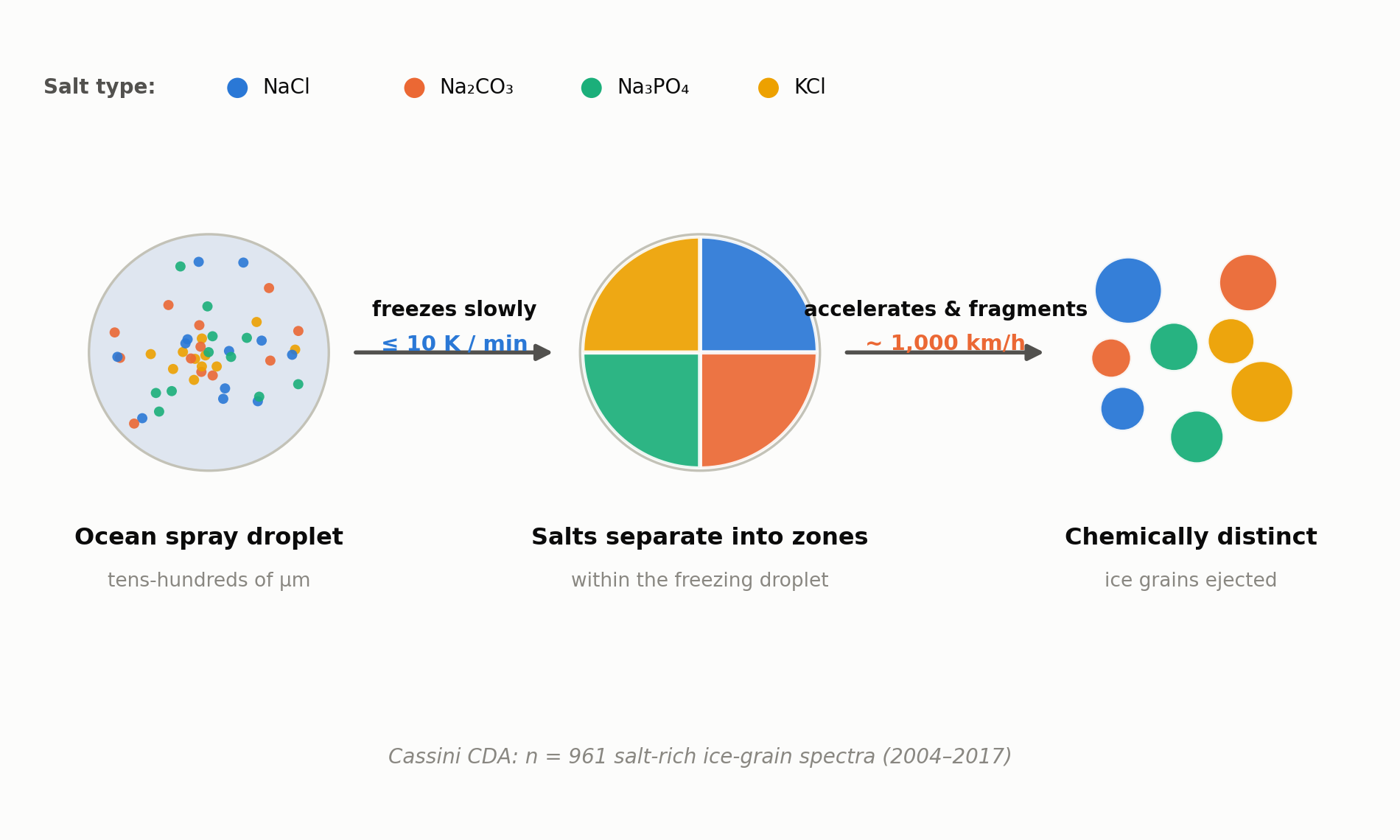
    The team ran lab experiments with droplets formulated to match the salts expected in Enceladus’s subsurface ocean. When droplets roughly 200 micrometers across were cooled slowly, at about 10 kelvin per minute or less, the dissolved salts did not freeze evenly into the ice. Instead, compounds such as sodium chloride, carbonates, phosphates and potassium salts separated out and concentrated into distinct regions within the droplet as it froze. Rapid freezing did not produce the same pronounced separation, the experiments showed.

    961 oddly different ice grains from Cassini

    What happens to a droplet after it freezes unevenly underground? The team proposes that as these droplets rise through narrow vent channels toward the surface, they accelerate — reaching roughly 1,000 km/h in the model — before shattering against the icy channel walls into the fine grains that eventually reach space. NASA’s Cassini spacecraft, which orbited Saturn from 2004 to 2017, carried a Cosmic Dust Analyzer (CDA) that recorded mass spectra for 961 salt-rich ice grains gathered over the course of its mission. Grain to grain, the chemistry varied widely — some grains dominated by sodium salts, others by carbonates or phosphates — even though they presumably all came from the same ocean. The new freeze-and-fragment model offers an explanation for why that is: each grain simply froze out of a different, already-segregated pocket of the original droplet.

    “The oceanic constituents are separated from each other and simultaneously concentrated into individual ice particles,” says Professor Frank Postberg of Freie Universität Berlin.
    Schematic of the proposed ice-grain formation model at Enceladus
    Source: created from data released by Freie Universität Berlin / Institute of Science Tokyo (proposed grain-formation model)

    A discovery that could change how we read the data

    The core implication is that no single ice grain can be assumed to represent the ocean’s average composition. That matters for mission concepts such as NASA’s proposed Orbilander, which would collect and analyze Enceladus’s plume grains directly: researchers will likely need to account for grain-to-grain differences when interpreting what they find. The team suspects organic molecules and other life-relevant compounds could be concentrated in a similar way, though confirming that will require further study.

    Enceladus remains one of the solar system’s most closely watched candidates for hosting life. Understanding how each ice grain came to be — rather than treating it as a simple drop of seawater — looks set to become an unavoidable consideration for the missions that follow.

    Xsciens editorial note

    This study is a model that explains an existing dataset, not a new observation of Enceladus. Its central claim, that cooling speed determines which salts end up in which ice grains, is a proposal that fits the 961 Cassini spectra. It has not been confirmed by a new spacecraft measurement. The reading is attractive because it ties grain composition to a physical process, but it also means any future mission, such as the Orbilander concept, would need to test it directly before the interpretation of the data is changed.

    Key terms

    • Cosmic Dust Analyzer (CDA): the Cassini instrument that analyzed the composition of individual ice grains in flight.
    • Cooling rate: how fast a droplet loses heat; the study ties it to which salts crystallize in a grain.
    • Vent: a fissure on Enceladus’ south pole through which water-rich material is ejected into space.

    Sources: Freie Universität Berlin press release, Science Advances (DOI: 10.1126/sciadv.aee7256)