Tag: Catalyst

  • A Green Hydrogen Catalyst Lasts Longest at the Freezing Point — RIKEN Finds

    A Green Hydrogen Catalyst Lasts Longest at the Freezing Point — RIKEN Finds

    Cool a chemical reaction down, and it should slow to a crawl — that’s basic chemistry. But for one hydrogen-making catalyst, the story turns out to be more complicated than that. Researchers at Japan’s RIKEN institute have found that a manganese oxide catalyst used to split water into hydrogen degrades the least right around the freezing point of water, and then degrades faster again once the water is chilled further still. The finding offers a new angle on one of green hydrogen’s stubborn cost problems: catalysts that wear out too fast.

    原論文情報 / Original Paper
    Title: Cooling Water to Near Freezing Breaks the Activity-stability Trade-off of Water Oxidation Electrocatalysis
    Authors: Wardhana, A. C. et al.
    Journal: Nature Chemistry
    DOI: 10.1038/s41557-026-02274-8

    The Weak Link in Green Hydrogen

    Splitting water into hydrogen and oxygen using electricity from solar or wind power is the core process behind “green hydrogen,” a carbon-free alternative to fossil fuels for power generation, steelmaking, and transport fuel. Hydrogen produced this way could, in principle, replace fossil fuels across a wide swath of heavy industry, which is why so much research funding is chasing it.

    The catch is cost. At the electrode where oxygen is released, the chemical environment is harshly oxidizing, and over time the catalyst coating that electrode slowly dissolves away. Replacing or maintaining it is a recurring expense, and durability problems like this are a big part of why electrolysis-based hydrogen still costs more than hydrogen made from natural gas. Any discovery that makes catalysts last longer without a complete materials overhaul is worth a closer look.

    Speed Versus Durability: The Old Rule

    Chemical reactions generally speed up as temperature rises — a basic rule of chemistry known as the Arrhenius relationship, named after the 19th-century chemist who first described it. Raise the temperature and a water-splitting reaction goes faster, which sounds like a straightforward way to boost hydrogen output. But raise the temperature too much, and the catalyst itself degrades faster too, since the harsh oxidizing side-reactions that eat away at it also speed up with heat. Cool things down, on the other hand, and the catalyst tends to last longer — but the water-splitting reaction itself slows to match. Engineers have generally treated this as a fixed trade-off: push for speed, and durability suffers; push for durability, and speed suffers.

    A Sweet Spot Right at Freezing

    A team led by Ryuhei Nakamura, team director at RIKEN’s Center for Sustainable Resource Science and a professor at the Earth-Life Science Institute at the Institute of Science Tokyo, decided to test that assumption directly. Using a manganese oxide (MnO2) catalyst, a common and inexpensive choice for this kind of reaction, the team ran the electrolysis across a wide temperature range — from a warm 80°C down to -12°C, well below the normal freezing point — and carefully tracked two things at once: how fast oxygen bubbled off the electrode, and how much manganese leached out of the catalyst as it broke down.

    The results were not what a simple reading of the Arrhenius relationship would predict. As the temperature dropped from 80°C toward 0°C, both the reaction rate and the degradation rate slowed down, as expected. But the degradation rate fell off by far more than the reaction rate did. In practical terms, that means that near 0°C, the catalyst could last substantially longer while giving up comparatively little reaction speed — a sweet spot hiding in plain sight. The team confirmed this wasn’t just a snapshot measurement: in longer-duration tests that ran a steady electric current through the cell and tracked how long the catalyst held up, lifespan peaked right around 0°C and then declined again as the electrolyte was chilled further, tracing out a distinct peak rather than a straight line.

    Why Colder Water Breaks It Faster

    The more surprising twist showed up below 0°C. Instead of continuing to degrade more slowly as temperatures kept dropping — which is what ordinary chemistry would predict — the catalyst flipped and started breaking down faster the colder it got. Chemists call this an “anti-Arrhenius” pattern, because it runs exactly opposite to the usual temperature rule. The effect was visible to the naked eye: an electrolyte solution held at -8°C turned noticeably deeper pink than one held at 2°C, a color change consistent with a buildup of permanganate ions, a telltale marker of the catalyst breaking down.

    Below 0°C, the colder the water got, the faster the catalyst broke down — the exact opposite of what ordinary chemistry would predict.

    The explanation traces back to a strange property of water itself, known as “supercooling.” Below 0°C, the sulfuric-acid electrolyte solution in the experiment didn’t freeze immediately — it stayed liquid in an unstable, supercooled state, confirmed in the study by triggering ice formation with mechanical shock and watching how the liquid behaved beforehand. Using Raman spectroscopy to examine the molecular structure of the water, the researchers found that the network of hydrogen bonds connecting water molecules in this supercooled state looks markedly different from the structure of ordinary water above 0°C. The team’s working hypothesis is that this altered molecular structure is what accelerates manganese loss from the catalyst, driving the faster breakdown seen at sub-zero temperatures.

    Catalyst durability has traditionally been tackled by redesigning the material itself — changing its chemical composition or its microscopic structure to make it more resistant to the oxidizing environment. A sulfur-based material that produces hydrogen from sunlight, developed elsewhere, is one recent example of that materials-first approach to cheaper hydrogen production. What stands out about this study is that it doesn’t touch the catalyst material at all. Instead, it shows that something as simple as tuning the temperature of the reaction environment can shift the balance between how active a catalyst is and how long it survives.
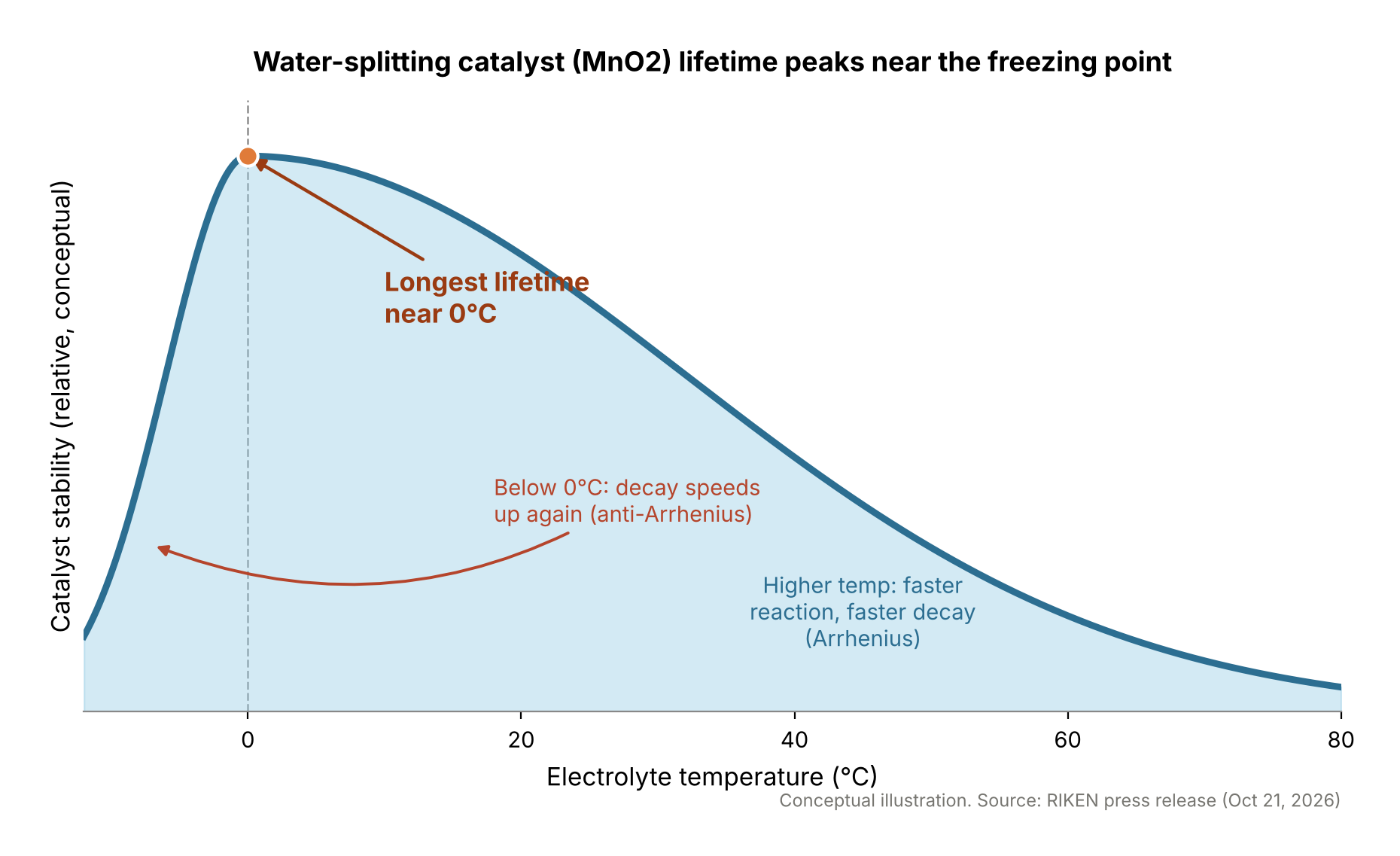
    Conceptual diagram showing catalyst stability peaking near 0C electrolyte temperature
    Based on the description in RIKEN’s press release (Oct 21, 2026)

    From Cold Climates to Icy Worlds

    The researchers see temperature as a new design lever that engineers could use alongside, or even instead of, changes to catalyst chemistry, to balance activity against stability. That has implications that go beyond ordinary industrial electrolyzers. The same principle could inform the design of electrochemical systems built to operate in cold or polar climates, where keeping equipment near room temperature is itself an energy cost. More speculatively, the findings could also help explain electrochemical reactions involving low-temperature water on other planetary bodies, where near-freezing or supercooled water may be common. The research team frames the work as contributing to UN Sustainable Development Goals centered on clean water and clean, affordable energy. The results were published October 21, 2026, in the journal Nature Chemistry, with support from Japan’s GteX program, JSPS KAKENHI, and other funding bodies.

    Not Just the Material, But the Setting

    A catalyst’s performance isn’t dictated by its composition and structure alone — that’s the central insight of this study. Something as simple as the temperature of the surrounding water can shift the balance between how fast a reaction runs and how long the catalyst that drives it survives. This result won’t make green hydrogen cheaper overnight, and plenty of engineering work stands between a laboratory finding and a commercial electrolyzer. But the idea of designing catalysts around the conditions they operate in, rather than focusing solely on the materials they’re made from, gives engineers a new variable to work with — one that costs nothing to install, since it only requires controlling a temperature that already has to be managed anyway.

    Sources: RIKEN press release, “Electrolysis catalyst becomes longer-lived near 0°C”, Nature Chemistry (DOI: 10.1038/s41557-026-02274-8)
  • [Science] A Sulfur Crystal Turns Sunlight Into Hydrogen — A Step Toward Cheaper Fuel

    [Science] A Sulfur Crystal Turns Sunlight Into Hydrogen — A Step Toward Cheaper Fuel

    Chemists at Oregon State University have built a new crystalline material that uses sunlight to produce hydrogen from water, without bolting on a separate, expensive metal catalyst to make the reaction run. The work, published in the Journal of the American Chemical Society, does not come with a price tag or a factory timeline yet, but it offers a concrete lead on one of clean hydrogen’s biggest obstacles: catalysts that are too costly to use at the scale the energy system would need.

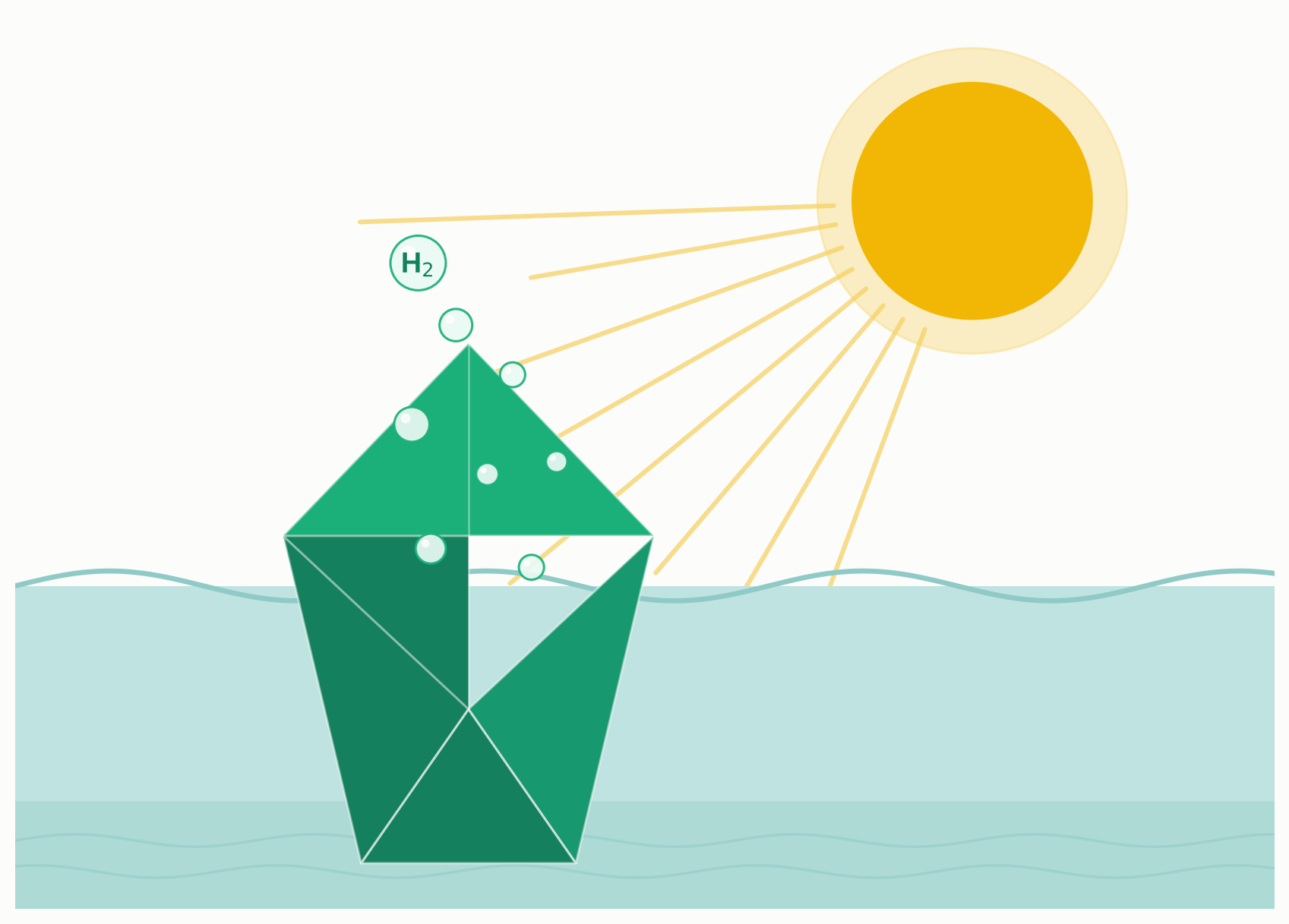
    Illustration of sunlight striking a crystal submerged in water, releasing hydrogen bubbles

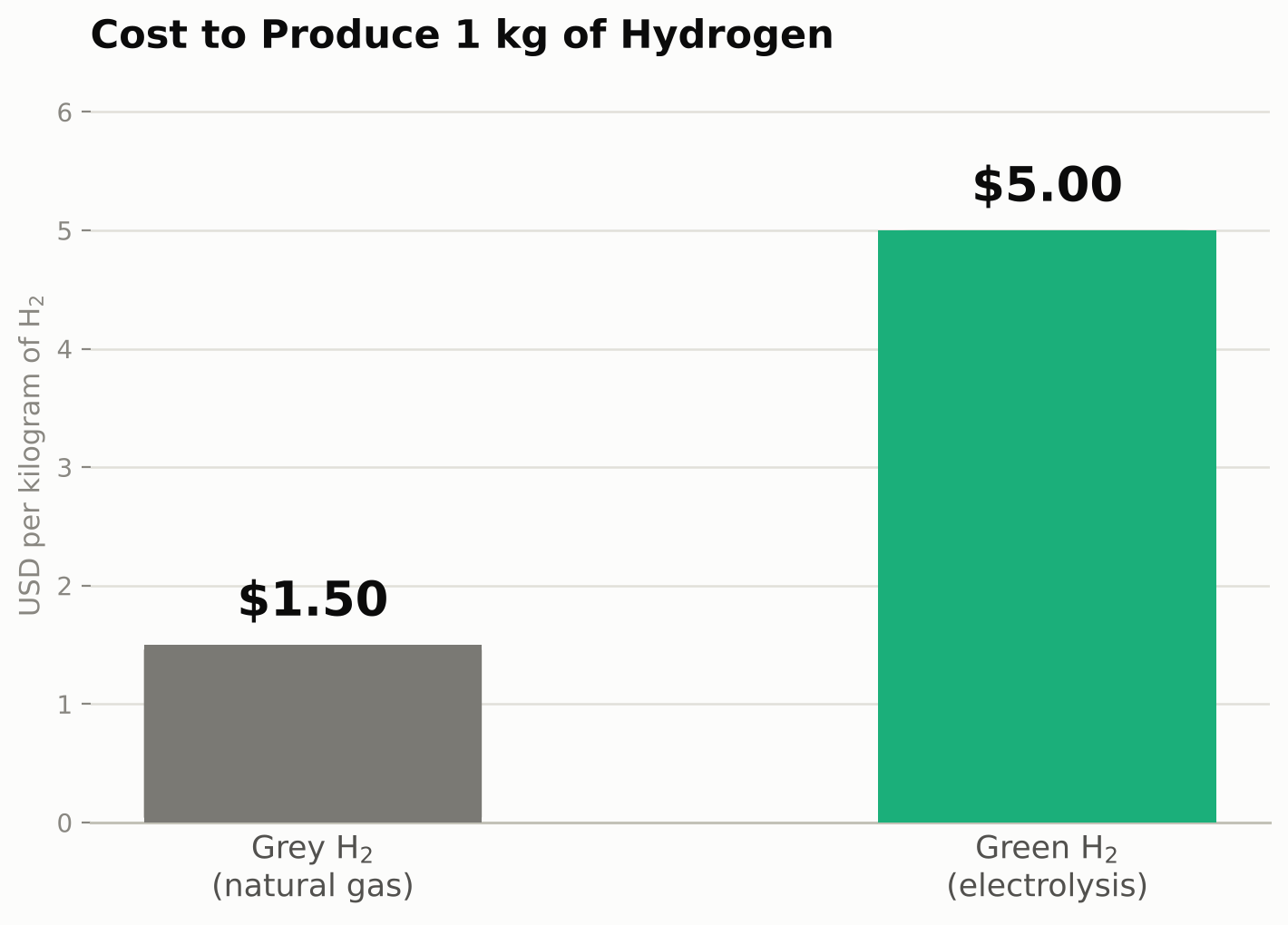
    Hydrogen is widely discussed as a fuel for ships, heavy trucks, steelmaking, and chemical plants that are hard to run on batteries alone, since it can generate electricity in a fuel cell with water as the main byproduct. The catch is how the hydrogen gets made. Today, hydrogen production is dominated by fossil fuels, mostly natural gas processed through a method called steam-methane reforming, with coal gasification also contributing a significant share, particularly in parts of Asia. That hydrogen is relatively cheap, on the order of $1.50 per kilogram by Oregon State’s figures, but it releases carbon dioxide in the process, which undercuts much of the climate case for switching to hydrogen in the first place.

    Hydrogen made by splitting water with renewable electricity or sunlight, often called green hydrogen, avoids that emissions problem, but it typically costs around $5 per kilogram today by the same estimate, more than three times as much. These are illustrative, broad figures rather than fixed prices; actual costs swing with local energy prices, plant scale, and technology. Still, part of the gap comes down to hardware: some electrolyzers and photocatalytic systems rely on precious-metal catalysts, platinum among them, to drive the reaction fast enough to be practical, and those materials are not cheap.

    Catching Light With Sulfur, Not Metal

    The Oregon State team, led by chemist Kyriakos Stylianou of the university’s Materials Discovery Laboratory, built a metal-organic framework, a class of crystalline, extremely porous materials assembled from metal ions linked together by organic molecules, that they call BVR-19. It forms spontaneously in water at room temperature, a synthesis route the researchers say avoids the high heat or pressure many materials need, though how that translates into a final production cost has not been established.

    The structural feature that matters most sits inside BVR-19’s organic linkers: a bond between two sulfur atoms that briefly breaks apart when struck by light, generating short-lived, highly reactive sulfur species. According to Oregon State’s announcement, it is these organic, sulfur-containing building blocks that help capture light energy and move electrons to where hydrogen is ultimately produced, working alongside the framework’s metal centers rather than leaving the metal to do that job alone.

    Cost comparison of grey and green hydrogen production, per kilogram in USD
    Source: approximate figures cited alongside Oregon State University’s announcement

    Metal-organic frameworks have drawn growing interest across chemistry over the past two decades because they are so tunable: change the metal, change the organic linker, and the pore size, surface area, and chemical behavior of the resulting crystal can shift dramatically, all within the same basic scaffold. That tunability is also what let the Oregon State team probe BVR-19’s inner workings, discussed next.

    Skipping the Bolted-On Metal Catalyst

    Photocatalytic water splitting conventionally needs more than a light-absorbing material: it usually also requires a separate metal co-catalyst, often platinum, physically attached to the structure to help the hydrogen-forming step run efficiently. Oregon State’s announcement describes BVR-19 as needing no additional expensive metal catalyst for that job, since its organic sulfur chemistry already contributes much of the light capture and electron transfer that a bolted-on catalyst would otherwise be doing.

    That should not be read as “metal-free.” BVR-19 still contains a metal center as part of its crystalline framework, and the team found that changing which metal sits there measurably changed how well the material performed, meaning the metal is far from irrelevant to the chemistry. The real, narrower claim is that no extra, separately added metal catalyst has to be layered on top of the base material the way platinum often is in other systems. It is a distinction worth keeping straight, because the innovation here is removing an added manufacturing step and its cost, not removing metal chemistry from the picture entirely.

    From One Experiment to Design Rules

    To understand why some versions of the framework outperformed others, the team systematically swapped out the metal ion at BVR-19’s core while leaving the rest of the structure essentially unchanged, then compared how each version performed under light. That side-by-side comparison let them connect differences in hydrogen output to specific changes in the material’s electronic structure, giving them a mechanistic explanation for why certain versions work better rather than only an empirical ranking of which ones do.

    “Our work provides a blueprint for designing better materials that can bring down the cost of green hydrogen,” Stylianou said in the university’s announcement of the findings. The team frames the result as a design principle to test and build on in future materials, rather than a finished, optimized catalyst.

    Research groups elsewhere are taking a similar mechanism-first approach to other energy-relevant reactions. A Kyoto University-led team, for instance, recently worked out in detail why a molybdenum molecular catalyst can convert nitrogen from the air into ammonia under comparatively mild laboratory conditions. In both cases, the advance was not a brand-new chemical but a clearer picture of why an existing catalyst behaves the way it does, which is usually what lets chemists improve a material on purpose instead of by trial and error.

    What Cheaper Hydrogen Could Unlock

    None of this means cheap, catalyst-light green hydrogen is imminent. Oregon State’s announcement and the peer-reviewed paper describe a laboratory-scale material and a design principle, not a measured hydrogen production rate, an efficiency figure, or a path to manufacturing; those numbers were not disclosed publicly alongside the findings. The work has not been tested at anything resembling industrial scale, and getting from a promising crystal in a lab to a working photocatalytic reactor typically requires years of further development, stability testing, and engineering, assuming it clears each step at all.

    What the study adds is a mechanistic foothold: evidence that letting an organic, sulfur-based structure share the light-absorbing and electron-transfer work can reduce a material’s dependence on costly bolted-on metal catalysts, at least in this framework, plus a method for figuring out which structural tweaks help and which do not. Whether that translates into cheaper hydrogen depends on factors the current study does not address, including the material’s hydrogen production rate, its durability over repeated use, and the cost of the reactor system built around it. If those later steps go well, incremental advances like this one, chipping away at the cost of individual components rather than reinventing hydrogen production overnight, are generally how energy technologies get cheaper over time. That is also what would let industries that are hard to electrify, such as steelmaking, shipping, and heavy trucking, lean more on low-carbon hydrogen instead of the fossil-derived hydrogen most of them use today.

    The project was funded by the Murdock Charitable Trust, the National Science Foundation, and Oregon State’s College of Science. For now, the result lives in a peer-reviewed paper and a university announcement, with the follow-up work, refining BVR-19, measuring its efficiency, and testing its durability, still ahead.

    Sources: Oregon State University, Journal of the American Chemical Society (DOI), ScienceDaily, Interesting Engineering

  • Turning Air Into Ammonia, More Gently — Kyoto University Team Explains Why a Molybdenum Catalyst Works

    Ammonia is the backbone of the world’s food supply as the raw material for fertilizer, but making it burns a staggering amount of energy worldwide. A research team including Kyoto University’s Fukui Institute for Fundamental Chemistry has now worked out the previously unknown mechanism behind a molecular catalyst that converts nitrogen gas (N2) — abundant in the air around us — into ammonia under comparatively mild conditions.

    A Process That Eats 1-2% of the World’s Energy

    Today, almost all industrial ammonia comes from the Haber-Bosch process, which forces nitrogen and hydrogen to react at roughly 400–500°C and hundreds of atmospheres of pressure. Because the hydrogen feedstock is mostly made from natural gas, the process comes with heavy CO2 emissions. Global ammonia production is estimated to account for something like 1–2% of the world’s total energy consumption, and chemists have long sought a way to fix nitrogen under gentler conditions.

    Turning Water Into a “Powerful Hydrogen Carrier”

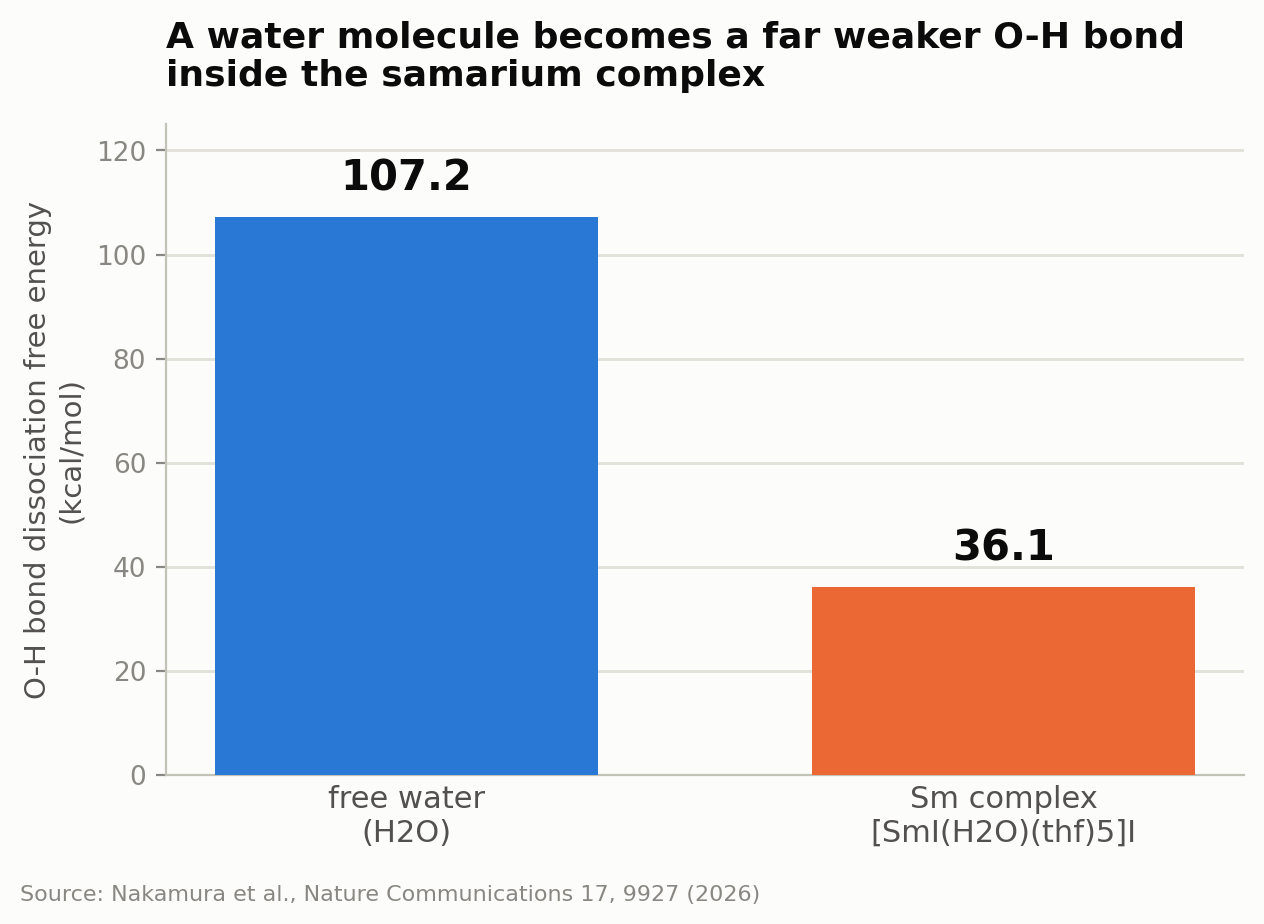
    The team focused on a reaction system that pairs a molybdenum (Mo) molecular catalyst with samarium diiodide (SmI2) and water. Normally, breaking water’s O-H bond to hand off a hydrogen — in chemical terms, a proton and an electron delivered together in a process called proton-coupled electron transfer (PCET) — takes a large amount of energy. But through theoretical calculations, the team found that when water binds to a samarium ion to form the complex [SmI(H2O)(thf)5]I, that O-H bond’s dissociation free energy drops dramatically.

    The O-H bond dissociation free energy of a free water molecule is 107.2 kcal/mol, but inside the samarium complex it falls to 36.1 kcal/mol — down to roughly a third, by calculation.
    Bar chart comparing O-H bond dissociation free energy of free water versus water in the samarium complex
    Figure: O-H bond dissociation free energy (BDFE) of water, free vs. bound in the samarium complex — 107.2 kcal/mol down to 36.1 kcal/mol. Source: Nakamura et al., Nature Communications 17, 9927 (2026)

    Mapping the Reaction Pathway for the First Time

    Combining experiments with theoretical calculations, the team also worked out the step-by-step pathway by which nitrogen on the molybdenum center transforms — from nitride (Mo≡N) to imide (Mo=NH) to amide (Mo-NH2) and finally to an ammonia complex. The step demanding the most energy, by calculation, was imide formation, with an activation free energy of 5.1 kcal/mol. Structural models corresponding to the imide and amide species — related compounds carrying a methyl group on nitrogen — were actually isolated and had their structures determined.

    Why It Matters

    With the reaction mechanism now mapped out, the team has a design roadmap for improving the catalyst further. A related molecular catalyst the same team has previously developed has produced as many as 60,000 equivalents of ammonia per molybdenum atom, and the new mechanistic insight is expected to feed into next-generation nitrogen-fixation technology. The findings were published in Nature Communications on September 24, 2026.

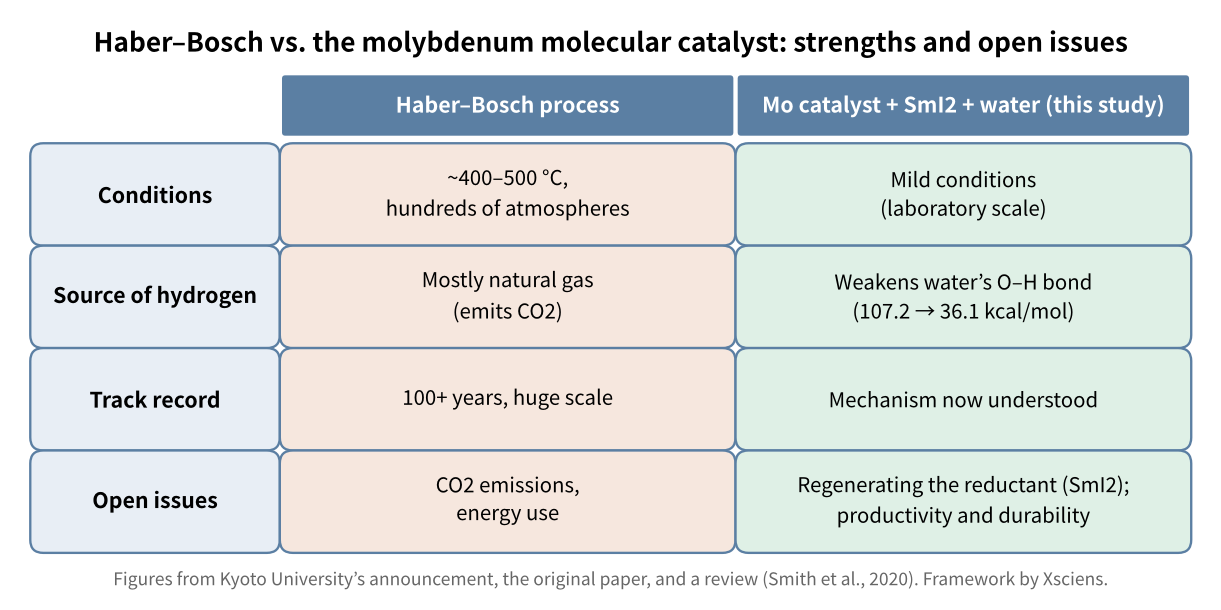
    Comparison table of the Haber–Bosch process and the molybdenum molecular catalyst: conditions, hydrogen source, track record and open issues
    Comparison of the industrial process and this catalyst (compiled by Xsciens from Kyoto University’s announcement, the paper and a review).

    The Team and Where This Work Fits

    The research was carried out by Kazunari Yoshizawa of Kyoto University’s Fukui Institute for Fundamental Chemistry (professor emeritus at Kyushu University), Professor Yoshiaki Nishibayashi of the University of Tokyo’s Graduate School of Engineering, Professor Hiromasa Tanaka of Daido University, and Assistant Professor Taiji Nakamura of Kyoto Institute of Technology, among others. Nishibayashi’s group had earlier reported that a molybdenum molecular catalyst can make ammonia from nitrogen and water at ordinary temperature and pressure (the reaction system also uses samarium diiodide). This time the team tackled the question of why that reaction proceeds.

    Experiments and Calculations Working Together

    The team isolated reaction intermediates, the species formed partway through the reaction, as stable compounds and confirmed their structures, which backed the proposed pathway experimentally. They also used quantum chemical calculations (computer methods that predict how molecules behave from quantum mechanics) to examine steps that are hard to observe directly, confirming the structure of the samarium diiodide and water complex and the important role of proton-coupled electron transfer in forming ammonia. According to Kyoto University, the hardest step in the whole reaction is the one that forms the imide.

    Hurdles Before Practical Use

    The result is an understanding of how the reaction works, and it does not by itself become an industrial production method. Using this understanding as a clue, the group aims to develop high-performance catalysts that make ammonia with less energy. It also says that sustainable ammonia production needs not only better catalysts but also work on reaction conditions to enable renewable energy use and lower production costs.

    According to Kyoto University, this result is part of the outcomes of NEDO’s Green Innovation Fund project (with Idemitsu Kosan as lead company). The same fund also includes a project to build a supply chain for ammonia as a fuel, such as demonstrations of technology to co-fire ammonia at 50% or more in the boilers of commercial coal-fired power plants (fiscal 2021 to 2028). That co-firing work is a separate theme from the catalytic mechanism studied here. Ammonia is attracting attention not only as a fertilizer ingredient but also as a medium for carrying and storing hydrogen and as a fuel.

    Xsciens Editorial Note

    The value of this study is not that ammonia has become cheaper to make. It is that we now know why the catalyst works.

    • What was shown. The mechanism by which water’s O–H bond is weakened to hand hydrogen to the catalyst, and the intermediate steps by which nitrogen becomes ammonia, were supported by both experiments and calculations.
    • What is still open. The reaction needs samarium iodide as a reductant. A review (Smith et al., 2020) points out that for metal-complex routes, the energy needed for the reducing agent and proton source tends to be much larger than for conventional Haber–Bosch, so how the reductant is regenerated or reduced will likely be the key to practical use.
    • A caution when reading. “Mild conditions” refers to the laboratory; it does not mean a giant plant can be replaced. A comparison only means something once scale, cost and emissions are taken into account.
    • Our imagination (speculation) — We wonder whether this work might not change fertilizer prices soon, but add “one more map” for catalyst designers. It could, for example, help researchers imagine small units that make fertilizer in places where a large factory is hard to build, such as remote islands or rural areas. This is only our speculation, and it depends on solving catalyst durability and the reductant problem.

    References for this note: Smith, Hill & Torrente-Murciano, “Current and future role of Haber–Bosch ammonia in a carbon-free energy landscape”, Energy & Environmental Science 13, 331–344 (2020)

    Sources

    Kyoto University, “Catalytic mechanism of next-generation ammonia synthesis method elucidated”
    Nakamura et al., “Unveiling full mechanistic picture of Mo-catalysed nitrogen fixation driven by SmI2–H2O system,” Nature Communications 17, 9927 (2026)