The most advanced chips in your phone, your car, and the AI models running in the cloud are usually associated with Taiwan or South Korea — but only a handful of countries can supply the machines that make those chips in the first place. Japan quietly controls this chokepoint in the global semiconductor supply chain, with companies like Tokyo Electron, SCREEN Holdings, and DISCO ranking among the world’s top makers of semiconductor manufacturing equipment. That strength shows up just as clearly in the patent world. Drawing on data from the Japan Patent Office and specialist patent-analytics firms, here’s a look at Japanese equipment makers’ patent trends, what they reveal, and one especially notable patent.
World-Leading in Both Patent Quantity and Quality
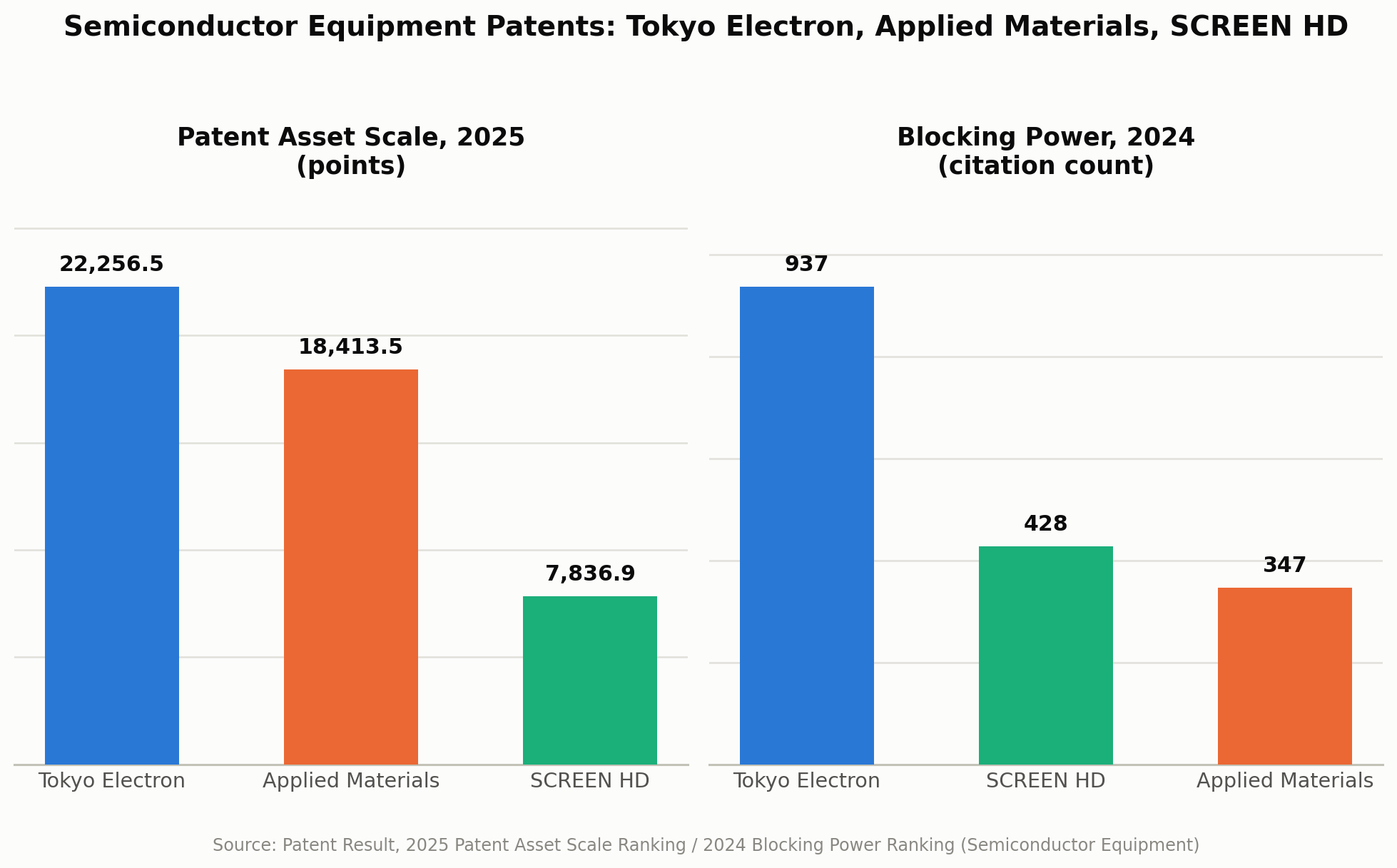
In the “2025 Patent Asset Scale Ranking for the Semiconductor Equipment Industry,” published by the patent analytics firm Patent Result, Tokyo Electron ranked first in the world with 814 registered patents and a score of 22,256.5 points. Applied Materials of the US came in second (586 patents, 18,413.5 points), and SCREEN Holdings placed third (329 patents, 7,836.9 points). This “patent asset scale” isn’t a simple count of filings — it’s calculated by multiplying each patent’s prominence (such as how often it’s cited) by its remaining term, so it measures not just volume but how many genuinely impactful patents a company holds.
Even more interesting is the 2024 “Blocking Power Ranking.” This tallies how many times a company’s patents were actually cited by examiners as prior art when rejecting other companies’ applications. Here too, Tokyo Electron topped the list with 937 citations, followed by SCREEN Holdings (428), Applied Materials (347), DISCO (277), and ULVAC (154) — Japanese companies took four of the top five spots. The more often a rival’s new invention gets bounced back with, in effect, “we already patented that,” the more that company’s technology has become foundational to the industry.
| Ranking (Year) | 1st | 2nd | 3rd |
|---|---|---|---|
| Patent Asset Scale (2025) | Tokyo Electron | Applied Materials | SCREEN HD |
| Blocking Power (2024) | Tokyo Electron | SCREEN HD | Applied Materials |
Three Things the Patent Data Reveals
1. Citation counts matter more than filing volume as a measure of real strength.
In a field like semiconductor equipment, where technology builds cumulatively, foundational inventions with broad applicability tend to get cited again and again as grounds for rejecting later filings. Tokyo Electron topping both rankings isn’t just about filing a lot of patents — it’s evidence the company holds foundational technology that rivals simply can’t route around.
2. Strength is concentrated in front-end processes (deposition, etching, cleaning).
Looking at the substance of the top-ranked patents, most cluster around “front-end” technologies that work directly on the wafer — deposition, etching, and cleaning. As chips keep shrinking, the value of nanometer-precision processing and cleaning technology keeps rising, so depth of patents in this area translates directly into competitiveness.
3. These companies have been filing with a global market in mind from the start.
According to Tokyo Electron’s own disclosures, the company has maintained a global patent filing rate — the share of patents also filed overseas — of roughly 75% for six consecutive years. Securing rights simultaneously not just in Japan but in the major chipmaking countries and regions (the US, China, South Korea, Taiwan) reflects a filing strategy that tracks the company’s global market share.
One Standout Patent: A Cleaning-Equipment Patent That’s the Industry’s Biggest “Wall”
A patent’s value isn’t just about how many there are — it’s also about how much it blocks competitors from filing around it. A good example is Tokyo Electron’s patent covering technology that cleans a wafer’s front surface, its beveled edge (the angled cut at the rim), and its back surface all in a single cleaning tool. According to Patent Result’s 2024 survey, this patent was cited more often than any other as grounds for rejection in competitors’ patent examinations — meaning rival makers’ new cleaning-technology filings have repeatedly run into this one idea.
Cleaning may sound like an unglamorous step, but a semiconductor becomes defective the moment a single invisible speck of dust lands on it. The idea of efficiently cleaning three differently shaped surfaces — front, back, and edge — in one machine is a foundational technology whose value only grows as miniaturization advances. It’s a good example of an unflashy technology that quietly props up the industry from behind the scenes.
The Bottom Line
Behind the flashy headlines about semiconductors themselves, the Japanese companies that build the machines that make them maintain a world-class presence in patents, both in quantity and quality. As demand for AI and leading-edge logic chips keeps growing, the patent competition around front-end technologies like deposition, etching, and cleaning looks set to intensify further.
Patent Result, “2025 Patent Asset Scale Ranking for the Semiconductor Equipment Industry: Top 3 Are Tokyo Electron, AMAT, and SCREEN”
Patent Result, “2024 Blocking Power Ranking for the Semiconductor Equipment Industry: Top 3 Are Tokyo Electron, SCREEN, and AMAT”
Tokyo Electron, “Intellectual Property and Intangible Assets”
Leave a Reply