Every day you live through is not quite the same length as the last one, and the difference is measured in milliseconds. Part of this wobble, especially its slow, multi-decade rhythm, is tied to how a hidden solid ball of iron at Earth’s center, the inner core, pulls against the mantle above it, according to a new model-based analysis by researchers at the University of Alberta. The precise tracking of Earth’s rotation that underlies GPS navigation and the world’s official timekeeping is not unrelated to this invisible tug-of-war deep inside the planet.
Title: Gravitational torque drives multidecadal variations in length of day
Authors: Zhang, H. and Dumberry, M.
Journal: Nature 658, 119–124 (2026)
URL: nature.com/articles/s41586-026-10999-2
A Tug-of-War Inside the Planet
Huifeng Zhang and Mathieu Dumberry, physicists at the University of Alberta in Canada, combined 55 years of Earth-rotation data (1964–2019) with a seismologically informed history of inner-core rotation and models of outer-core flow. They found that a roughly 60-to-70-year cycle in the length of day, with an amplitude of just a few milliseconds, can largely be explained by a model in which gravitational torque from the inner core is the main driver. Their paper appeared in the journal Nature on September 23, 2026.
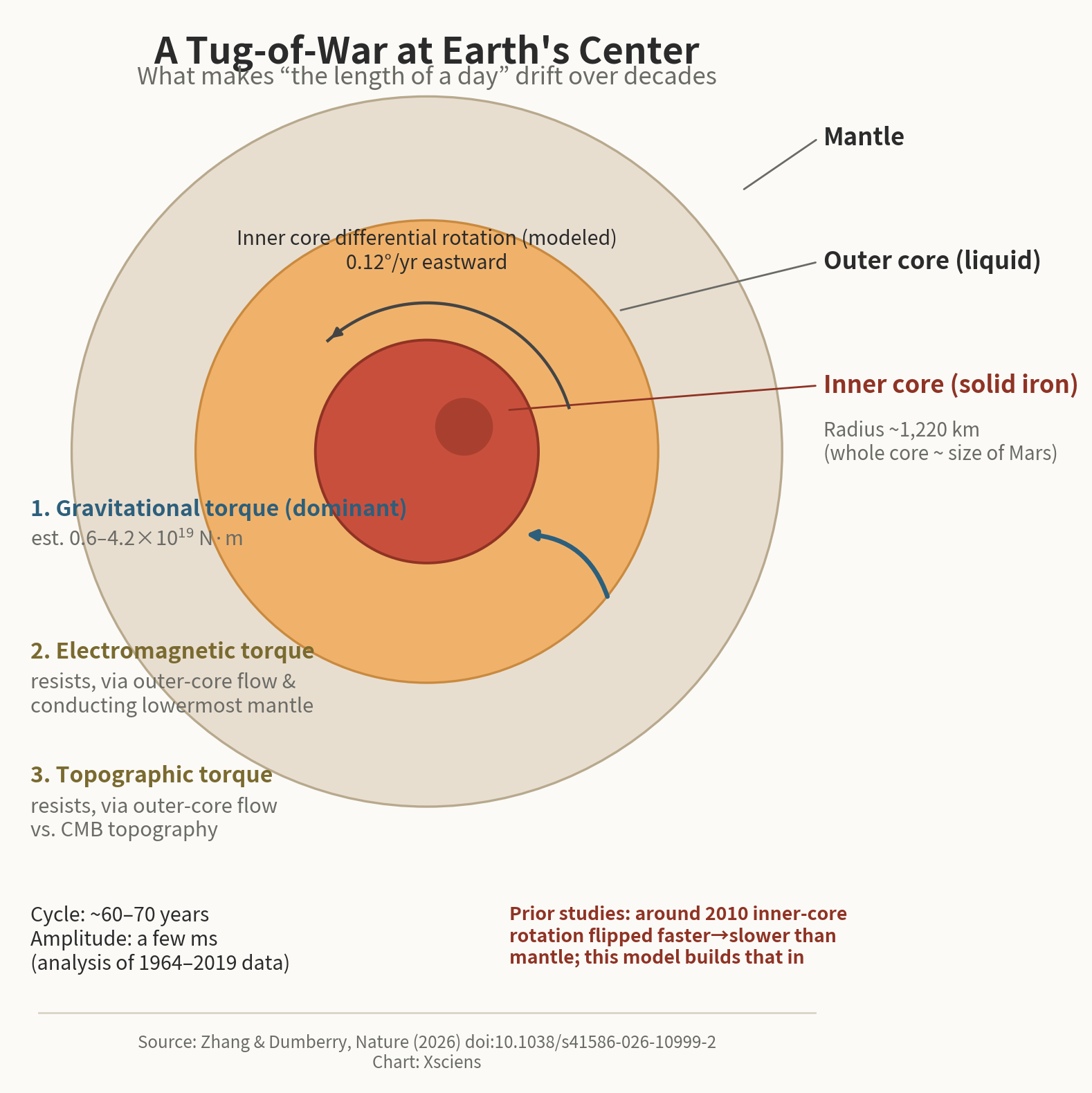
Roughly 5,000 km beneath the mantle sits a solid iron inner core with a radius of about 1,220 km, surrounded by the molten outer core (the inner and outer core together, as a single unit, are closer to the size of Mars). According to the researchers, a slight mismatch between the inner core’s shape and mass distribution and the denser regions of the mantle above generates what they call a gravitational torque, the main factor changing the rotation speeds of both the inner core and the rest of the planet.
An Invisible Core, and How We Track Earth’s Spin
Two other forces push back against that gravitational pull: a “topographic torque,” arising as outer-core flow interacts with bumps and dips on the core-mantle boundary (CMB), and an “electromagnetic torque,” transmitted through Earth’s magnetic field as the outer core flows past the electrically conducting lowermost mantle. Together they act as a brake. The model estimates the gravitational torque at roughly 0.6 to 4.2 × 10¹⁹ newton-meters, with the inner core creeping eastward relative to the mantle by about 0.12 degrees a year. None of these are direct measurements — they are values inferred from rotation data by working backward through the model.
Prior seismological studies suggest that, around 2010, the inner core switched from rotating faster than the mantle to rotating slower — a pattern this new model builds into its calculations.
These small shifts in Earth’s rotation matter for precisely tracking and predicting Earth’s orientation, which underlies satellite navigation, and for decisions about “leap seconds,” the adjustments occasionally used to keep Coordinated Universal Time aligned with Earth’s actual rotation. Earth’s spin has been trending slightly faster in recent years, and international timekeeping bodies are now discussing changes to how leap seconds are handled. Work like this offers a way to connect small, surface-level timing signals to physical models of a part of the planet no one can observe directly.
Because no one can drill down to the inner core, scientists have had to infer its properties indirectly, mostly from how seismic waves travel through it. The authors themselves note that their results depend on the accuracy of the underlying models of inner-core rotation and outer-core flow. Still, connecting an everyday measure like the length of a day to physical models of Earth’s deep interior offers one more way to probe a part of the planet we may never see directly.
Xsciens editorial note: inferred, not measured
The key caution is in the article’s own wording: the torque strength (about 0.6 to 4.2 × 10¹⁹ newton-meters) and the inner core’s drift (0.12 degrees per year eastward) are values inferred through a model, not measured directly. They show that a gravitational-torque model can explain the observed 60-to-70-year cycle in the length of day, which is different from proving it is the only explanation.
Another detail worth noticing is the time span. The rotation data cover 1964 to 2019, about 55 years, which is shorter than one full 60-to-70-year cycle, so the long rhythm is being inferred from less than a complete period. The model also builds in a seismology-based claim that the inner core switched around 2010 from turning faster than the mantle to turning slower. What to watch next is whether new seismic observations of the inner core and further years of rotation data keep agreeing with the model.
Key terms
- Inner core: the solid iron ball at Earth’s center, with a radius of about 1,220 km
- Outer core: the liquid layer surrounding the inner core
- Mantle: the thick rocky layer between the core and Earth’s crust
- Torque: a twisting force that changes how fast something rotates
- Core-mantle boundary (CMB): the interface between the outer core and the mantle
- Leap second: an occasional one-second adjustment that keeps Coordinated Universal Time aligned with Earth’s rotation
Sources: Zhang, H. & Dumberry, M. “Gravitational torque drives multidecadal variations in length of day.” Nature 658, 119–124 (2026), Nature News & Views commentary, ScienceDaily
Leave a Reply