Cool a chemical reaction down, and it should slow to a crawl — that’s basic chemistry. But for one hydrogen-making catalyst, the story turns out to be more complicated than that. Researchers at Japan’s RIKEN institute have found that a manganese oxide catalyst used to split water into hydrogen degrades the least right around the freezing point of water, and then degrades faster again once the water is chilled further still. The finding offers a new angle on one of green hydrogen’s stubborn cost problems: catalysts that wear out too fast.
Title: Cooling Water to Near Freezing Breaks the Activity-stability Trade-off of Water Oxidation Electrocatalysis
Authors: Wardhana, A. C. et al.
Journal: Nature Chemistry
DOI: 10.1038/s41557-026-02274-8
The Weak Link in Green Hydrogen
Splitting water into hydrogen and oxygen using electricity from solar or wind power is the core process behind “green hydrogen,” a carbon-free alternative to fossil fuels for power generation, steelmaking, and transport fuel. Hydrogen produced this way could, in principle, replace fossil fuels across a wide swath of heavy industry, which is why so much research funding is chasing it.
The catch is cost. At the electrode where oxygen is released, the chemical environment is harshly oxidizing, and over time the catalyst coating that electrode slowly dissolves away. Replacing or maintaining it is a recurring expense, and durability problems like this are a big part of why electrolysis-based hydrogen still costs more than hydrogen made from natural gas. Any discovery that makes catalysts last longer without a complete materials overhaul is worth a closer look.
Speed Versus Durability: The Old Rule
Chemical reactions generally speed up as temperature rises — a basic rule of chemistry known as the Arrhenius relationship, named after the 19th-century chemist who first described it. Raise the temperature and a water-splitting reaction goes faster, which sounds like a straightforward way to boost hydrogen output. But raise the temperature too much, and the catalyst itself degrades faster too, since the harsh oxidizing side-reactions that eat away at it also speed up with heat. Cool things down, on the other hand, and the catalyst tends to last longer — but the water-splitting reaction itself slows to match. Engineers have generally treated this as a fixed trade-off: push for speed, and durability suffers; push for durability, and speed suffers.
A Sweet Spot Right at Freezing
A team led by Ryuhei Nakamura, team director at RIKEN’s Center for Sustainable Resource Science and a professor at the Earth-Life Science Institute at the Institute of Science Tokyo, decided to test that assumption directly. Using a manganese oxide (MnO2) catalyst, a common and inexpensive choice for this kind of reaction, the team ran the electrolysis across a wide temperature range — from a warm 80°C down to -12°C, well below the normal freezing point — and carefully tracked two things at once: how fast oxygen bubbled off the electrode, and how much manganese leached out of the catalyst as it broke down.
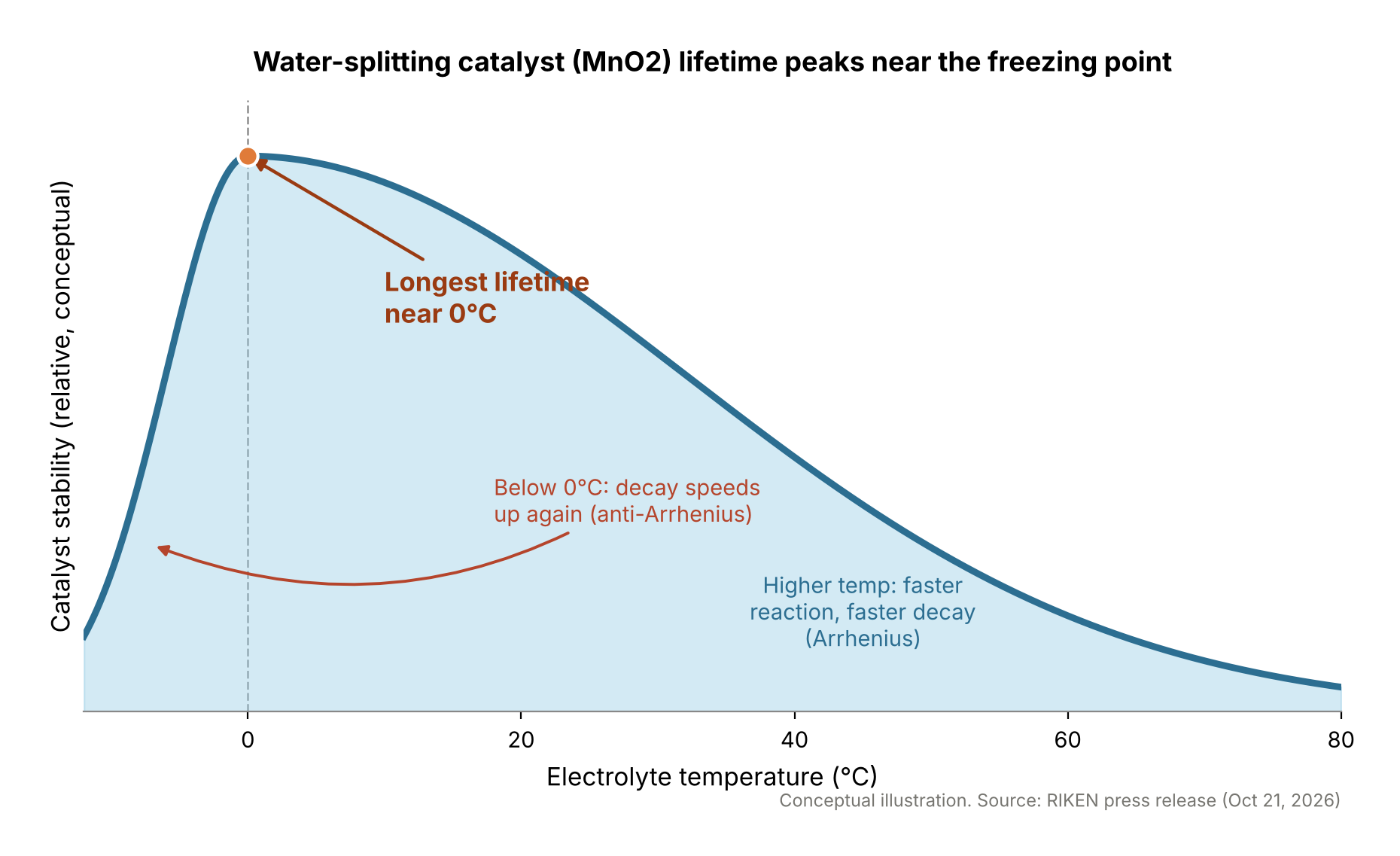
The results were not what a simple reading of the Arrhenius relationship would predict. As the temperature dropped from 80°C toward 0°C, both the reaction rate and the degradation rate slowed down, as expected. But the degradation rate fell off by far more than the reaction rate did. In practical terms, that means that near 0°C, the catalyst could last substantially longer while giving up comparatively little reaction speed — a sweet spot hiding in plain sight. The team confirmed this wasn’t just a snapshot measurement: in longer-duration tests that ran a steady electric current through the cell and tracked how long the catalyst held up, lifespan peaked right around 0°C and then declined again as the electrolyte was chilled further, tracing out a distinct peak rather than a straight line.
Why Colder Water Breaks It Faster
The more surprising twist showed up below 0°C. Instead of continuing to degrade more slowly as temperatures kept dropping — which is what ordinary chemistry would predict — the catalyst flipped and started breaking down faster the colder it got. Chemists call this an “anti-Arrhenius” pattern, because it runs exactly opposite to the usual temperature rule. The effect was visible to the naked eye: an electrolyte solution held at -8°C turned noticeably deeper pink than one held at 2°C, a color change consistent with a buildup of permanganate ions, a telltale marker of the catalyst breaking down.
Below 0°C, the colder the water got, the faster the catalyst broke down — the exact opposite of what ordinary chemistry would predict.
The explanation traces back to a strange property of water itself, known as “supercooling.” Below 0°C, the sulfuric-acid electrolyte solution in the experiment didn’t freeze immediately — it stayed liquid in an unstable, supercooled state, confirmed in the study by triggering ice formation with mechanical shock and watching how the liquid behaved beforehand. Using Raman spectroscopy to examine the molecular structure of the water, the researchers found that the network of hydrogen bonds connecting water molecules in this supercooled state looks markedly different from the structure of ordinary water above 0°C. The team’s working hypothesis is that this altered molecular structure is what accelerates manganese loss from the catalyst, driving the faster breakdown seen at sub-zero temperatures.
Catalyst durability has traditionally been tackled by redesigning the material itself — changing its chemical composition or its microscopic structure to make it more resistant to the oxidizing environment. A sulfur-based material that produces hydrogen from sunlight, developed elsewhere, is one recent example of that materials-first approach to cheaper hydrogen production. What stands out about this study is that it doesn’t touch the catalyst material at all. Instead, it shows that something as simple as tuning the temperature of the reaction environment can shift the balance between how active a catalyst is and how long it survives.
From Cold Climates to Icy Worlds
The researchers see temperature as a new design lever that engineers could use alongside, or even instead of, changes to catalyst chemistry, to balance activity against stability. That has implications that go beyond ordinary industrial electrolyzers. The same principle could inform the design of electrochemical systems built to operate in cold or polar climates, where keeping equipment near room temperature is itself an energy cost. More speculatively, the findings could also help explain electrochemical reactions involving low-temperature water on other planetary bodies, where near-freezing or supercooled water may be common. The research team frames the work as contributing to UN Sustainable Development Goals centered on clean water and clean, affordable energy. The results were published October 21, 2026, in the journal Nature Chemistry, with support from Japan’s GteX program, JSPS KAKENHI, and other funding bodies.
Not Just the Material, But the Setting
A catalyst’s performance isn’t dictated by its composition and structure alone — that’s the central insight of this study. Something as simple as the temperature of the surrounding water can shift the balance between how fast a reaction runs and how long the catalyst that drives it survives. This result won’t make green hydrogen cheaper overnight, and plenty of engineering work stands between a laboratory finding and a commercial electrolyzer. But the idea of designing catalysts around the conditions they operate in, rather than focusing solely on the materials they’re made from, gives engineers a new variable to work with — one that costs nothing to install, since it only requires controlling a temperature that already has to be managed anyway.
Sources: RIKEN press release, “Electrolysis catalyst becomes longer-lived near 0°C”, Nature Chemistry (DOI: 10.1038/s41557-026-02274-8)