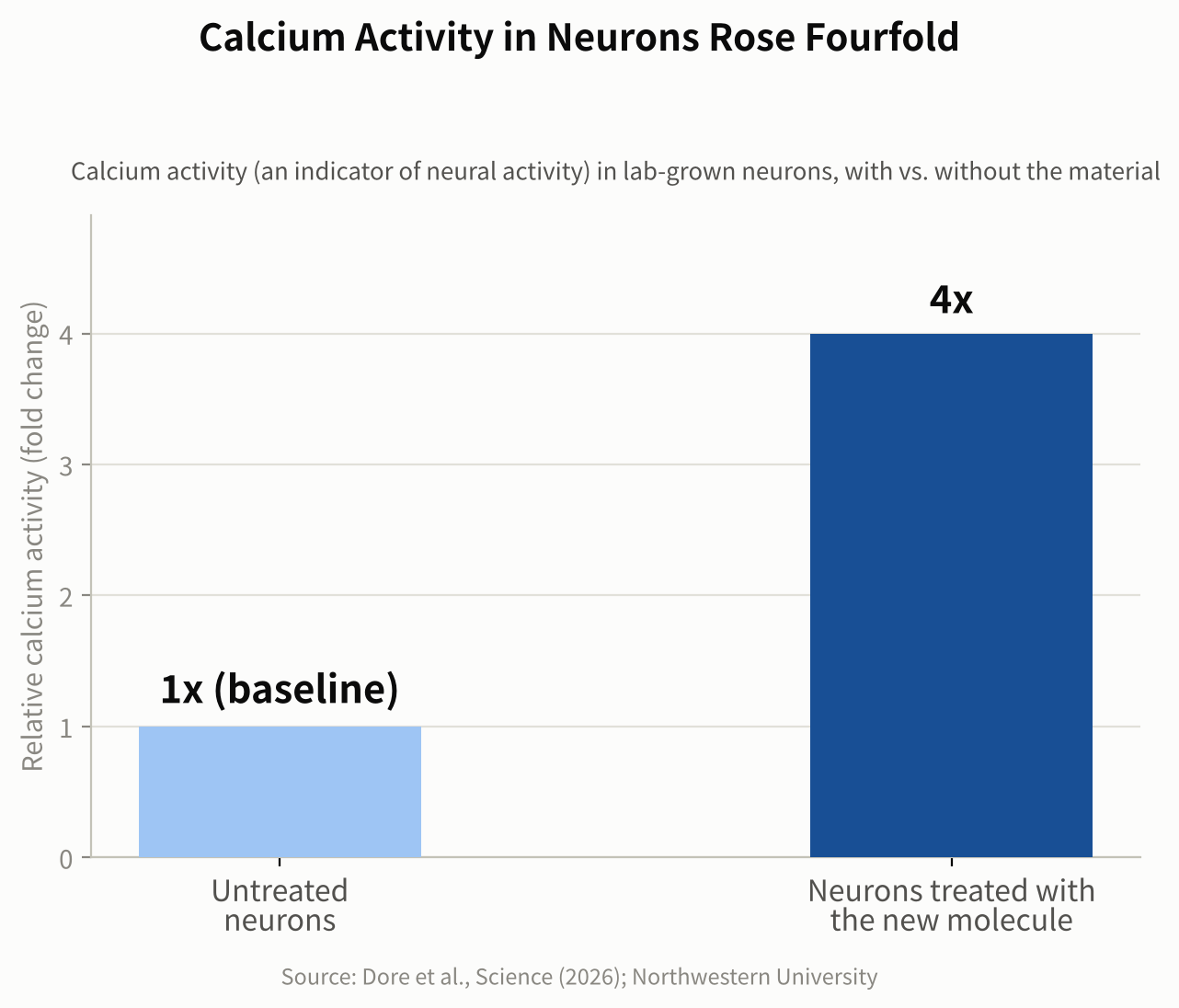
- A newly built, self-assembling material made nerve cells growing in a lab dish roughly four times more biologically active than usual, hinting that materials like it could one day help repair damaged nerves.
- Chemists at Northwestern University found a new way to precisely control how long a certain kind of molecular thread grows, and how its positively and negatively charged segments are arranged along the way.
- By molecular standards the resulting threads are enormous — roughly 100 times heavier than typical plastic-like polymers and bigger than even the largest proteins found in nature — even though they are built from many smaller molecules that click together on their own, rather than one molecule held together by ordinary chemical bonds.
- So far the effect has only been shown in cells grown in a lab dish, not in animals or people, so any real treatment is still a long way off.
Billion-Dalton Supramolecular Polymers: A Structure Big Enough to Rival a Cell
A team led by the chemist Samuel I. Stupp at Northwestern University has built a new kind of giant structure, described in the journal Science on October 1, 2026. It belongs to a class of materials called supramolecular polymers. Rather than being a single molecule held together by strong chemical bonds the way an ordinary plastic is, it is made of many smaller molecules that click onto one another and hold themselves together more loosely, the way a line of magnets snaps together end to end. That looseness usually makes supramolecular polymers easy to assemble but hard to control, since there has been no reliable way to stop them from growing at a chosen point.
Scientists weigh molecules in daltons, a unit named after the 19th-century chemist John Dalton, where one dalton is roughly the mass of a single hydrogen atom. Northwestern researchers point to common high-mass synthetic polymers used in materials science, which weigh around 10 million daltons, for comparison. Some of the largest proteins found in nature — the kind that give muscle tissue its structure — are in the roughly 3 to 5 million-dalton range. The new Northwestern assembly reaches a combined mass in the billions of daltons, around 100 times heavier than those conventional polymers, and its longest threads stretch farther than the width of a single living cell.

Why Controlling the Length Was So Hard
Because supramolecular polymers assemble themselves from many separate molecules rather than being built link by link under a chemist’s control, they have historically kept growing in a somewhat unpredictable way. That made it hard to control how long any given thread would grow, or where along its length particular features would end up. The Northwestern team solved this with a technique they call self-capping supramolecular polymerization: as the supply of available building-block molecules runs low, flexible regions at each end of the growing thread fold over on themselves, effectively capping the ends and stopping further growth.
That trick let the researchers control two things at once: the overall length of each thread, and how positively and negatively charged segments are arranged along it. In a statement describing the work, Stupp called the result a breakthrough in materials design.
“We discovered something we had never seen before in chemistry or in biology.”
Precise Length and Charge Segmentation: The Charge Pattern Made the Difference
Before arriving at their final design, the researchers tried several simpler charge patterns on neurons growing in a lab dish. Threads carrying only positive charge essentially killed the neurons; threads carrying only negative charge did almost nothing; and threads with positive and negative charge mixed randomly along their length produced no notable response either. Only one design worked well: a short positively charged segment flanked by longer negatively charged segments, arranged with precision rather than left to chance.
To see how this winning design affected living neurons in culture, the researchers added it to cells growing in a lab dish and tracked them over 7 and 14 days. They used a technique called calcium imaging, which tracks what is known as calcium activity — a widely used indicator of how active a nerve cell is, since neurons briefly let calcium ions flow across their outer membrane as part of firing a signal. It is a standard, well-established way for researchers to gauge neural activity, though it is an indirect measure rather than a literal count of signals fired.
Neurons treated with the winning design showed overall calcium activity roughly four times greater than untreated neurons after seven days, and had formed more synapses by 14 days. The researchers propose that the precise charge pattern works by shaping how the material interacts with the neurons’ outer membrane and with proteins around it, though they describe this as a proposed mechanism rather than a fully confirmed one. Notably, the effect appeared without adding any separate drug, growth factor, or other biological signaling molecule — the geometry of the charge pattern alone was enough to measurably change how the cells behaved.
That matters because nerve cells are known to rely on their electrical activity, along with other cues, to grow new branches and form synapses, the junctions where one neuron passes a signal to the next. Materials associated with more active, better-connected neurons are therefore of particular interest for regenerative medicine, the branch of science focused on helping the body rebuild tissue it has lost or damaged, including nerve tissue after an injury. The researchers describe the link between an entirely synthetic, self-assembling material and this kind of change in living cells as the most surprising part of the result.
From a Lab Dish to a Possible Therapy
So far this particular design has only been tested on neurons growing in a dish, not in animals or people, so any medical use is still likely years away. Lab-dish results are a long way from a treatment: cells in a dish do not have to survive inside a living body, fight off an immune response, or integrate with surrounding tissue the way they would after an actual injury. The Stupp lab has, however, spent years designing self-assembling materials aimed at nerve repair and tissue regeneration, and the researchers see this new level of precision as a step toward building more reliable, tunable materials for that purpose. A logical next stage would be testing whether the material remains safe and effective in animal models of nerve damage, before any human study could even be considered.
The achievement also matters well beyond medicine. Being able to build a giant synthetic structure with a chosen length and a precisely controlled charge pattern opens the door to new materials with tunable mechanical or electrical behavior, useful in fields far from biology too. More broadly, it shows how self-assembly can be used to control a material’s properties over distances far larger than a single molecule — a step toward manufacturing matter with a level of precision that has mostly been limited, until now, to much smaller scales.
Sources: Northwestern Now, EurekAlert!
Paper: Dore, M. et al., “Precise length and charge segmentation of billion-dalton supramolecular polymers”, Science (2026).
Related: new to the topic? Start with What Is a Supramolecular Polymer? A Simple Guide to How It Works.