
Children with older siblings tend to develop fewer allergies — and new gut-microbiome research may point to part of the reason why. A team led by Japan’s RIKEN institute, together with researchers at five Japanese universities, analyzed stool samples from 903 two-year-olds enrolled in a nationwide birth cohort study, with 684 of them followed up again at age four. The number of older siblings a child had was linked to distinct gut-bacteria “types” and to the levels of health-related metabolites in their stool — and, notably, the association held from infancy all the way through the preschool years, a period earlier studies had largely left unexamined.
Title: Sibling factors associated with gut microbiota and fecal short-chain fatty acids in preschoolers
Authors: Tanaka Y. et al.
Journal: Pediatric Research (online, October 14, 2026)
DOI: 10.1038/s41390-026-05478-3
Siblings and gut bacteria: what’s the link?
Epidemiological studies have long reported that children with older siblings face a lower risk of developing allergic diseases. One proposed explanation, the “hygiene hypothesis,” suggests that exposure to microbes picked up from siblings may shape how a child’s immune system develops. But most earlier research focused on infancy or children under three, leaving it unclear whether the link persists into the preschool years — or what pathway might drive it. Sibling composition is tangled up with many other factors, from breastfeeding and diet to daycare attendance and antibiotic use, which has made the relationship hard to untangle. The gut microbiome itself is a hot topic in medicine, linked not just to immunity but to metabolism and long-term risk of allergies, obesity, and autoimmune disease. Families today look very different than they did a generation ago, with more children growing up as only children, so understanding exactly what siblings contribute — and through which biological pathway — has practical stakes well beyond basic science.
Three gut-bacteria types in 903 toddlers
The researchers analyzed stool from 903 two-year-olds across five regions of Japan (Chiba, Hyogo, Kochi, Miyagi, and Toyama), using 16S rRNA gene sequencing to profile bacterial composition and measuring short-chain fatty acids and other metabolites. Short-chain fatty acids are compounds gut bacteria produce by fermenting dietary fiber, thought to play a role in gut-barrier function and immune regulation. By grouping samples with similar bacterial profiles, the team identified three broad gut-microbiota “types,” or enterotypes. Type 1 had the lowest bacterial diversity and the lowest fecal propionate levels, with a high proportion of the Ruminococcus (Mediterraneibacter) gnavus group; Type 2 was dominated by Faecalibacterium; Type 3 by Ruminococcus. At age two, Type 1 was most common, accounting for 413 children (46%); by age four, Type 2 had become most common among the 684 children followed up, at 345 (50%) — a shift that itself suggests a toddler’s gut community keeps maturing well past infancy, rather than settling into a fixed state early on. It’s worth noting that this classification reflects differences in microbial composition, not a direct measure of a child’s health status or disease risk. A “low-diversity” label does not, by itself, mean a child is less healthy or more prone to illness; it simply describes which bacterial groups happen to dominate.
More siblings, lower odds of Type 1
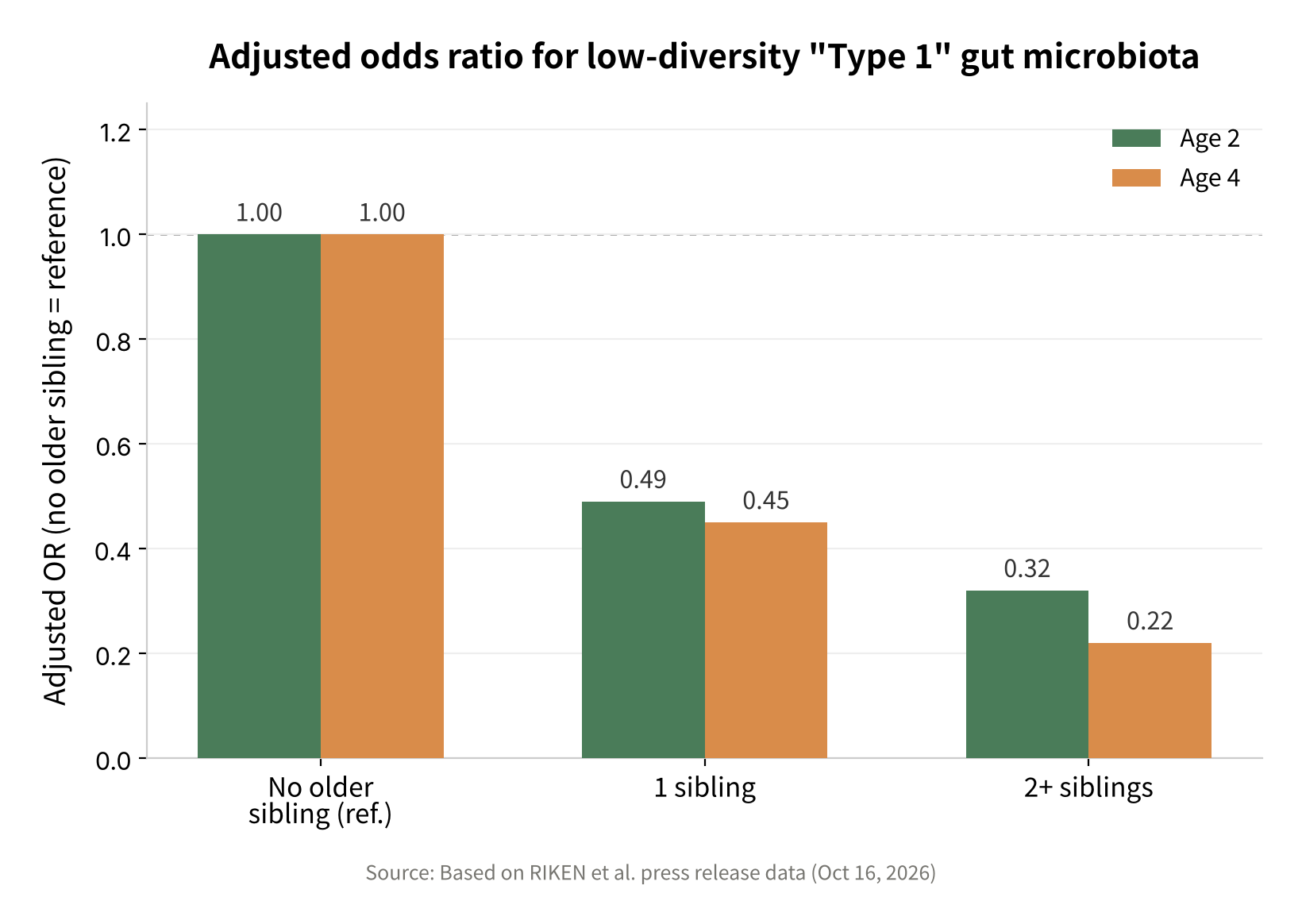
The study’s central finding concerns how the number of older siblings relates to gut-microbiota type. Compared with children with no older siblings, the adjusted odds ratio for falling into Type 1 (versus Type 2) at age two was 0.49 for children with one older sibling and 0.32 for those with two or more. The same pattern held at age four among the 684 children followed up: 0.45 with one sibling, 0.22 with two or more. In other words, children with two or more older siblings had roughly a third of the odds of being classified as Type 1 compared with those who had none — not a third of the probability of being Type 1, a distinction worth keeping in mind. The association held even after adjusting for socioeconomic status, birth conditions, household size, and pet ownership, among other factors — a level of statistical control that makes it harder to dismiss the finding as a byproduct of some other feature of larger families, such as income or living space.
Metabolite levels followed a related pattern. At age two, several short-chain and branched-chain fatty acids correlated positively with the number of older siblings (with the exceptions of acetate and hexanoate); at age four, propionate alone showed the same association. It’s striking that something as variable from household to household as the number of siblings shows up this clearly in a toddler’s internal biology.
What breastfeeding and daycare don’t explain
Because sibling composition correlates with breastfeeding practices, diet, daycare attendance, and antibiotic use, the team ran a mediation analysis to see how much of the sibling-microbiota link these factors could account for — essentially, a statistical test of whether the “obvious” explanations were doing the real work behind the scenes. Most of the factors examined explained little of the association. The one exception: at age four, antibiotic use within the previous three months appeared to explain part of the link, though even that effect was modest.
That doesn’t mean direct contact with siblings has been proven to be the cause. Unmeasured factors, or pathways the analysis simply couldn’t capture, may also be involved — perhaps the sheer frequency of everyday physical contact between siblings, or subtler lifestyle differences the survey wasn’t designed to pick up. This broader idea — that a child’s early environment can leave a lasting mark on later health — echoes another RIKEN finding on how early-life nutrition shapes long-term lifespan.
Toward allergy prevention: what’s next
The research team is careful to stress that the results don’t show that simply having siblings prevents disease. Whether these gut-microbiota differences actually translate into a lower risk of allergies and other conditions still needs to be tested, and causality is a much higher bar than the correlations described here.
Children with two or more older siblings had roughly a third the odds, at age two, of being classified into the low-diversity gut-bacteria type compared with children who had none.
The team plans to investigate next whether the sibling-linked changes in gut bacteria and metabolites actually translate into measurable differences in allergy outcomes, and whether specific bacterial groups or metabolites turn out to matter more than others. As a growing share of families raise only children, research like this could eventually offer clues toward interventions — dietary, probiotic, or otherwise — that help shape a healthy gut environment regardless of whether a child happens to have siblings at all.
Sources: RIKEN press release, Pediatric Research (original paper)