- About one in four people carry a common gene variant that raises their odds of developing Alzheimer’s disease later in life — and scientists have now pinpointed, for the first time, exactly what that variant does to blood vessels in the brain.
- The variant, called APOE4, is something people are simply born with; it isn’t caused by diet, exercise, or lifestyle.
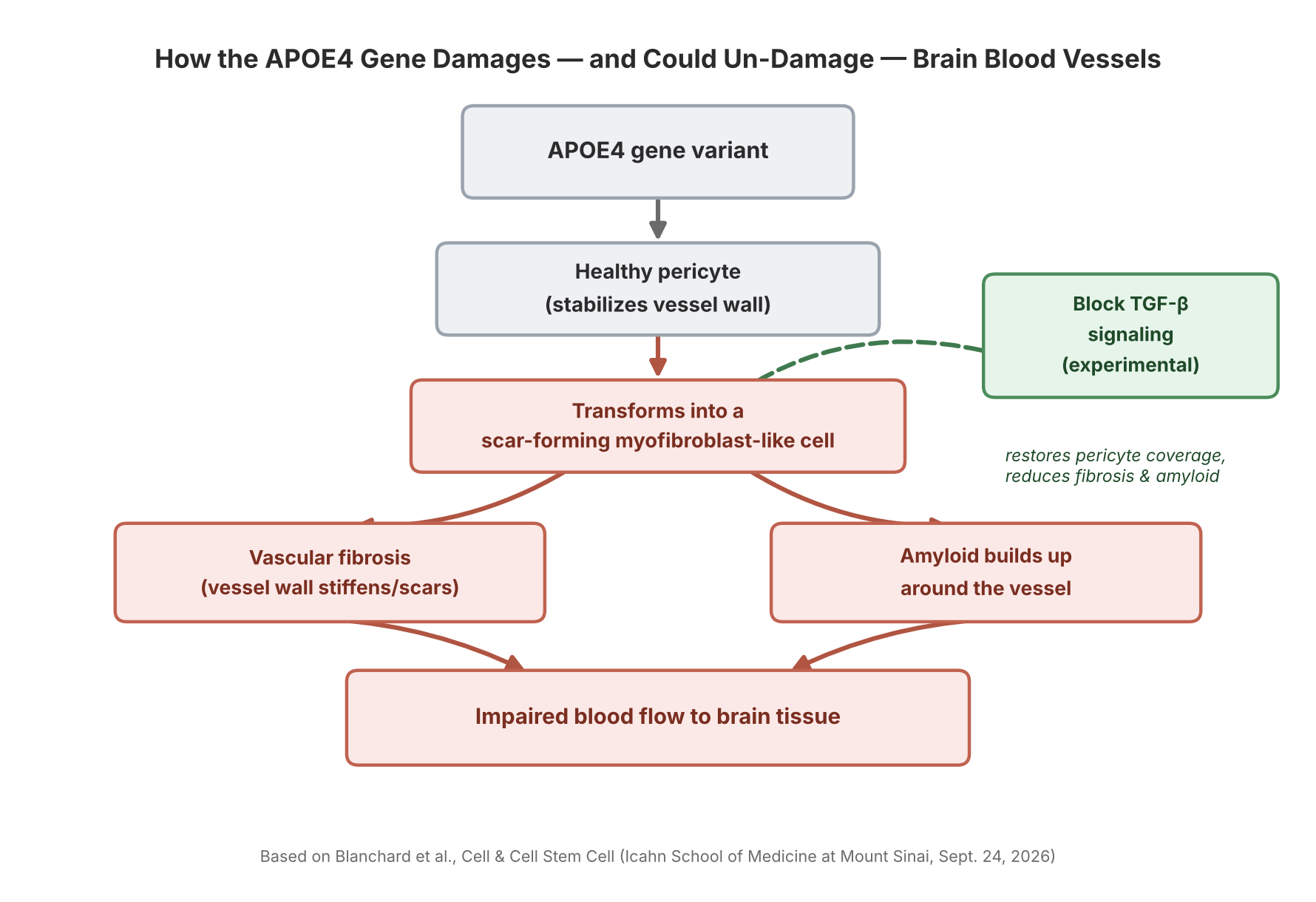
- Researchers found that APOE4 causes the cells that protect brain blood vessels to turn into “scar-forming” cells, making those vessels stiffer and more likely to clog.
- The same team then found a way to brake that process in lab experiments, and even partly undo it.
- The work is still limited to lab-grown tissue and animal models, but it points to a future where carrying this gene variant may not simply be something people have to live with — a treatment that slows or blocks the damage could eventually become possible.
A Gene Long Blamed, Now Tied to a Specific Mechanism
Scientists have linked APOE4 to Alzheimer’s since landmark studies in 1993, and subsequent research has implicated it in several disease-related processes, including amyloid-β metabolism and clearance, lipid handling, and inflammation. What has stayed less clear is exactly how APOE4 damages brain blood vessels, an abnormality long observed in carriers alongside the disease’s hallmark protein buildup. In a paper published in the journal Cell on September 24, 2026, a team led by Dr. Joel W. Blanchard at Mount Sinai pinned the vascular damage to a specific cell-identity switch, using evidence from human brain tissue, lab-grown human brain models, and mice.
How a Support Cell Turns Into Scar Tissue
Tiny blood vessels in the brain are wrapped in pericytes, cells that help stabilize the vessel wall and maintain the blood-brain barrier. The Mount Sinai team found that APOE4 pushes a portion of these pericytes into a myofibroblast-like state — a cell identity similar to the scar-forming cells involved in fibrosis in organs such as the liver and lungs. As more pericytes shift into this state, they produce a dense, fibronectin-rich extracellular matrix that accumulates in the vessel wall (a process called vascular fibrosis) and promotes the buildup of amyloid protein around the vessel. Mount Sinai’s own description of the work says these changes “may compromise blood flow” and contribute to neurodegeneration — a more cautious framing than saying blood flow is cut off outright, since that specific chain of cause and effect in people has not been directly demonstrated.
Built From Human Brain Tissue, Not Just Mice
A notable part of this work is how closely it was tied to human biology. The researchers assembled a single-cell transcriptomic atlas of the human brain’s blood vessels, then examined the pericyte-to-myofibroblast switch in miBrains — a lab-grown, three-dimensional tissue model derived from human induced pluripotent stem cells that contains multiple brain cell types, including vascular cells — as well as in postmortem human brain tissue. They also examined the mechanism in aged APOE4 mice. The clearest demonstration that the process could be reversed came from the miBrain model: blocking TGF-β signaling there restored pericyte coverage and reduced fibrosis and vascular amyloid. Combining human tissue data with a human-cell model and an animal model, rather than relying on mice alone, gives the mechanism more weight as a plausible driver of disease in people — though it is still evidence from models, not a demonstration in living human patients.
A Second, Related Finding: Cholesterol and the Brain’s Cleanup System
A companion paper from the same group, published online in Cell Stem Cell on August 24, 2026, points to a related problem in a different brain cell type. The team found that APOE4 causes cholesterol to accumulate inside astrocytes — star-shaped support cells involved in clearing cellular waste through the endolysosomal system, the cell’s internal recycling and degradation pathway. That cholesterol buildup impaired the astrocytes’ ability to process alpha-synuclein, the protein that forms the toxic clumps central to Parkinson’s disease and Lewy body dementia, and which can also appear as a secondary pathology in some Alzheimer’s cases. Together, the two papers point to two distinct cellular mechanisms through which APOE4 may contribute to neurodegenerative disease, though the papers don’t claim these are the only routes involved.
Blocking TGF-β signaling “restored pericyte coverage and reduced both fibrosis and vascular amyloid” in the researchers’ experimental models — evidence that at least some APOE4-associated vascular abnormalities are not necessarily permanent.
Why “Reversible in Models” Is the Real Headline
The most consequential detail in the Mount Sinai findings isn’t the damage itself — it’s that part of it could be undone experimentally. The pericyte-to-myofibroblast switch is driven by a signaling pathway called TGF-β. When the researchers blocked TGF-β signaling in their models, pericytes stopped converting into scar-forming cells, and both vascular fibrosis and amyloid buildup around the vessels were reduced. That gives researchers a specific, experimentally testable target to study further: TGF-β signaling, along with the lipid-metabolism and endolysosomal pathways highlighted in the companion paper, now stand out as candidate starting points for future research into Alzheimer’s and other neurodegenerative diseases involving alpha-synuclein pathology — a different starting point than simply trying to clear amyloid after it has already built up.
What This Means If You Carry the Gene
None of this is a treatment, and the reversal was shown in cell and animal models, not in people — any drug built on these targets would still need years of testing before reaching patients. But the finding reframes what APOE4 does: carrying the variant doesn’t guarantee disease, and it isn’t an on/off switch for Alzheimer’s — rather, it can shift several biological processes, including this pericyte transition, in ways that raise vulnerability. For the roughly one in four people who carry an APOE4 copy, the significance of this research is that it offers a starting point for seeing APOE4 not only as a risk marker, but as a set of specific cellular mechanisms that future research could study, and potentially target, directly.
Sources: Mount Sinai Newsroom, Cell, Cell Stem Cell, National Institute on Aging