- Different animals can end up finding very different things “delicious” — and new research shows part of the reason comes down to the exact molecular shape of their taste sensors.
- A Japanese research team used the SPring-8 synchrotron facility to determine the structure of the ligand-binding region of an umami receptor from pufferfish — the part that recognizes taste molecules.
- The human umami receptor is highly selective: it responds strongly to only one mirror-image form of its target amino acid, and barely at all to the other. The pufferfish receptor, the team found, responds to both.
- This is so far a test-tube finding about how the receptor binds molecules, not direct proof of what a pufferfish actually tastes. The difference may be related to the pufferfish’s diet, and the discovery could eventually help with new seasonings or aquaculture feed.
Why the Same Food Doesn’t Taste the Same to Every Animal
Umami — alongside sweet, sour, salty, and bitter — is one of the five basic tastes. It’s the savory taste produced when a receptor on the tongue detects certain amino acids, most notably glutamate, the compound behind the savory taste of kombu seaweed and dried bonito flakes. A receptor is a protein that changes shape when a specific molecule binds to it, and that shape change is what sends a signal into the cell. Scientists have long pictured this as a “lock and key”: a molecule has to be the right shape to fit and trigger a response.
It has been difficult to determine exactly why umami receptors differ between species, partly because their three-dimensional structures are technically difficult to solve. Until now, structures of these receptors had been determined for only a small number of species, leaving the molecular basis of these differences unclear — even though different animals clearly do not all find the same molecules appetizing.
Capturing the Pufferfish Receptor’s Shape at SPring-8
A research team led by Professor Atsuko Yamashita at the Institute for Protein Research, Osaka University, working with Meiji University, Okayama University, Science Tokyo, and RIKEN, used X-ray crystallography to determine the crystal structure of the ligand-binding domain of the Tas1r1/Tas1r3 receptor complex — the extracellular region where taste molecules bind — in the tiger pufferfish (Takifugu rubripes, known in Japan as torafugu).
The work was carried out at SPring-8, a large synchrotron radiation facility in Hyogo Prefecture, Japan. By aiming X-rays at extremely small protein crystals and analyzing the resulting diffraction pattern, the team worked out the three-dimensional structure of the pufferfish receptor’s taste-binding region for the first time.
A Receptor That Also Responds to the “Mirror Image”
Amino acids found in nature can exist in two mirror-image forms, often described loosely as “left-handed” and “right-handed” — what chemists call L- and D-amino acids. The human umami receptor strongly recognizes only the left-handed form — the same form as L-glutamate, the umami compound in kombu — and responds only weakly, if at all, to the right-handed form. To humans, that right-handed form often tastes sweet rather than savory.
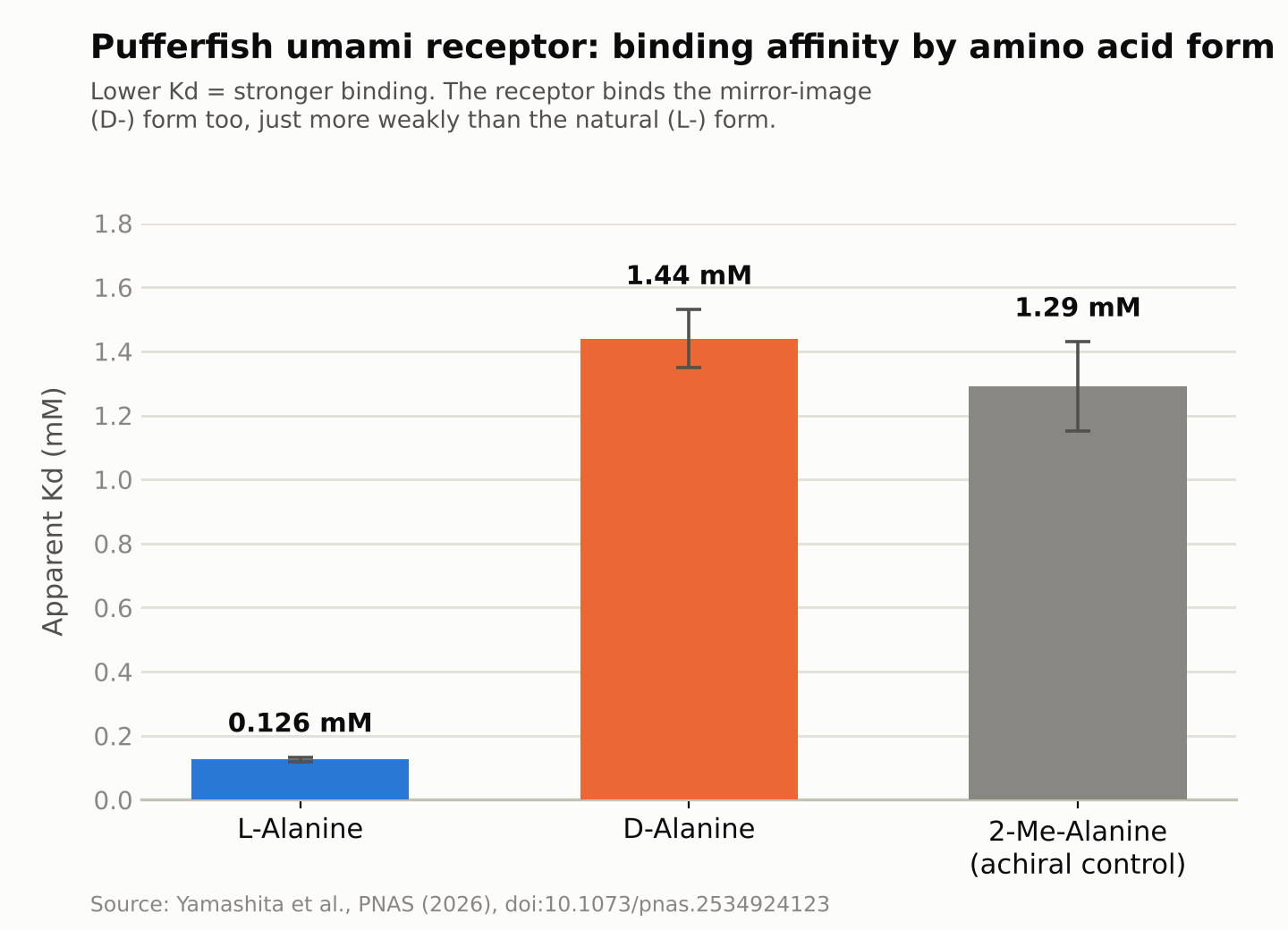
The new study found that the pufferfish receptor binds, and sends a signal in response to, both forms. Measuring binding strength directly, the team found the receptor bound the left-handed form of the amino acid alanine strongly, at a concentration of about 0.126 millimolar, while it bound the right-handed form more weakly, at about 1.44 millimolar — roughly a tenfold difference. Weaker binding still triggered the receptor, though. It’s worth being precise about what this does and doesn’t show: the result demonstrates that the isolated receptor binds and signals in response to the right-handed molecule in a test tube. It does not, on its own, prove that a live pufferfish actually perceives that molecule as delicious.
A Molecular “Latch” That Holds the Receptor Shut
The receptor resembles a two-lobed clamshell that closes around a bound molecule of the right shape, and that closing motion is what sends the taste signal. The right-handed amino acid doesn’t fit neatly into the human version of this receptor. When the team examined the pufferfish receptor’s structure closely, they found an additional set of interactions between the two lobes — acting like a molecular latch — that helps keep the binding cleft closed even when the bound molecule’s chirality doesn’t match the usual, better-fitting form. That latch appears to let the receptor keep signaling even while holding a right-handed amino acid that would otherwise bind too loosely to trigger a response.
The researchers suggest that this broader receptor specificity may be related to the pufferfish’s diet: mollusks and crustaceans, which make up much of what it eats, contain relatively high amounts of right-handed (D-) amino acids. Whether pufferfish actually perceive these molecules as tasty in the way we understand taste is a separate question the receptor data alone cannot answer — but the researchers note it as a plausible evolutionary explanation for why the receptor tolerates both forms.
Toward New Seasonings and Aquaculture Feed
What the study shows is limited to the structure and binding behavior of an isolated receptor studied in the lab; it doesn’t directly confirm how a living pufferfish experiences taste. Still, the research institutions involved say the structural information could eventually be useful for designing new umami compounds suited to the human palate, or for developing feed that farmed fish and livestock find more palatable — a question worth attention in aquaculture, where improving feed acceptance can matter for production efficiency and cost. The team also says it hopes to compare receptor shapes across more species going forward, providing structural information that could eventually help develop AI models for predicting how taste receptors recognize different molecules.
Sources: Meiji University press release, RIKEN press release, Mizoguchi, Toda, et al., PNAS (2026)