Every second, the icy moon Enceladus sprays countless grains of ice from its hidden ocean into space, feeding one of Saturn’s rings. An international team led by the Freie Universität Berlin and the Earth-Life Science Institute at the Institute of Science Tokyo has proposed that, on the way out, that water gets chemically sorted. The upshot: an individual ice grain is not simply a miniature sample of the whole ocean, which matters for any future mission trying to read Enceladus’s ocean chemistry for signs of life.
Journal: Science Advances (DOI: 10.1126/sciadv.aee7256)
Press release: Freie Universität Berlin
Data: 961 ice-grain spectra recorded by Cassini’s Cosmic Dust Analyzer
Cooling speed decides which salt goes where
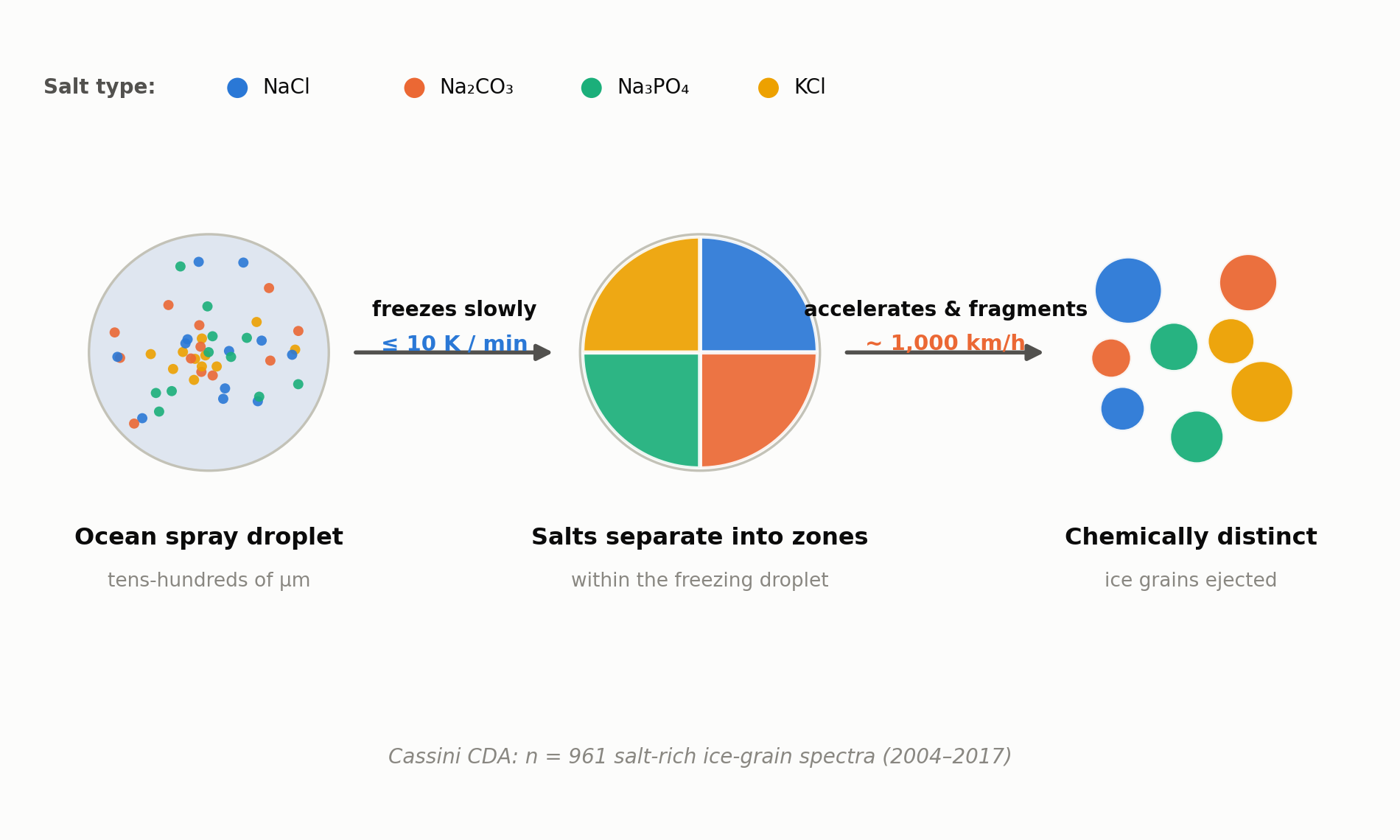
The team ran lab experiments with droplets formulated to match the salts expected in Enceladus’s subsurface ocean. When droplets roughly 200 micrometers across were cooled slowly, at about 10 kelvin per minute or less, the dissolved salts did not freeze evenly into the ice. Instead, compounds such as sodium chloride, carbonates, phosphates and potassium salts separated out and concentrated into distinct regions within the droplet as it froze. Rapid freezing did not produce the same pronounced separation, the experiments showed.
961 oddly different ice grains from Cassini
What happens to a droplet after it freezes unevenly underground? The team proposes that as these droplets rise through narrow vent channels toward the surface, they accelerate — reaching roughly 1,000 km/h in the model — before shattering against the icy channel walls into the fine grains that eventually reach space. NASA’s Cassini spacecraft, which orbited Saturn from 2004 to 2017, carried a Cosmic Dust Analyzer (CDA) that recorded mass spectra for 961 salt-rich ice grains gathered over the course of its mission. Grain to grain, the chemistry varied widely — some grains dominated by sodium salts, others by carbonates or phosphates — even though they presumably all came from the same ocean. The new freeze-and-fragment model offers an explanation for why that is: each grain simply froze out of a different, already-segregated pocket of the original droplet.
“The oceanic constituents are separated from each other and simultaneously concentrated into individual ice particles,” says Professor Frank Postberg of Freie Universität Berlin.
A discovery that could change how we read the data
The core implication is that no single ice grain can be assumed to represent the ocean’s average composition. That matters for mission concepts such as NASA’s proposed Orbilander, which would collect and analyze Enceladus’s plume grains directly: researchers will likely need to account for grain-to-grain differences when interpreting what they find. The team suspects organic molecules and other life-relevant compounds could be concentrated in a similar way, though confirming that will require further study.
Enceladus remains one of the solar system’s most closely watched candidates for hosting life. Understanding how each ice grain came to be — rather than treating it as a simple drop of seawater — looks set to become an unavoidable consideration for the missions that follow.
Xsciens editorial note
This study is a model that explains an existing dataset, not a new observation of Enceladus. Its central claim, that cooling speed determines which salts end up in which ice grains, is a proposal that fits the 961 Cassini spectra. It has not been confirmed by a new spacecraft measurement. The reading is attractive because it ties grain composition to a physical process, but it also means any future mission, such as the Orbilander concept, would need to test it directly before the interpretation of the data is changed.
Key terms
- Cosmic Dust Analyzer (CDA): the Cassini instrument that analyzed the composition of individual ice grains in flight.
- Cooling rate: how fast a droplet loses heat; the study ties it to which salts crystallize in a grain.
- Vent: a fissure on Enceladus’ south pole through which water-rich material is ejected into space.
Sources: Freie Universität Berlin press release, Science Advances (DOI: 10.1126/sciadv.aee7256)