A team at Japan’s RIKEN institute has focused an “attosecond laser” — a flash of light lasting a mere quintillionth of a second — onto a spot smaller than a micrometer, at more than 100 times the intensity previous tabletop sources achieved. The team frames the advance as a shift from simply watching how electrons move inside matter to actively putting that motion to work. Down the road, the underlying technology could feed into nanoscale material processing and research on next-generation electronic materials and devices.
Title: Submicrometer Focusing of Isolated Attosecond XUV Pulses Approaching 1016 W/cm2
Authors: Imasaka, K. et al.
Journal: Ultrafast Science (2026)
DOI: 10.34133/ultrafastscience.0198
What “attosecond science” means
An attosecond is a quintillionth of a second (10-18 seconds) — a timescale almost impossible to picture. Electrons inside atoms move on exactly this scale, and the technique for capturing that instant won the 2023 Nobel Prize in Physics. What RIKEN produced is an “isolated attosecond pulse,” generated by driving a laser through a process called high-harmonic generation. This new result is a major upgrade to the focusing technology needed to turn that pulse from a tool for observation into one for processing and control.
A 100-fold jump, a world record for tabletop sources
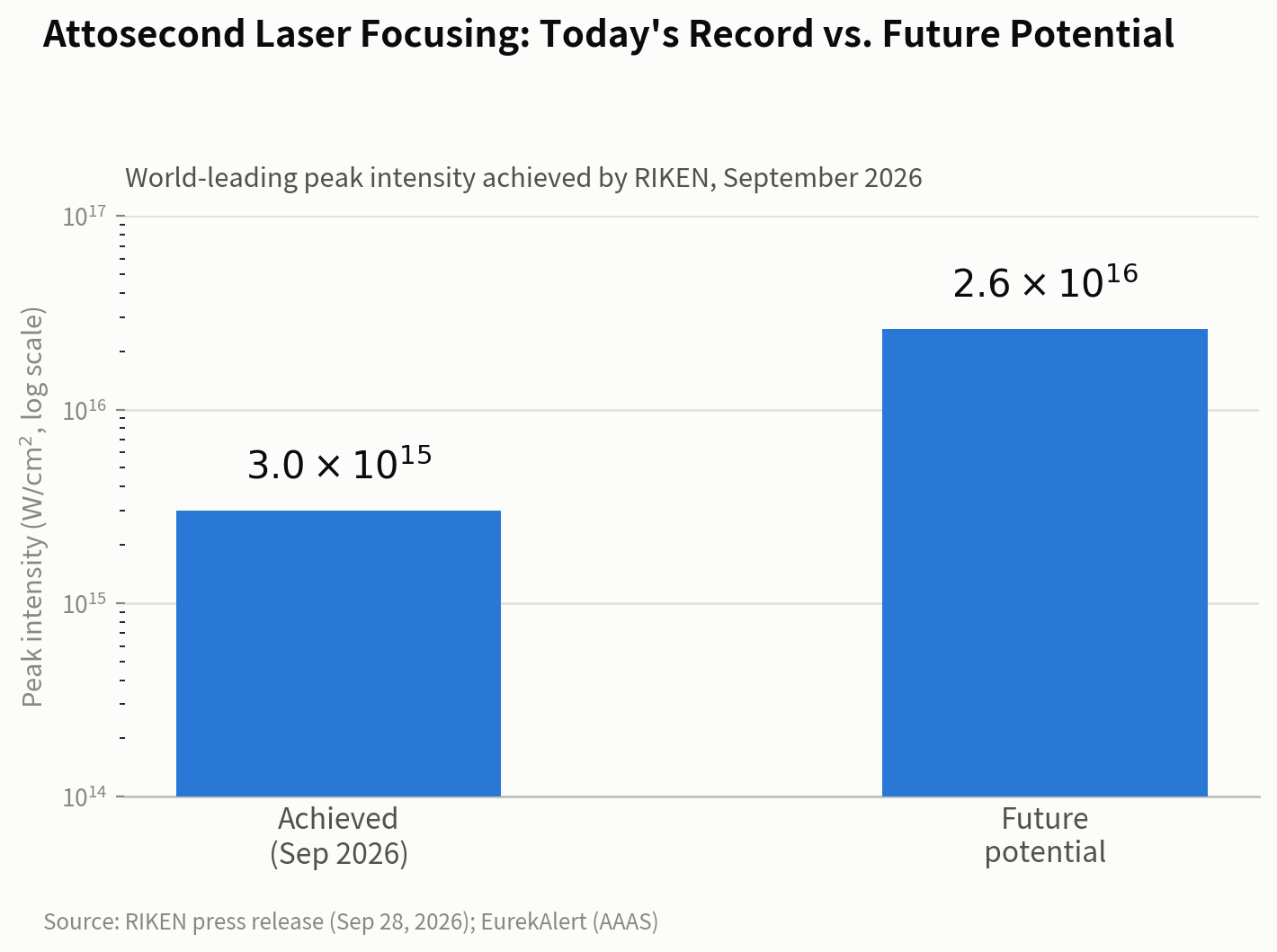
A team led by Special Postdoctoral Researcher Kotaro Imasaka at RIKEN’s Center for Advanced Photonics built a new elliptical multilayer mirror finished to sub-nanometer surface quality (roughly 0.892 nm RMS roughness), paired with a real-time system that stabilizes the focal point. The result: a focal spot of just 460±130 by 360±120 nanometers — under a micrometer across — reaching a peak intensity of 3.0×10¹⁵ W/cm² (3 quadrillion watts per square centimeter) at the pulse’s peak. That is the highest peak intensity ever reported for an isolated attosecond pulse from a tabletop light source, more than 100 times beyond previous tabletop sources of the same kind.
The team describes the achievement as opening the door to “a new ultrafast, high-intensity optical science” that moves beyond observing electron motion toward changing and harnessing it.
EurekAlert, the news service run by the American Association for the Advancement of Science, corroborated the finding, reporting a peak pulse power of 1.1 gigawatts. It added that, with further refinement, the method could in principle reach 2.6×10¹⁶ W/cm² — about 8.7 times today’s figure — though that remains a future projection, not something already achieved. The underlying paper appeared online in the journal Ultrafast Science on September 23, 2026.
Why it matters
When light gets intense enough, a material’s response to it stops being simply proportional — unusual effects start to appear. That’s the realm of “nonlinear optics.” With higher intensity and tighter focusing, researchers can now push these nonlinear effects onto the attosecond timescale — “nonlinear attosecond optics” — not just in gases but in solids and liquids too. The team points to nanoscale surface processing and studies of ultrafast electron dynamics inside condensed matter as near-term applications, with possible spillover into future electronic materials and devices further out. For now, though, this remains basic research: turning it into real products or industrial applications will take further work.
Xsciens editorial note: reading the 100-fold claim
Two qualifiers matter. First, the record is for tabletop sources: laser setups that fit in a laboratory rather than large facilities, so the comparison is with other tabletop systems and not with every attosecond light source in the world. Second, the headline intensity of 3.0×10¹⁵ W/cm² is what was achieved, while the 2.6×10¹⁶ W/cm² reported by EurekAlert is only what refinement could allow in principle, about 8.7 times higher.
The advance is also in the focusing, not in making a stronger pulse. The team made the pulse hit a spot under a micrometer wide by building a very smooth mirror and keeping the focus stable in real time. That is why the work matters for experiments on solids and liquids, where tightly concentrated light is needed to trigger nonlinear effects. What to watch next is whether the nonlinear attosecond experiments the team describes are actually carried out in condensed matter, since for now this is basic research.
Key terms
- Attosecond: one quintillionth of a second, the timescale of electron motion in atoms
- High-harmonic generation: a process in which an intense laser produces light at much higher frequencies, used to make attosecond pulses
- Isolated attosecond pulse: a single, extremely short flash of light rather than a train of pulses
- Nonlinear optics: the realm where a material’s response to light stops being proportional to its intensity
- Tabletop source: a light source small enough to be built in an ordinary laboratory
Sources: RIKEN press release, EurekAlert! (AAAS), Ultrafast Science journal article