A chip about the size of a pinhead, implanted beneath the retina, is still giving some people with an advanced, largely untreatable form of vision loss enough artificial central vision to read letters and words three years after surgery. New follow-up data from the PRIMA retinal implant, presented in a late-breaking session at a major European retina congress and discussed at the American Academy of Ophthalmology’s 2026 annual meeting, suggest that the vision gain patients saw in year one did not fade by year three — it grew slightly instead, an encouraging early sign for a disease that otherwise only gets worse with time, even if the follow-up group is still small.
What the Three-Year Data Show
The results come from PRIMAvera, a clinical trial that implanted the PRIMA device in 38 people across 17 centers in five European countries, all diagnosed with geographic atrophy, the advanced form of age-related macular degeneration that destroys central vision. The trial had no control group, so every participant received the implant. At the start of the study, their average vision was about 20/460, meaning they could not reliably make out even the largest letter on a standard eye chart.
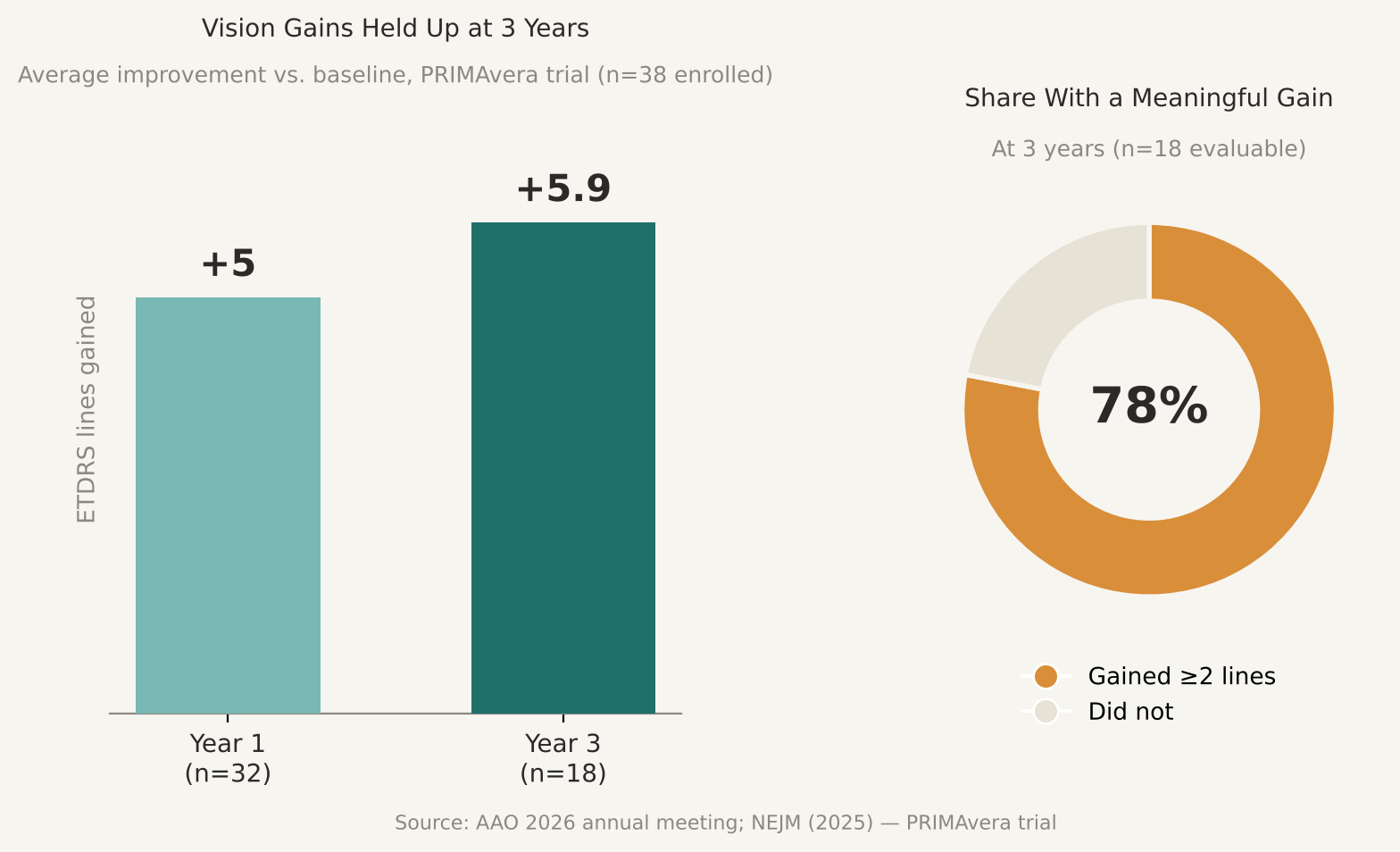
At 12 months, 32 of the 38 implanted participants were evaluable, and their eyes had gained an average of 24.5 letters on a standard vision chart, roughly five lines, a result published in a peer-reviewed paper in The New England Journal of Medicine. At 36 months, among the 18 participants still evaluable for vision testing at that later point, a smaller and not necessarily identical group, the reported average gain was 29 letters, nearly six lines, bringing vision to roughly 20/120. Seventy-eight percent of those patients, 14 of 18, had improved by at least 15 letters, or three lines, a threshold researchers consider clinically meaningful. The 36-month figures come from a conference presentation rather than a peer-reviewed publication, so they should be read as encouraging early evidence of durability rather than a final, confirmed picture of long-term outcomes for everyone who receives the implant.
“In clinical trials, PRIMA is working better at month 36 than it did at month six.” — Max Hodak, co-founder and CEO of Science Corporation
Two further findings add context. With the implant switched off, so that patients were relying only on whatever natural vision remained, that baseline vision stayed essentially unchanged over three years, a reassuring sign even though it does not, by itself, rule out subtler structural effects on the retina. Meanwhile, patients’ untreated fellow eyes kept losing vision, as geographic atrophy typically does without any intervention. On safety, researchers reported no new type of safety signal between 12 and 36 months; in the original 12-month study, serious adverse events were concentrated in the weeks after surgery and mostly resolved within two months, though a smaller follow-up group makes it harder to rule out rare or delayed complications.
Recovering Some Ability to Read
Geographic atrophy affects more than five million people worldwide and is among the leading causes of severe central vision loss in older adults, though many patients retain some peripheral vision. Approved treatments for the condition can only slow its progression; none had previously been shown to restore central vision that was already lost. That is what makes the PRIMAvera results notable: in the original 12-month study, 27 of 32 assessed participants were able to read letters, numbers or words using the implant, the clearest and best-documented functional outcome. Reports of patients managing longer passages or recognizing faces come from investigators and company accounts rather than a single standardized test, so they are best read as illustrative rather than guaranteed results for every patient.
Researchers are careful to note that the device does not restore natural eyesight. Patients rely on it only in the implanted eye, need weeks of rehabilitation to learn to interpret its artificial signal, and see a simplified, lower-resolution image rather than full natural detail. Still, for people who previously had no reliable way to read, the functional gain is meaningful, which is part of why Dr. Frank Holz, the lead author of the original NEJM paper, has described the implant as “a paradigm shift in treating late-stage AMD.”
How the PRIMA Chip Restores Sight
PRIMA is a wireless chip measuring 2 by 2 millimeters and just 30 microns thick, about half the thickness of a human hair, surgically placed beneath the retina in the area damaged by geographic atrophy. Patients wear glasses fitted with a miniature camera that captures the scene in front of them and projects it onto the chip as pulses of near-infrared light, invisible to the eye, rather than ordinary visible light. A built-in zoom feature lets patients magnify text.
The chip’s surface works like a miniature solar panel, covered with microscopic photovoltaic pixels that convert the infrared light into small electrical currents. Those currents stimulate the retinal neurons that normally relay visual signals toward the brain, in the same location where vision would ordinarily be processed if the light-sensing photoreceptor cells had not died. The brain then interprets the resulting pattern as a crude, pixelated image.
The technology was originally developed by Professor Daniel Palanker at Stanford University and is now manufactured by Science Corporation, a neural-engineering company based in Alameda, California. PRIMA received the CE Mark in 2026, clearing it for sale, and the company says it is now commercially available in Europe and the United Kingdom, though in practice access will depend on which hospitals offer the surgery and on local funding arrangements. In the United States, PRIMA remains investigational and has not been approved by the Food and Drug Administration, though Science Corporation says an approval process is underway.
Why Durability Matters So Much
For implanted neurotechnology, the central question is rarely whether a device works at first, but whether the benefit lasts. Scar tissue can build up around an implant, electronics can degrade, and the body’s response to a foreign object can gradually blunt a signal that worked well in the first few months. Earlier generations of retinal implants, and some other neural devices, have shown promising short-term results that faded within a few years.
That is why the 36-month PRIMAvera data matter more than a typical one-year readout. In a disease that normally only gets worse, average vision in the implanted eye did not just hold steady between 12 and 36 months; it continued to improve. “Three years after implantation, the patients who gained vision have kept it, even improved it,” said Dr. Mahi Muqit of Moorfields Eye Hospital and University College London, who presented the data. Researchers attribute part of the extra gain to patients becoming more skilled at interpreting the implant’s artificial signal with practice, and part to evidence that the hardware itself remains stable in the eye over time.
Who Can Access It, and Who Can’t
For now, PRIMA is commercially available only in Europe and the United Kingdom, and only for geographic atrophy caused by age-related macular degeneration; it has not been tested as a treatment for other causes of vision loss, such as inherited retinal disease or diabetic eye disease. Even where it is approved, access will likely stay limited at first to specialized retinal surgery centers, given the operation required to place the chip and the weeks of visual rehabilitation that follow.
In the United States, the device remains investigational, meaning patients can currently obtain it only by enrolling in a clinical trial, if one is available, while the FDA approval process continues. An editorial accompanying the original one-year results in The New England Journal of Medicine described PRIMA as the first approach shown to restore vision, rather than merely slow its loss, in advanced geographic atrophy, a framing that underscores how little direct competition this approach has today, and how much is still being learned about its place in everyday eye care.
Caveats Behind the Headline Numbers
The study design leaves real uncertainty. PRIMAvera had no control group, so researchers cannot fully separate the implant’s own effect from a practice effect, in which patients simply get better at using the device’s artificial signal over time regardless of how the hardware is performing. Larger, controlled trials would be needed to settle how much of the measured improvement comes from the chip itself.
The shrinking sample size is also worth noting: of the 38 people originally implanted, only 27 remained evaluable for safety and 18 for vision at the three-year mark, and the publicly presented data do not explain why the others dropped out of assessment. If patients who were doing poorly were more likely to leave the study, the remaining group could make the device look more effective than it actually is across everyone who receives it.
Whether PRIMA reaches more patients in the United States, and how it performs in a larger and more varied population, remains to be seen. But for a disease that has long offered people only the prospect of a slower decline, three years of durable, measurable improvement is a meaningful data point, and one that eye specialists are likely to watch closely as the device moves toward wider use.
Sources: Science Corporation, Newswise / American Academy of Ophthalmology