
A two-year randomized trial found that high-dose DHA, the main omega-3 in fish oil, raised a marker of DHA in the fluid surrounding the brain, yet it did not improve memory-and-thinking scores or slow shrinkage of the memory-related hippocampus compared with placebo. For the many older adults who take fish oil hoping to ward off dementia, the result is a reminder that moving a nutrient into the nervous system is not the same as protecting memory.
Title: CNS target engagement of high-dose DHA supplementation in older adults at risk for dementia: a randomised, double-blind, placebo-controlled trial
Authors: Yassine HN et al.
Journal: eBioMedicine 2026;129:106316
DOI: 10.1016/j.ebiom.2026.106316
What the researchers tested
The phase IIa trial, run at the University of Southern California (USC) between September 2018 and May 2024, enrolled 365 adults aged 55 to 80 who did not have dementia, ate little DHA (under 200 mg a day), and had at least one dementia risk factor. About 47% carried APOE ε4, a gene variant that is the strongest common genetic risk factor for late-onset Alzheimer’s disease, although carrying it does not mean a person will inevitably develop the disease.
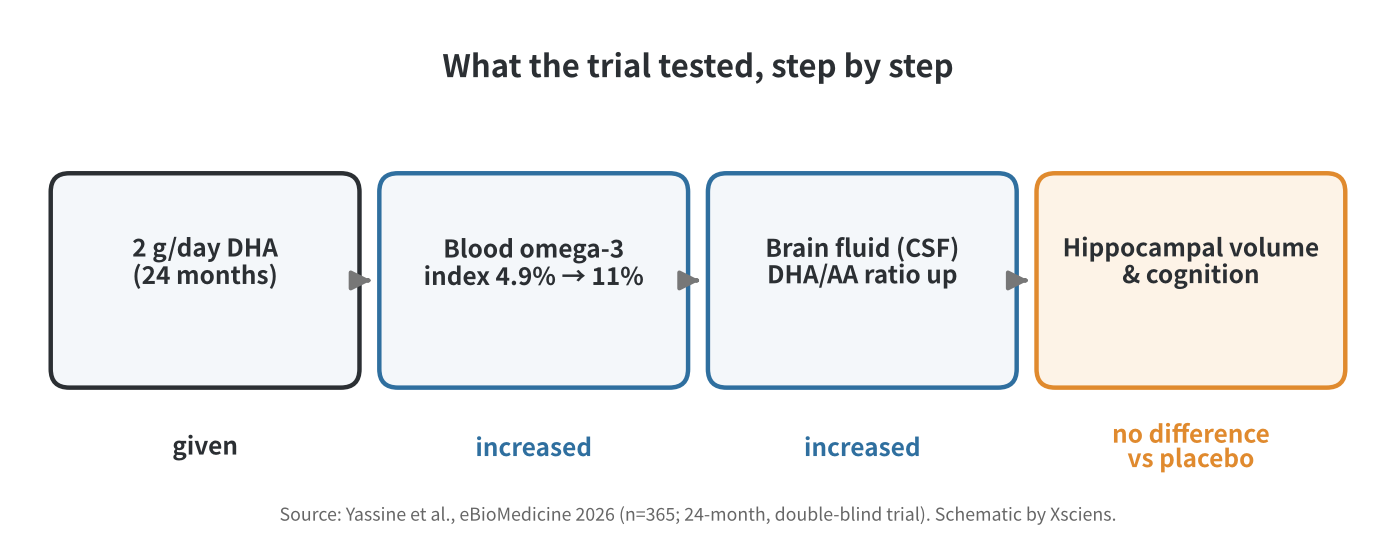
Participants were randomly assigned to take either 2 grams of DHA a day or a placebo for 24 months, and neither they nor the staff knew who got which. The work was funded by the U.S. National Institute on Aging and the Alzheimer’s Drug Discovery Foundation, and was published online in June 2026.
Step one: the marker moved
The trial’s primary question was whether high-dose DHA could measurably change a biochemical marker of DHA availability in the central nervous system. To check, a subgroup of participants agreed to a lumbar puncture so researchers could sample cerebrospinal fluid (CSF), the liquid that surrounds the brain and spinal cord.
At six months, the ratio of DHA to arachidonic acid (AA, an omega-6 fat) in CSF had risen by 0.17 in the DHA group and fallen by 0.02 in the placebo group, a difference of 0.19 (95% confidence interval 0.16 to 0.21). The supplement also raised the omega-3 index, a measure of omega-3 fats in red blood cells, from 4.9% to 11%. The CSF increase did not depend on whether participants carried APOE ε4.
Step two: the outcomes did not
Cognition and brain structure were secondary outcomes. On a standard memory-and-thinking battery (RBANS), scores rose by 2.76 points in the DHA group and 2.67 in the placebo group. The hippocampus shrank by an estimated 0.75% a year (left) and 0.55% (right) with DHA versus 0.63% and 0.67% with placebo. The authors reported no significant difference between groups for either measure, and side effects were similar, with no serious ones attributed to the supplement.
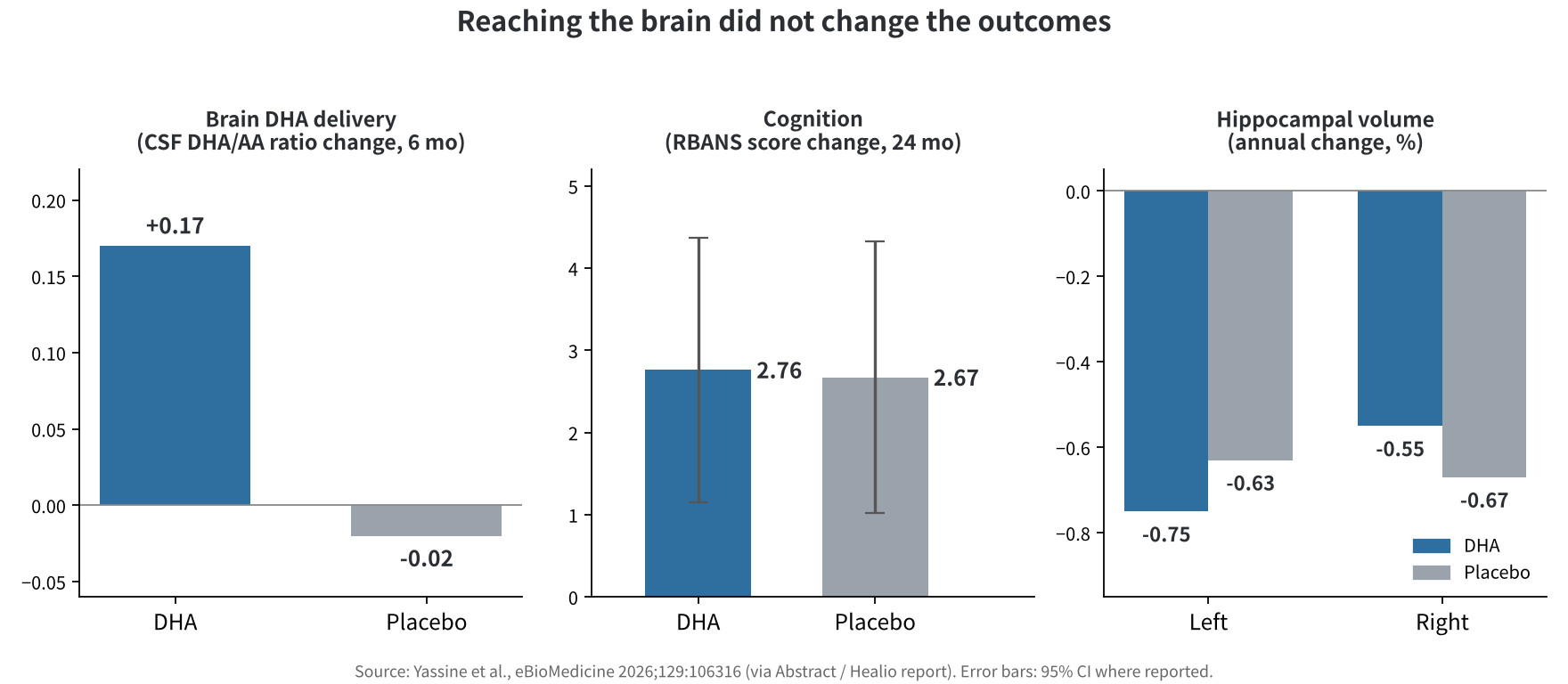
In other words, despite a clear biochemical response, the DHA group did not outperform placebo on the cognitive or structural measures over the two years.
How to read “no benefit”
Several caveats matter. About 38% of participants dropped out, mainly because of COVID-19 disruptions. That reduced statistical power and may have introduced bias, because those who left differed from those who stayed, so small effects cannot be ruled out. Participants were also relatively young, well educated and cognitively healthy, so 24 months may be too short to see much decline in anyone. Only one form and dose of omega-3 was tested, and a single supplement may be too little against a disease with many contributing causes.
The authors argue that future research should prioritize understanding how the brain processes DHA and which people might respond differently. Lead investigator Hussein Yassine said staying active, sleeping well and eating a balanced diet remain the most powerful tools for lowering Alzheimer’s risk. The result also does not say that eating fish is pointless: the study tested a high-dose supplement, not diet.
Where this fits
Earlier randomized evidence points in the same direction. A 2012 Cochrane review of three trials, with cognitive data from 3,536 cognitively healthy adults aged 60 and over, found no cognitive benefit from omega-3 supplements. The VITAL-Cog analysis, which included 4,218 adults in two cognitive substudies, likewise found no significant effect on global cognition from 1 gram a day of marine omega-3 over about two to three years. Neither establishes whether supplements can prevent dementia itself.
Observational research, by contrast, has suggested that people who eat more seafood may have a lower risk of cognitive decline, according to the U.S. National Center for Complementary and Integrative Health, which is one reason the question keeps being asked. For now, the evidence does not support taking high-dose DHA specifically to preserve memory in otherwise cognitively healthy older adults.
Xsciens Editorial Note
The core of this trial: high-dose DHA raised a brain-fluid marker, but in this group it made no measurable difference to cognition or hippocampal shrinkage.
- Measured versus interpreted. The rise in the brain-fluid DHA-to-AA ratio was directly measured and was the trial’s primary outcome; cognition and brain volume were secondary outcomes. Both groups’ test scores rose by about 2.7 points, which could partly reflect familiarity with repeated testing, though the study cannot say how much. The finding is the absence of a group difference, not a prevented decline.
- Limits. Roughly 38% dropout (with completers differing from dropouts), a cognitively healthy and well-educated group, a 24-month window, one dose and a phase IIa design all limit how far the result generalizes. It cannot rule out small effects, and it says nothing about dementia itself, which the trial did not measure.
- What to watch. Whether particular groups, such as people whose brains handle DHA differently, respond better (a hypothesis, not a finding); longer follow-up with measures sensitive to decline; and replication in other populations.
- From the editors — if you take fish oil for your memory, this trial gives you less reason to expect a payoff. The upside is a sharper research question: now that DHA is known to shift a brain-fluid marker, the next step is working out why that is not translating into better memory, and for whom. That said, this is one trial in cognitively healthy people; it does not show that omega-3 is harmful or that fish on your plate is pointless, and the lifestyle basics the lead author points to deserve at least as much of your attention as the capsule. If you take fish oil for another reason, such as heart health, talk to your doctor before changing anything.
References for this note: Sydenham et al., Cochrane review (2012), Kang et al., VITAL-Cog (2022), NCCIH: Omega-3 Supplements
Sources: eBioMedicine (Yassine et al., 2026), Healio, News-Medical, ScienceDaily (USC release)