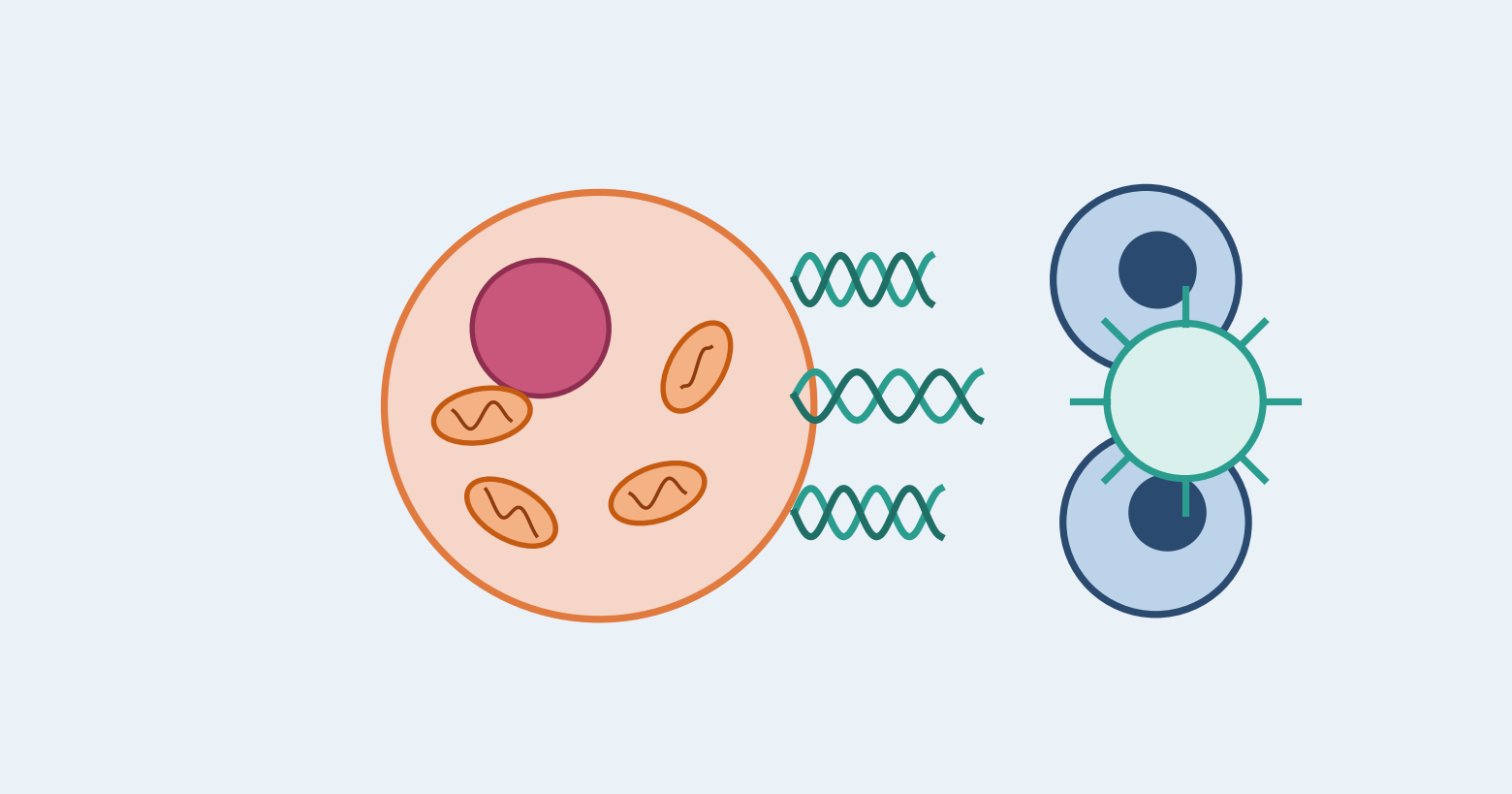
Whether a dying cancer cell wakes up the immune system may depend on how much mitochondrial DNA it carries. A Japanese research team reports that cancer cells carrying KRAS mutations tend to accumulate mitochondrial DNA, and that a combination of drugs can make such cells die in a way that alerts the immune system. So far this has been shown only in cell experiments and mice, not in patients.
Title: Mitochondrial DNA abundance is a determinant of immunogenic cell death in cancer
Authors: Kosuke Tanaka, Yasuki Adachi, et al.
Journal: Immunity (2026)
DOI: 10.1016/j.immuni.2026.10.002
Why the way a cancer cell dies matters
Many cancer drugs work by killing tumor cells, but cells can die in different ways. In apoptosis, an orderly form of cell death, dead cells are generally cleared away without a strong immune response. Some deaths, however, alert the immune system. Researchers call this immunogenic cell death: the dying cells release signals that help immune cells recognize tumor material and go after surviving cancer cells. A widely cited 2020 consensus paper describes it as death that provides enough “antigenicity and adjuvanticity”, roughly, enough recognizable tumor antigens and enough additional signals to activate an immune response.
This matters for treatment. Targeted drugs that block a specific faulty molecule in a tumor often work well at first, but cancers can resist them or relapse. Pairing them with immune checkpoint inhibitors, drugs that release the brakes on immune cells, is an attractive idea. Whether the pairing works may depend on whether the targeted drug makes cancer cells die in a way the immune system can see, and what decides that has been poorly understood. The researchers therefore asked whether something inside the cancer cell itself could tip the balance. Their attention turned to mitochondria, the structures that produce energy for the cell.
KRAS-mutant cancers hoard mitochondrial DNA
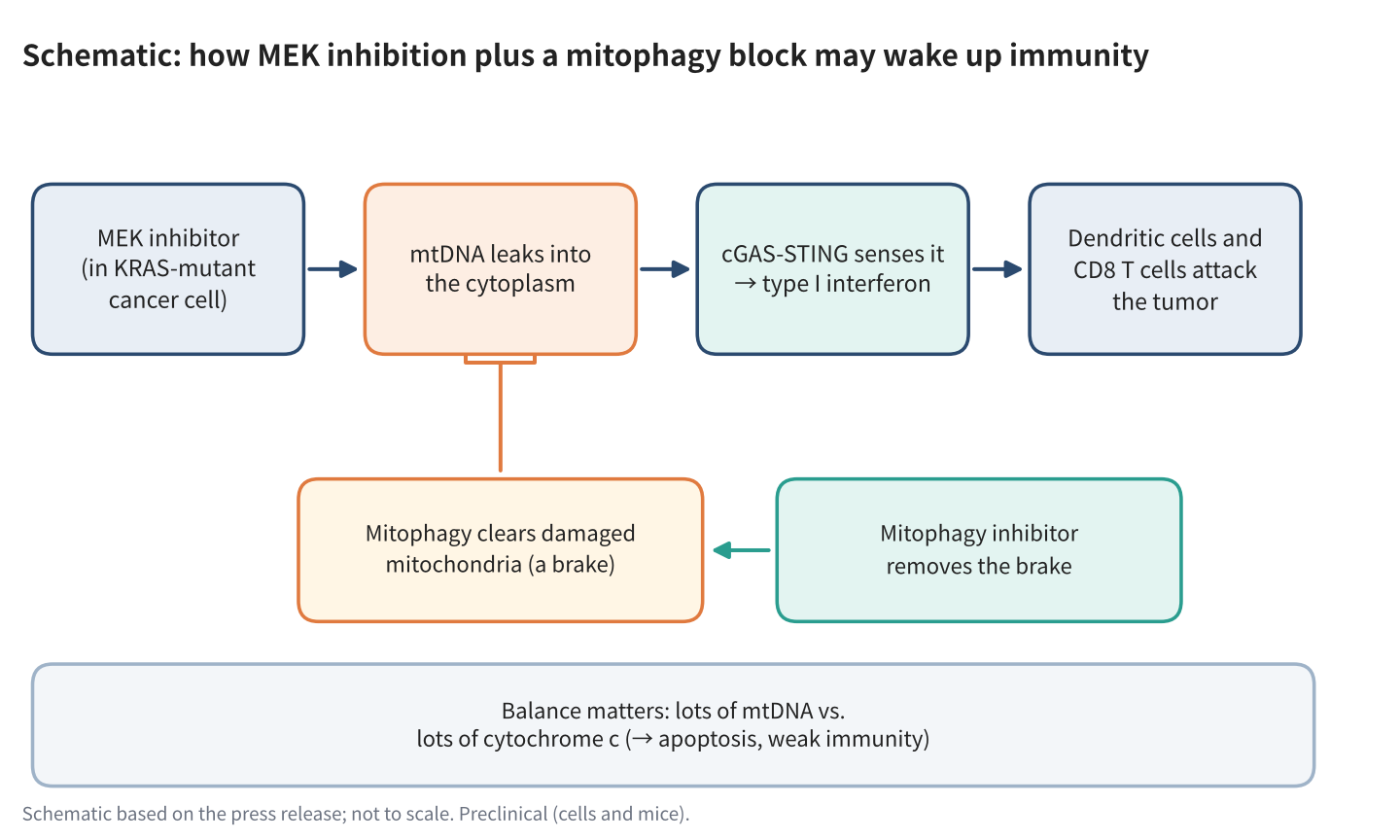
Mitochondria carry a small loop of their own DNA, called mtDNA. When mtDNA leaks into the main body of the cell, a protein called cGAS detects it and activates another protein, STING. This cGAS-STING pathway triggers the production of type I interferons, immune signaling proteins that help alert the body’s defenses.
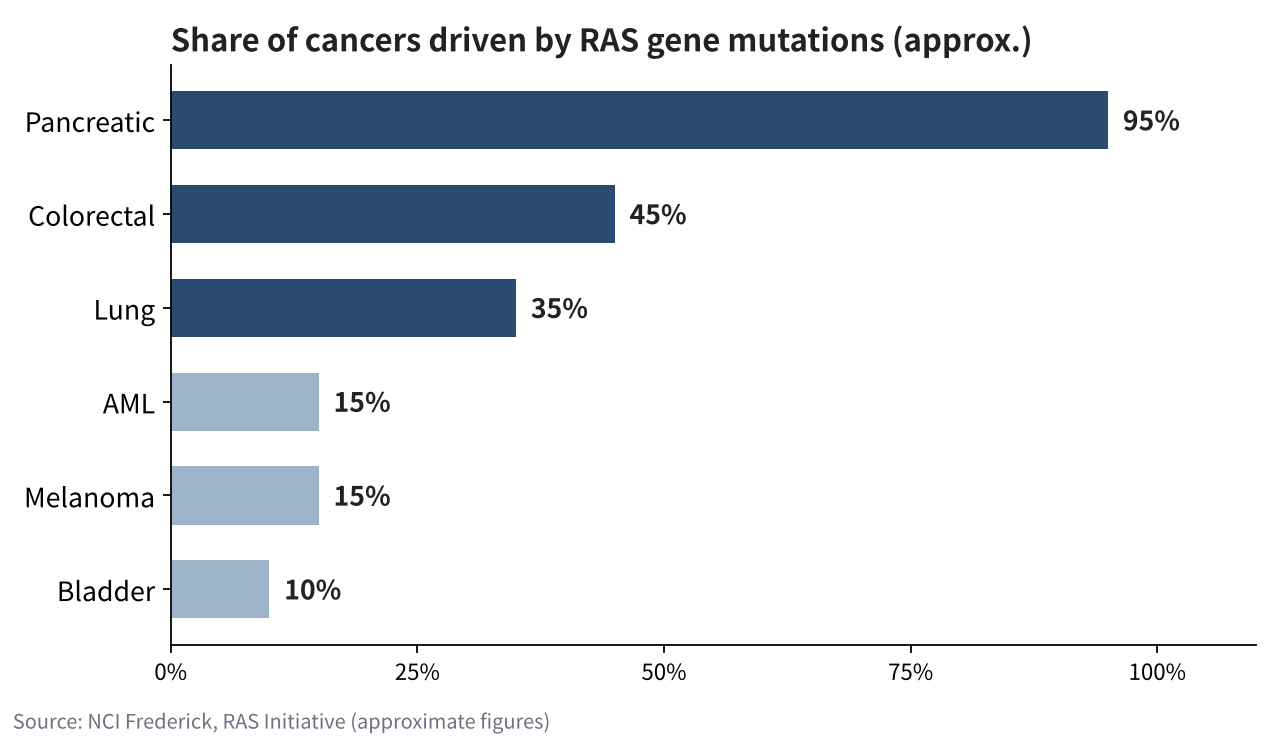
The team first mined public databases of cancer cell lines. Whether a line carried a KRAS mutation tracked its mtDNA level more closely than the type of cancer did, and lung, colorectal, pancreatic and biliary cancers with KRAS mutations tended to hold more mtDNA. According to the researchers, KRAS mutations increase reactive oxygen species (ROS), chemically reactive molecules that can damage cell components, and these also promote the copying of mtDNA. Such cancers are common: the U.S. National Cancer Institute’s RAS Initiative estimates that mutations in the RAS gene family, which includes KRAS, are found in roughly a third of human cancers, including about 95 percent of pancreatic cancers, 45 percent of colorectal cancers and 35 percent of lung cancers.
Letting the DNA out, then removing the brake
In KRAS-mutant cells, a drug that blocks MEK, a protein in the same growth-signaling chain as KRAS, made mtDNA escape into the cytoplasm. But the drug also switched on mitophagy, the cell’s routine for clearing out damaged mitochondria, which limited the leak. The team found that this cleanup involved a protein called PRKN, which helps remove damaged mitochondria and thereby holds back the release of mtDNA.
The two drugs thus work in opposite ways: one causes mitochondrial damage and releases mtDNA, while the other stops the cell from cleaning up. When the researchers added chloroquine, which they used experimentally to inhibit mitophagy, damaged mitochondria were no longer cleared as effectively, mtDNA kept escaping, and the type I interferon response grew stronger. The response did not appear in cells with little mtDNA or in cells lacking STING. Across human cancers, the team also noted that higher PRKN expression went along with less immune-cell infiltration.
A balance with cytochrome c
There was a second ingredient. Cytochrome c is a protein normally involved in energy production inside mitochondria; when released into the cell, it helps trigger the machinery of apoptosis. The researchers found that the relative amounts of mtDNA and cytochrome c help determine whether drug-treated cells undergo apoptosis or immunogenic cell death.
In lung cancer cells with a lot of mtDNA, such as those with KRAS mutations or ALK or ROS1 gene fusions, the drug combination produced an immune response. In EGFR-mutant lung cancer cells, which carry a lot of cytochrome c, cells mainly died by apoptosis, and lowering cytochrome c shifted them toward immunogenic death. Pushing the drugs too hard also favored apoptosis and weakened the immune response, a hint that simply killing more cancer cells is not always the better goal.
What happened in mice
In a mouse model of KRAS-mutant colorectal cancer, the team combined a MEK inhibitor, a mitophagy inhibitor and an anti-PD-1 antibody, a type of checkpoint inhibitor. The three-drug combination suppressed tumor growth, and tumors disappeared in 2 of 12 mice. The effect depended on dendritic cells, which show tumor fragments to other immune cells, and on CD8-positive T cells, the immune system’s cancer-killing cells. Tumors with low mtDNA did not respond. These results show an effect in a preclinical model; whether the same strategy can work in patients remains unknown.
The findings suggest that successful cancer treatment may depend not only on how many cancer cells are killed, but also on how their deaths affect the immune system. According to the press release, the team’s next steps are to test whether mtDNA abundance can predict how patients respond to treatment and to develop strategies that combine targeted drugs with immunotherapy. The work was supported in part by Japan’s AMED and the Moonshot R&D Program.
Xsciens Editorial Note
The study suggests that how much mitochondrial DNA a tumor carries helps decide whether drug-induced cell death rouses the immune system.
- Observation versus model. What was observed: KRAS mutation tracked mtDNA levels in public cell-line data, and the drug combination caused mtDNA leakage and interferon signaling in cells. The mtDNA-versus-cytochrome c “balance” is the team’s explanation, built from experiments in which those molecules were manipulated in cells. The 2-of-12 figure counts complete tumor disappearance in mice, not an overall response rate.
- Limits. The evidence comes from cell experiments, analyses of public cancer databases and mouse models. Although the researchers looked at patterns in human cancers, they have not shown that the drug combination works in patients. Chloroquine was an experimental tool to inhibit mitophagy, not a validated cancer treatment, and nothing here supports anyone taking it for cancer.
- What to watch. Whether mtDNA abundance can predict treatment response in patients, and whether it must be read alongside cytochrome c levels and other features of the tumor environment. The team says this still needs testing.
- From the editors — if this holds up, cancer care could get smarter about how tumors die, not just whether they do. Doctors might one day check a tumor’s mitochondrial DNA to pick drugs that leave the immune system alert to any survivors, which could mean fewer relapses. But all of this rests on cells and mice so far, and pushing a tumor too hard can backfire, as this very study shows. If you or someone close is in treatment, keep an eye on this field, but treat no single drug as the answer.
References for this note: Galluzzi et al., Consensus guidelines for the definition, detection and interpretation of immunogenic cell death (J Immunother Cancer, 2020), NCI Frederick, RAS Initiative, Lin et al., Editorial: Mitochondrial damage interacts with the immune system and tumor microenvironment (Front Immunol, 2025)
Sources: Immunity (Tanaka et al., 2026), Nagoya University / National Cancer Center Japan / Kyoto University press release (Nov 2, 2026, in Japanese), Kyoto University research news (in Japanese)