What if a single patent could translate into a legal claim worth tens of billions of yen for the individual engineer who invented it? Shuji Nakamura, inventor of the blue LED, originally received an in-house bonus of just ¥20,000 for his work — yet a later court case calculated his personal contribution to the invention at roughly ¥60.4 billion. Patents tend to conjure an abstract image, something like a technologist’s badge of honor. But for both companies and the inventors who work for them, a patent is a genuine money-making mechanism. This piece lays out how patents translate into corporate profit, then looks at one real example of a single patent generating extraordinary value: Nichia Corporation’s blue LED patent.
What a Patent Actually Is
A patent is a right the government grants to whoever makes a new invention: the exclusive right to use that invention for a set period. In Japan, for 20 years in principle from the filing date, no one but the patent holder may manufacture or sell that invention without permission. In other words, a patent isn’t the technology itself — it’s an asset representing the right to prevent others from using that technology, or to charge them for the privilege, and that right can be bought, sold, and enforced.
Four Ways Patents Drive Corporate Profit
High margins through exclusivity (competitors can’t make the same product, so there’s no price competition and margins stay high); license revenue (a company doesn’t have to manufacture anything itself — it can license the technology to others for royalties); litigation and negotiating leverage (a company can seek damages from unauthorized use, or negotiate settlements from a position of strength); and value as an intangible asset (patents held by a company represent enterprise value that doesn’t show up on the balance sheet, but still factors into stock price, fundraising, and M&A valuations). Of these four, exclusivity-driven high margin is by far the most powerful.
Case Study: How the Blue LED Patent Built a Trillion-Yen Business
In 1993, Shuji Nakamura, then an engineer at Nichia Corporation, developed the world’s first practical high-brightness blue LED. Until then, LEDs came only in red and green; adding blue completed the three primary colors of light, making full-color displays possible and enabling white LED lighting (created by combining blue with yellow). White LEDs spread around the world as an energy-efficient alternative to incandescent and fluorescent lighting, and Nichia used its blue LED patents to seize an overwhelming share of the global market.
A 2004 Tokyo District Court ruling put a number on that patent’s worth. Nakamura sued Nichia seeking compensation for his invention under Japan’s employee-invention system, and the court calculated the patent’s value as follows: Nichia’s cumulative blue-LED-related sales came to roughly ¥1.2086 trillion; applying a 20% royalty rate to the portion the patent protected yielded an estimated monopoly profit of roughly ¥120.8 billion; and crediting Nakamura with a 50% contribution to the invention put his compensation at roughly ¥60.4 billion. Of that ¥60.4 billion, the court ordered Nichia to pay the ¥20 billion Nakamura had originally sought. The case was ultimately settled at the Tokyo High Court in 2005, with Nichia paying about ¥843.91 million including delay damages — a steep discount from the district court figure, but still, set against Nakamura’s original in-house invention bonus of just ¥20,000, a striking illustration of how much economic value a single invention and a single patent can carry. In 2014, Nakamura was awarded the Nobel Prize in Physics for the invention.
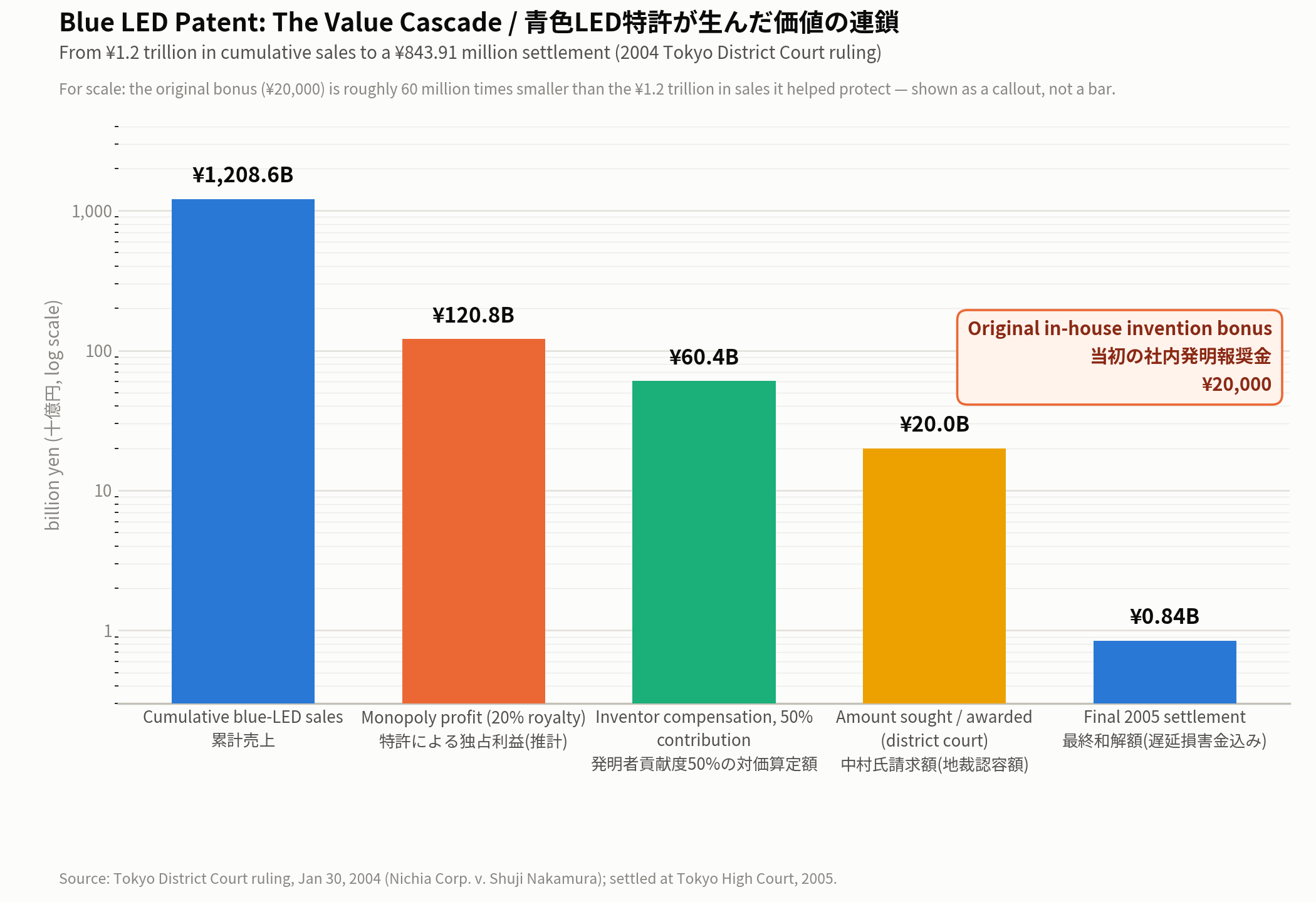
The original in-house invention bonus was ¥20,000. The court’s own calculation of Nakamura’s contribution came to roughly ¥60.4 billion — a gap of about three million times.
How Japan’s Employee-Invention Rules Changed Afterward
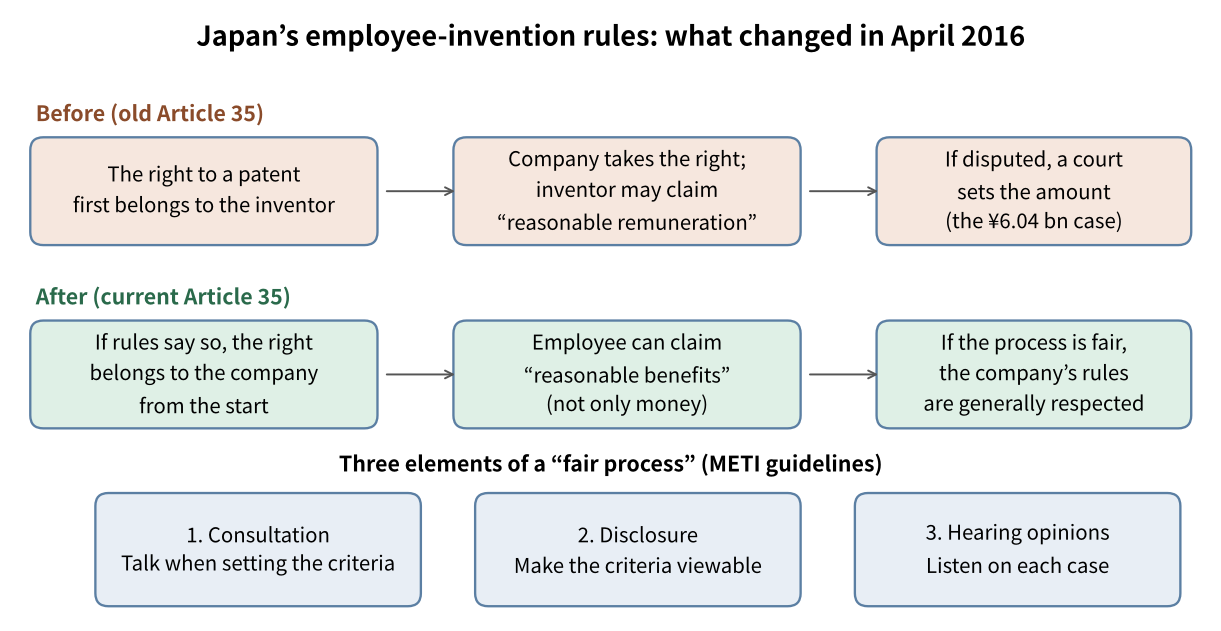
Employee inventions are governed by Article 35 of Japan’s Patent Act. Under the 2015 amendment (in force from April 1, 2016), if a contract or work rules state in advance that the company acquires the rights, the right to obtain a patent belongs to the company from the moment the invention is made (Article 35, paragraph 3). Before the amendment, the right first belonged to the inventor and the company took it over. The change was meant to remove the complications that arise in joint research and the risk of an inventor assigning the same rights to a third party.
Employees still keep the right to receive a “reasonable benefit” (paragraph 4). Such a benefit is not limited to money: stock options, promotions, paid leave beyond what the law or work rules require, and study-abroad opportunities can count, but a mere certificate of commendation does not. When a company sets standards for the benefit in a contract or work rules, giving benefits under those standards must not be found unreasonable (paragraph 5). In judging that, the process is taken into account in three steps: consultation when the standards were set, disclosure of the standards, and hearing the employee’s opinion when the benefit for an individual invention is decided. If these steps were handled properly, the company’s standards are respected. The Minister of Economy, Trade and Industry issues guidelines on proper procedure (paragraph 6).
Five Points to Check in Your Own Company’s Rules
- Does a contract or the work rules state that the company acquires the rights from the start?
- Was there an opportunity to consult with employees when the standards for the benefit were set?
- Are the standards disclosed so that employees can read them, with specific content and conditions?
- Can employees state opinions or objections when the benefit for an individual invention is decided?
- If the benefit is not money, is its content specified?
Inventions made before April 1, 2016 are in principle covered by the old law, and those made on or after that date by the amended law. For a specific case, consult your company’s intellectual property department or a patent attorney or lawyer. This article is general information, not legal advice.
The Rest of Article 35: Non-Exclusive License and How Benefits Are Valued
Paragraph 1 provides that even when an employee obtains a patent on an employee invention, the company holds a non-exclusive license to use it free of charge. The idea is that the company provided the research environment and equipment.
Paragraph 2 makes void any contract or work rule that gives the company advance rights to inventions that are not employee inventions. A company cannot, by rule, automatically own an individual’s invention unrelated to the job.
Paragraph 7 covers cases in which no standard exists, or in which giving the benefit as the standard provides is found unreasonable under paragraph 5. In that case the content of the reasonable benefit must be decided by considering the profit the company earns from the invention, the burden the company bears in connection with it, the contribution of the company and the inventor, and the treatment of the employee. This is the logic of comparing the value of the invention with each side’s contribution, and it is the idea that comes into play when amounts are disputed.
The Bottom Line
A patent is a certificate of technical achievement, but it’s also a business asset that feeds directly into company profit through exclusivity, licensing, litigation leverage, and enterprise value. As the blue LED case shows, being first to lock up a genuinely pivotal technology with a patent can be enough, on its own, to build a trillion-yen business — and, as Nakamura’s case shows, can turn a single engineer’s idea into a legal claim worth tens of billions of yen. That’s exactly why companies pour as much energy into patent strategy as they do into R&D itself.
Xsciens Editorial Note
The striking “¥20,000 to ¥60.4 billion” figure is real, but the more important story is what happened afterward: the rules themselves changed.
- A court’s calculation is not money received. As the article notes, the case was settled on appeal for roughly ¥840 million. Remembering only the headline number gives the wrong picture of how the system works.
- The focus moved from the amount to the process. Under the amendment effective April 2016, if the process (consultation, disclosure and hearing of opinions) is fair, a company’s own rules are generally respected. In principle, that leaves fewer situations in which a court decides the amount afterward.
- What we still cannot tell. A proper process does not by itself tell us whether the resulting criteria feel fair to employees. That depends on how each company operates.
- Our imagination (speculation) — We wonder whether, for people who will invent things in the future, reading the company’s invention rules once when joining may matter more than a famous court figure. Knowing the criteria before results appear is likely easier than arguing after them. This is only our speculation, and individual contracts and rules differ widely.
References for this note: Japan Patent Office, “Overview of the Employee Invention System” (in Japanese; 2015 amendment effective April 2016, “reasonable benefits”, consultation / disclosure / hearing of opinions)
Tokyo District Court, judgment of January 30, 2004 (the blue LED compensation lawsuit, Nichia Corporation v. Shuji Nakamura)
ITmedia NEWS, “Blue LED Lawsuit: Nichia Settles for ¥843.91 Million”
Nichia Corporation, “Settlement in Tokyo High Court Case No. 962 (ne) and No. 2177 of Heisei 16”