Much of chemotherapy’s toll on the body comes from the fact that the drug attacks healthy, fast-dividing cells right along with cancerous ones. A team from RIKEN and Institute of Science Tokyo has developed a way around that: instead of administering an active drug, they deliver an inert precursor that only turns into a cancer-fighting compound once it is inside a cell, using carbon monoxide (CO) — a metabolite that runs elevated in some cancer cells — as the raw material. In effect, the cancer cell is enlisted to manufacture its own drug from a harmless precursor, while cells with lower CO output make far less of it. It’s an early-stage, cell-culture result rather than a ready-made treatment: the researchers themselves describe the selectivity they observed as modest, and animal or human safety data don’t yet exist.
Title: Harnessing endogenous carbon monoxide for cancer-selective drug synthesis
Authors: Kawai, M. et al.
Journal: Nature Communications 17, 9603 (2026)
DOI: 10.1038/s41467-026-77616-8
A palladium catalyst smuggled in by the body’s own protein
The team built what they call an albumin-palladium complex: a palladium catalyst tucked into a hydrophobic pocket of human serum albumin, the most abundant protein in blood. A small anchor molecule steers the complex to albumin’s drug-binding site, and this packaging keeps the catalyst active even in the presence of glutathione, an abundant cellular antioxidant that would normally deactivate a bare palladium compound. Once inside a cell, the complex reacts with intracellular CO to assemble a phenanthridinone-scaffold compound with topoisomerase-I-inhibiting activity — a mechanism shared with established anticancer drugs. The approach flips the usual order of drug delivery: rather than making a drug and shipping it to the cell, the team ships an inert precursor and lets the cell’s own CO serve as the building material for the final compound, assembled on site.
Up to ninefold more compound formed in cancer cells
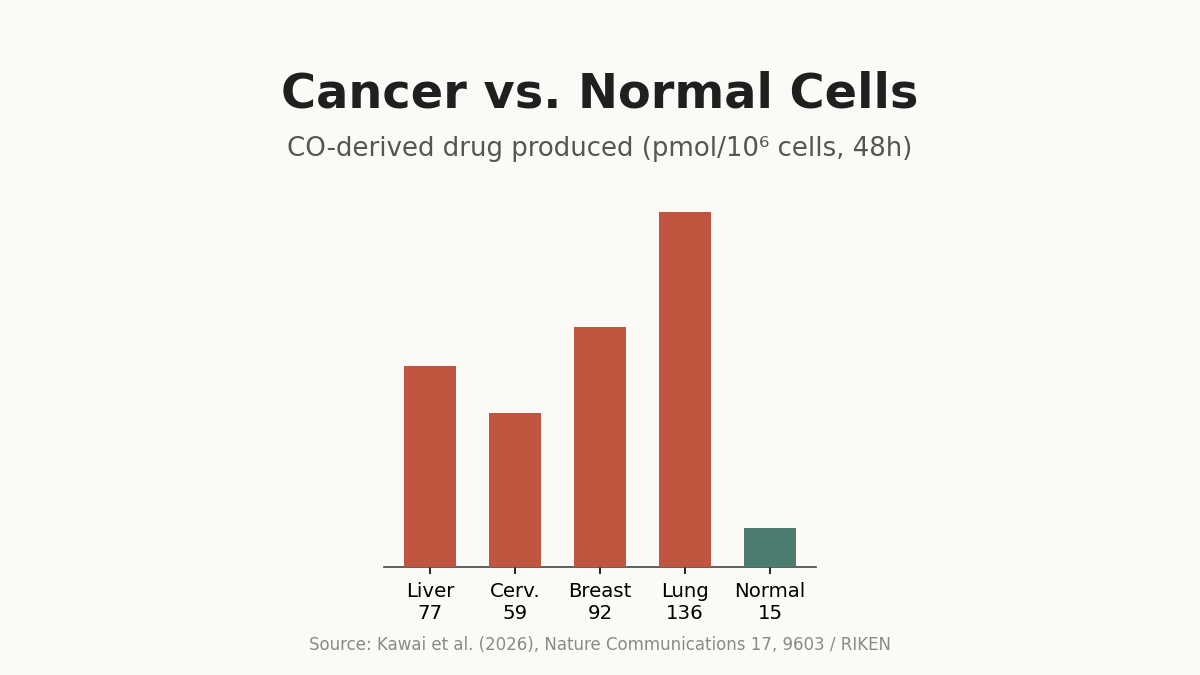
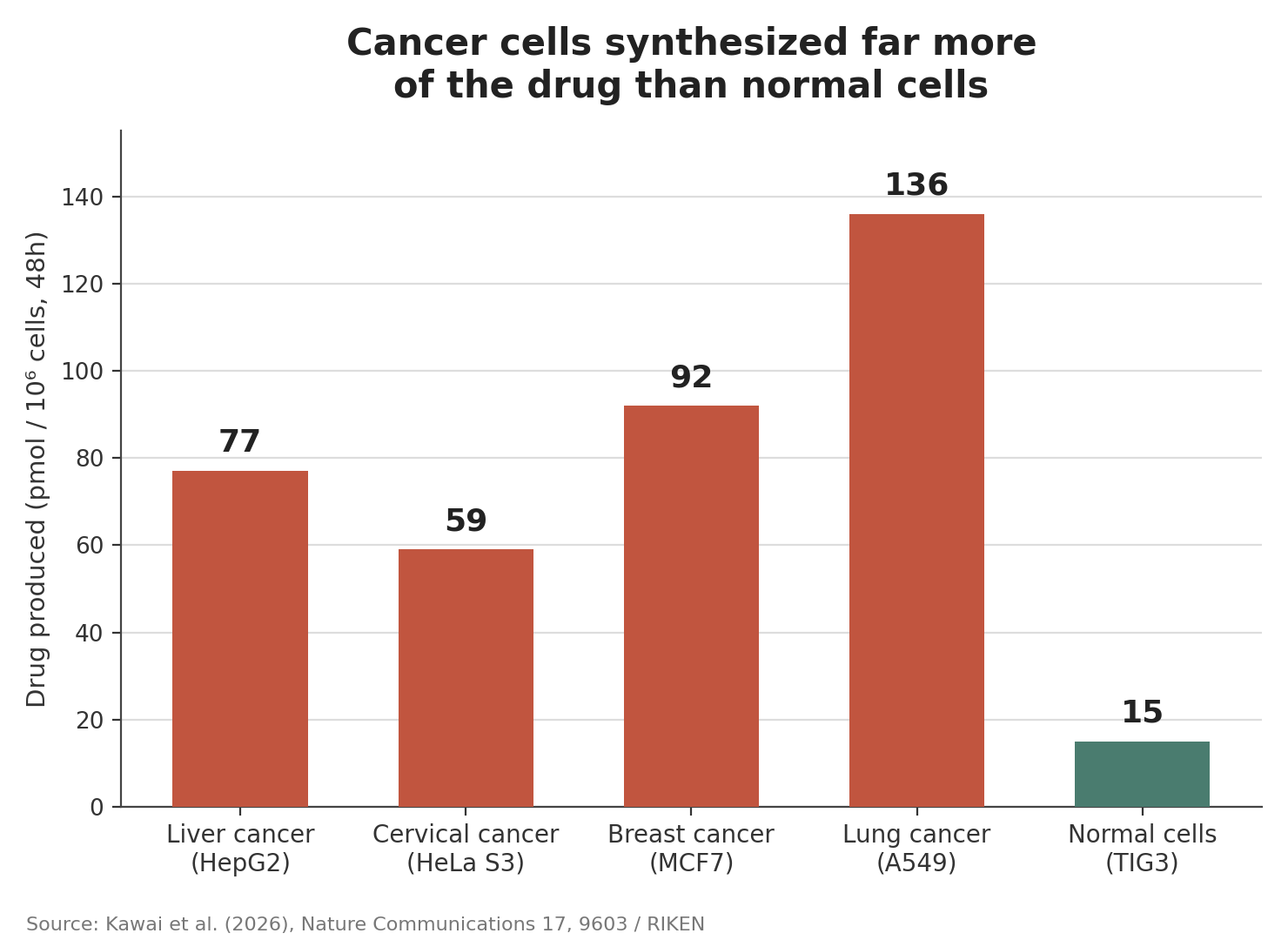
According to the paper, after 48 hours in culture, the amount of CO-derived compound produced in four cancer cell lines — liver (HepG2), cervical (HeLa S3), breast (MCF7), and lung (A549) — was up to roughly ninefold higher than in normal fibroblasts (TIG3): 136 picomoles per million cells for the lung line versus 15 picomoles for the normal one. In the liver cancer line, the concentration needed to be effective (IC50) was 13.99 micromolar, about a third of the 37.54 micromolar needed against normal fibroblasts. In breast cancer cells, RIKEN’s release reports that treatment at 5 to 10 micromolar significantly suppressed colony formation over 12 days, with near-complete inhibition at 10 micromolar and above.
After 48 hours, lung cancer cells used CO to synthesize roughly nine times as much of the drug compound as normal fibroblasts did.
A new chemical angle on reducing chemotherapy’s toll
The researchers frame this as an early step toward a broader drug-design strategy: using disease-specific metabolites, not just in cancer, as the raw material for synthesizing therapeutics inside the body rather than merely as diagnostic markers. The comparisons so far involve one cancer cell line and one normal cell line at a time, and the work is limited to cultured cells — animal and clinical studies still lie ahead. Still, it offers a new chemical approach to the long-standing challenge of designing cancer treatments that spare healthy tissue.
The study was published on September 17, 2026, in Nature Communications.
Xsciens editorial note: what the numbers do and do not show
The most striking figure is the up to ninefold difference in how much compound the cells made, with lung cancer cells producing 136 picomoles against 15 picomoles in normal fibroblasts. But that is a measure of synthesis inside cells, not of tumor shrinkage. The effective concentration (IC50) in liver cancer cells, 13.99 micromolar versus 37.54 micromolar in normal fibroblasts, is about a third, so the selectivity in killing cells is real but more modest than the ninefold synthesis gap suggests.
It is also worth noting how the idea differs from conventional targeted drugs. Those aim at a molecule on or in the cancer cell. Here, a harmless precursor is delivered first and the cancer cell’s own metabolism supplies carbon monoxide as a building block, so the strategy depends on how much CO a given tumor makes. The comparisons so far use single cell lines in culture, so how well this works in tumors made of mixed cells, and whether enough precursor can reach them, are open questions for animal and clinical studies.
Key terms
- Albumin: the most abundant protein in blood, here used as a carrier for the catalyst
- Palladium complex: a compound of the metal palladium that acts as a catalyst, speeding up a chemical reaction
- Glutathione: an antioxidant present in large amounts in cells that can deactivate many catalysts
- Topoisomerase I inhibitor: a drug that blocks an enzyme cells need to copy DNA, a mechanism used by established anticancer drugs
- IC50: the concentration of a compound needed to reduce cell growth by half
Sources: RIKEN, Kawai et al., Nature Communications 17, 9603 (2026), Tech & Bio Life Sciences