Researchers at Japan’s New Energy and Industrial Technology Development Organization (NEDO), the University of Tokyo, the Japan Agency for Marine-Earth Science and Technology (JAMSTEC), and Gunma University have built a biodegradable plastic that keeps its strength while dry but speeds up its own breakdown once wear and water reach enzymes mixed into the material. In seafloor trials at a depth of 5,503 meters, the enzyme-laced plastic lost weight far faster than the same material without the enzymes. The team sees the work as a potential tool against marine plastic pollution, which research groups worldwide have struggled to tackle largely because so much plastic debris, once lost at sea, is effectively impossible to retrieve.
原題(Title): Enzyme-embedded polyesters for accelerated biodegradation in the deep sea
著者(Authors): QiuYuan Huang et al.
掲載誌(Journal): Nature
DOI: 10.1038/s41586-026-11192-1
A Plastic Built to Switch On When Wet
An estimated eight million tons of plastic waste enters the ocean every year, and some of it can take more than 300 years to break down in the natural environment. The same research team had previously shown, for the first time, that biodegradable plastics are broken down by microbes on the seafloor at depths of 757 to 5,552 meters — but even the fastest cases took years to fully degrade. The deep sea is cold and under high pressure, and only a limited population of microbes there is capable of breaking down this particular type of plastic, so degradation tends to be slow.
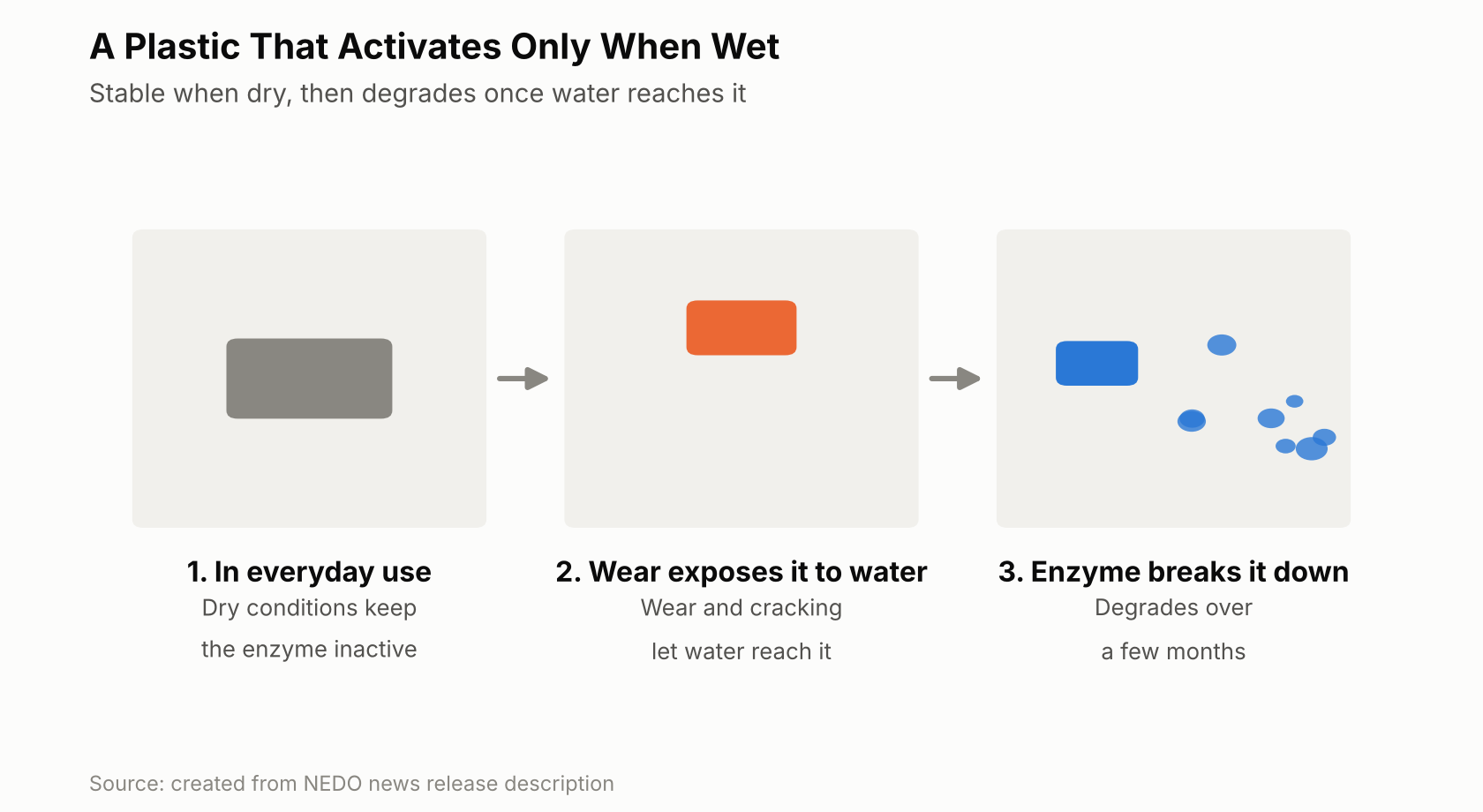
This time, the team changed the plastic’s mechanism rather than its base material. They melted the plastic and mixed in natural degrading enzymes — HiC cutinase, which cuts polyester bonds and comes from a mold species, and CaLB lipase, an enzyme involved in fat breakdown that here was repurposed for plastic, sourced from an Antarctic yeast. These enzymes stay inactive without water, so the plastic keeps close to its original strength while dry and in use. But once wear or fragmentation in the environment lets water reach the enzymes inside, degradation accelerates from there — in effect, a plastic that switches on once it gets wet.
It’s worth separating two related but different ideas here: how much weight a sample loses, and how completely it eventually breaks down into simpler compounds through microbial action, a process researchers call mineralization. The paper backs up its weight-loss measurements with both chemical analysis of what the enzymes actually produce and biochemical oxygen demand testing, which tracks how far seawater microbes carry that breakdown — so the result isn’t based on weight loss alone.
Weight Loss Confirmed Even at 5,503 Meters
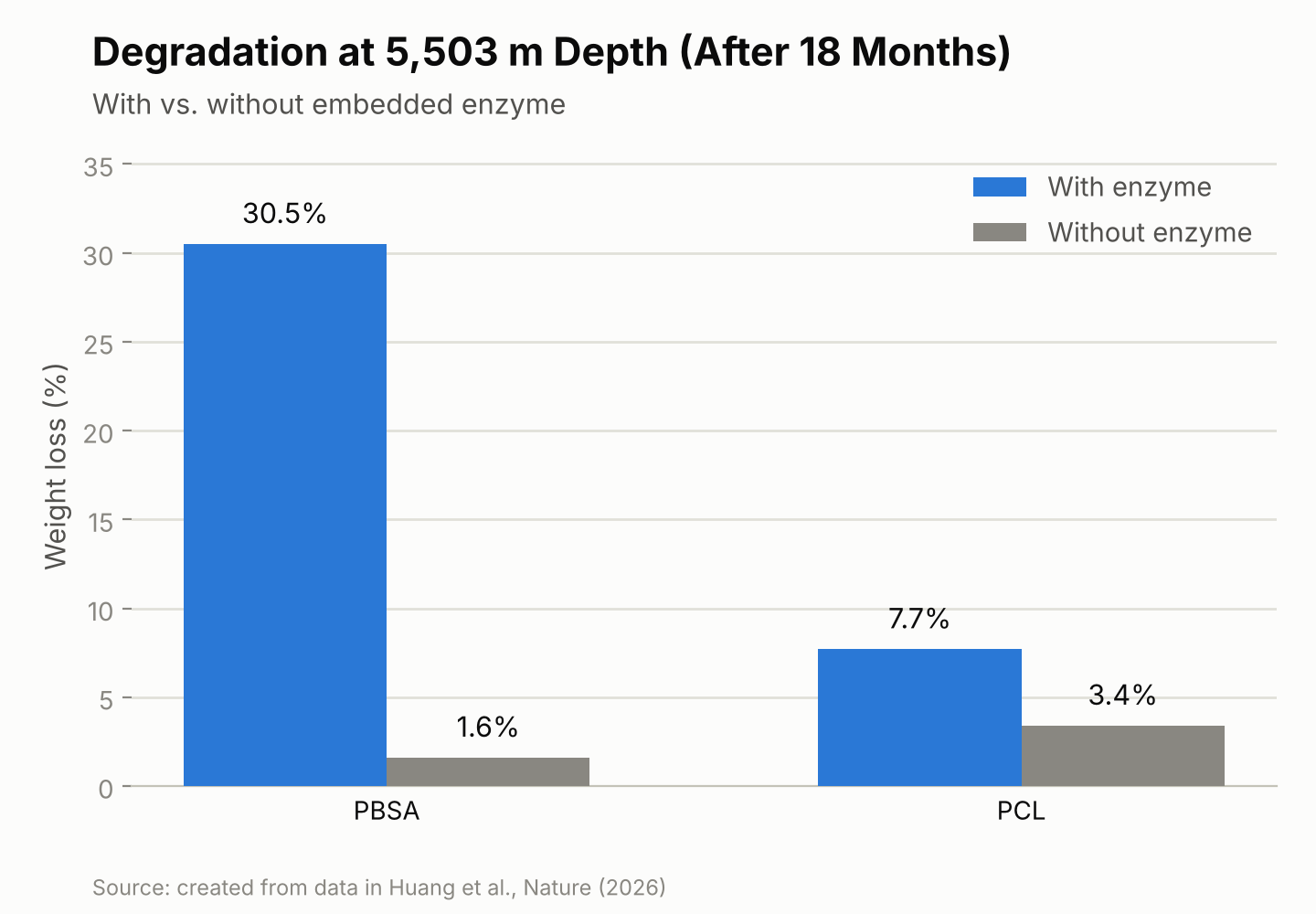
The team sank plastic films at coastal sites (2 to 6 meters deep) and at several deep-sea locations — 757, 855, 1,292, and 5,503 meters — and compared how their weight changed over time. Even at 757 meters, 4°C, and 7.6 MPa of pressure (about 75 times atmospheric pressure), some of the enzyme-laced materials lost nearly all their weight within five months, versus barely any loss for the enzyme-free material over the same period. At the deepest site, 5,503 meters, enzyme-laced PBSA (polybutylene succinate adipate, hereafter PBSA) lost about 30.5% of its weight after 18 months, far more than the roughly 1.6% lost by the same material without the enzyme. Degradation varied by material, though — not every sample lost weight at the same rate, and PCL, another material in the trial, lost only about 7.7% of its weight over the same 18 months even with the enzyme added.
Coastal seawater trials, run separately from the deep-sea deployments, told a similar story on a faster timeline: even at a lower enzyme loading of around 0.1 weight percent, several of the materials lost a substantial share of their weight within a single month in the water near shore. That matters for how the result should be read — degradation isn’t an on/off switch that waits until plastic reaches the deep ocean, but a process that speeds up as soon as water reaches the enzyme, in whatever environment that happens.
Fast Degradation Without Losing Strength
A natural question is whether making the plastic easier to break down also weakens it as a product. According to the team, adding the enzyme at around 0.1 weight percent barely affects tensile strength, and even at the roughly 3 weight percent used for the deep-sea trials, the drop in strength and elongation stays within what the researchers describe as a practically usable range. Comparing weight-loss speed at 757 meters, the enzyme-laced material lost about 97 micrograms per square centimeter per day, versus just 0.9 micrograms for the enzyme-free material — a specific comparison in which the difference reached roughly 100-fold. Separately, NEDO describes the project’s overall achievement as roughly a 30-fold increase in degradation speed compared with the enzyme-free version. Both figures are accurate; they simply describe different materials and conditions rather than contradicting each other.
Embedding the enzyme directly in the material showed that a biodegradable plastic’s weight loss can be sped up substantially, even in the deep sea, where it once degraded only very slowly.
Micro-Sized Beads Respond Too
The same approach was also applied to test microbeads 20 to 300 micrometers across, which degraded across a range of coastal and deep-sea conditions. This doesn’t confirm the effect in actual cosmetic-grade microbeads on the market — it’s a result from lab test particles sized to resemble microplastics. Smaller plastic particles are more likely to be taken up by marine life, and once they spread into the environment, recovering them is difficult; microbeads in particular are one of the hardest categories of marine plastic to clean up once released, since conventional filtration and collection methods struggle at that size. Building degradability into a product’s design from the start could become a new way to reduce how much plastic lingers after release. How well this translates to real products, and how much it actually reduces pollution, still needs further testing.
What’s Left Before Real-World Use
The team’s next steps include testing long-term durability and safety under realistic conditions, extending the approach to a wider range of biodegradable plastics, making the enzyme-mixing process more efficient and affordable, and scaling up for mass production. Deep-sea degradation still takes several months to more than a year, so this isn’t a case of plastic vanishing the instant it’s lost. Cost is likely to be a major factor in whether the approach ever reaches store shelves, since biodegradable plastics already tend to cost more to manufacture than conventional ones, and adding a purified enzyme to the mix adds another expense on top of that. Still, compared with the several years existing biodegradable plastics have needed to break down in the deep sea, this result looks like a promising option for tackling marine plastic pollution.
Xsciens Editorial Note
What stands out most here is the mechanism itself: a plastic engineered to activate only once it gets wet, rather than a change to the base material.
- “30x” and “100x” describe different comparisons. NEDO’s “about 30-fold” figure represents the project’s overall result, while the “about 100-fold” figure in this article comes from one specific comparison — weight-loss speed at 757 meters (at 5,503 meters, PBSA lost about 30.5% of its weight with the enzyme versus about 1.6% without it over 18 months; at 757 meters, the daily weight-loss rate was about 97 micrograms with the enzyme versus about 0.9 micrograms without it). Neither number is wrong, but it’s safer not to let a single multiplier stand in for every condition.
- The materials and timescales involved have limits. The enzymes tested here work on polyester-based biodegradable plastics — PBS, PBSA, PCL, and PBAT — and don’t directly apply to everyday polyethylene or polypropylene, the materials used in most plastic bottles and bags. Deep-sea degradation still takes at least a few months, and sometimes more than a year depending on the material, so this isn’t a case of plastic disappearing the moment it’s lost.
- Long-term, real-world testing is the next thing to watch. What’s been shown so far comes from experimental deployment trials. The research team itself lists durability and safety testing under real-use conditions, and establishing mass-production methods, as future challenges. How much this technology can actually reduce marine plastic’s buildup, while keeping costs low enough for wide adoption, remains to be seen.
- From the editors — once this reaches the market, choosing plastic products could come with a little less guilt. Expect more everyday items — food packaging, fishing gear — built with technology like this, cutting into ocean plastic pollution without sacrificing convenience. That said, “it breaks down anyway” shouldn’t become an excuse to get careless about waste. Even as the technology improves, reducing what we throw away is still on us as consumers.
References for this note: Chamley et al., “Polymer material biodegradation in the deep sea. A review,” Science of The Total Environment (2024), Japan Ministry of the Environment, Eco-Label Database, “Marine Biodegradable Plastics” certification program
Sources: NEDO news release, Huang et al., “Enzyme-embedded polyesters for accelerated biodegradation in the deep sea,” Nature (2026)