- A drug already tested in cancer patients turns out to work mainly by blocking a different target than scientists believed — a mix-up that could change how its past and future trials are read.
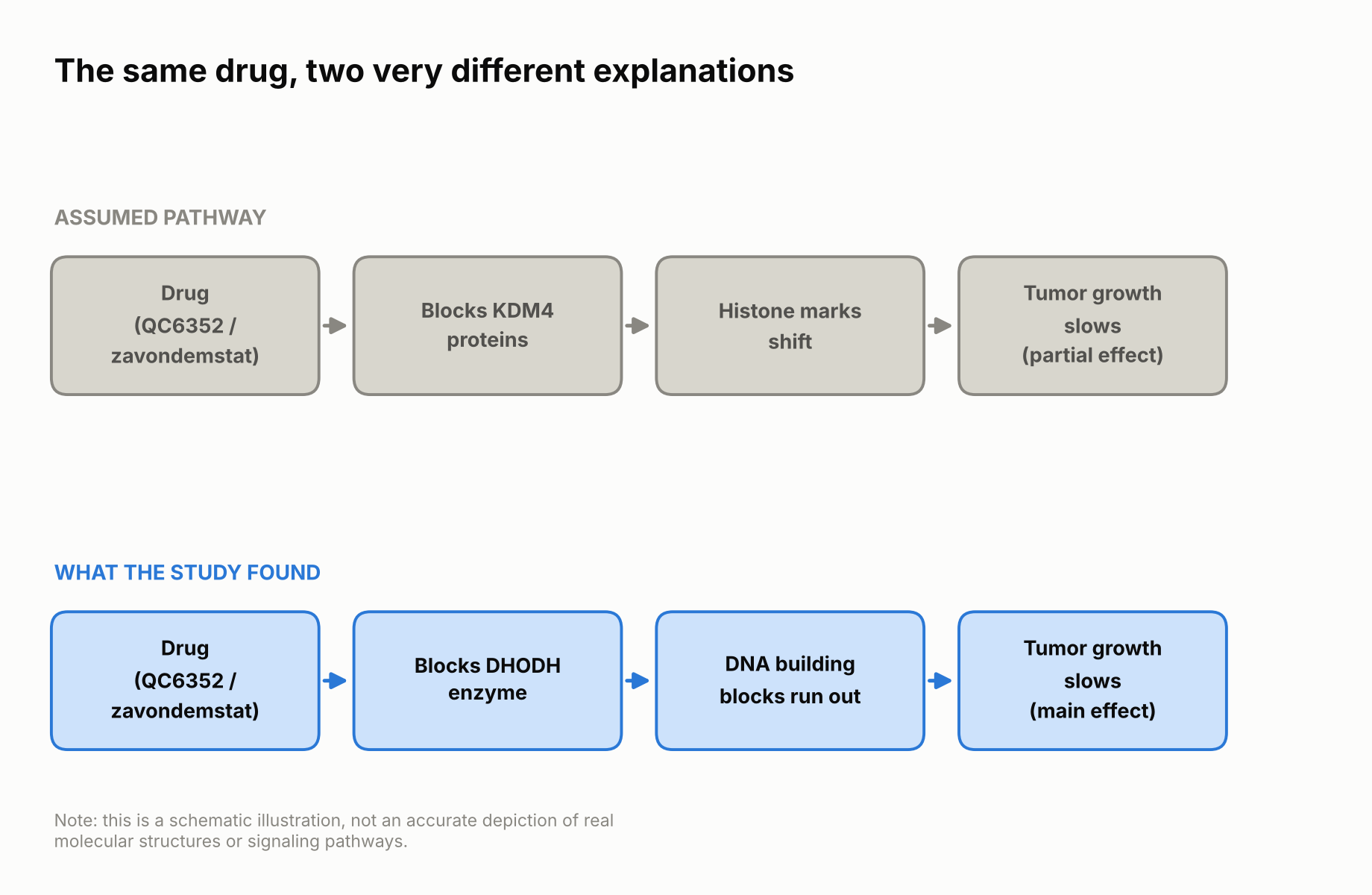
- Researchers at the University of Sydney were testing whether the drug, called zavondemstat, could also work against glioblastoma, a particularly hard-to-treat brain cancer, when its effects stopped matching its supposed target, a protein family called KDM4.
- Using brain-tumor cells grown from patients, genetic tricks, and detailed chemistry, the team traced the drug’s real effect to an enzyme called DHODH, which fast-growing cancer cells need to build new DNA.
- The work is still confined to lab-grown cells and mice, not patients, but it also points to a possible new treatment route for glioblastoma, since other drugs that block the same enzyme already exist.
Most new cancer drugs are designed around a specific molecular target: a protein that, when blocked, is expected to slow or stop tumor growth. But a study published on October 6, 2026 in Nature Chemical Biology by a University of Sydney-led team shows that an experimental drug already tested in cancer patients may owe most of its power to a completely different target than the one it was built for. The discovery does not mean the drug fails to work — it still slows cancer growth in the lab and in mice. What changed is the explanation for why, and that explanation matters for how the drug’s clinical trials — past and future — are designed and interpreted.
A drug built for other cancers, tested against a tougher one
The drug at the center of the study is called zavondemstat. It has already been tested in a phase 1 clinical trial of 30 patients with advanced, heavily pretreated solid tumors — about 40% of them colorectal cancer, along with prostate, pancreatic, and several other cancer types. Roughly 44% of the patients who could be evaluated had their disease stay stable on the drug, including a few who stayed stable for six months or more, and reported side effects were mild. The trial’s sponsor chose to halt the study early for business reasons before testing higher doses, so what comes next for zavondemstat is not yet settled. The drug was developed to block a family of proteins called KDM4, which many tumors produce in excess to help themselves grow and spread. A closely related laboratory compound, QC6352, has been widely used by researchers as a tool for studying what KDM4 does inside cells.
A team led by Professor Lenka Munoz at the University of Sydney’s Charles Perkins Centre, working with collaborators at Goethe University, the University of Oxford, and the Institute of Cancer Research in London, wanted to see whether zavondemstat or QC6352 could also help against glioblastoma. Glioblastoma is the most common malignant brain tumor in adults and one of the hardest cancers to treat, so researchers routinely test whether drugs built for other cancers might also work against it.
The target did not add up
QC6352 showed strong activity against glioblastoma stem cells — tumor cell populations, grown from patient samples, that have stem-cell-like properties and are thought to drive the cancer’s growth and resistance to treatment. It blocked their growth at very low concentrations in lab dishes, while normal human brain support cells kept growing almost normally even at roughly ten times that concentration. That looked like confirmation that blocking KDM4 was the key to the effect. But when the researchers tested other drugs that block KDM4 just as strongly, those drugs failed to reproduce QC6352’s cancer-slowing effect. If KDM4 were really the main target, a different KDM4 blocker should have worked about as well. It did not, and that mismatch was the first sign that something else was going on.
Tracing the main target: an enzyme called DHODH
To find the true cause, the team ran a series of genetic and chemical tests. One enzyme kept coming up: DHODH, short for dihydroorotate dehydrogenase. DHODH helps cells manufacture pyrimidines, chemical building blocks that cells assemble into the nucleotides needed to make new DNA and RNA. Fast-dividing cancer cells depend heavily on a steady supply of these building blocks, so blocking DHODH can slow their growth sharply.
Two lab experiments made the case convincingly. First, the researchers added extra uridine, a related building block that cells can absorb directly and use to bypass a blocked DHODH; this restored the cells’ growth despite the drug still being present, which is a sign that DHODH, not KDM4, was what the drug was really acting through. Second, when they engineered cancer cells to carry a version of DHODH that the drug could not grab onto, those cells also kept growing normally even with the drug present. Both are standard laboratory rescue experiments, not something that could be done safely in a patient, but together they pointed squarely at DHODH as the main driver of the anti-cancer effect.
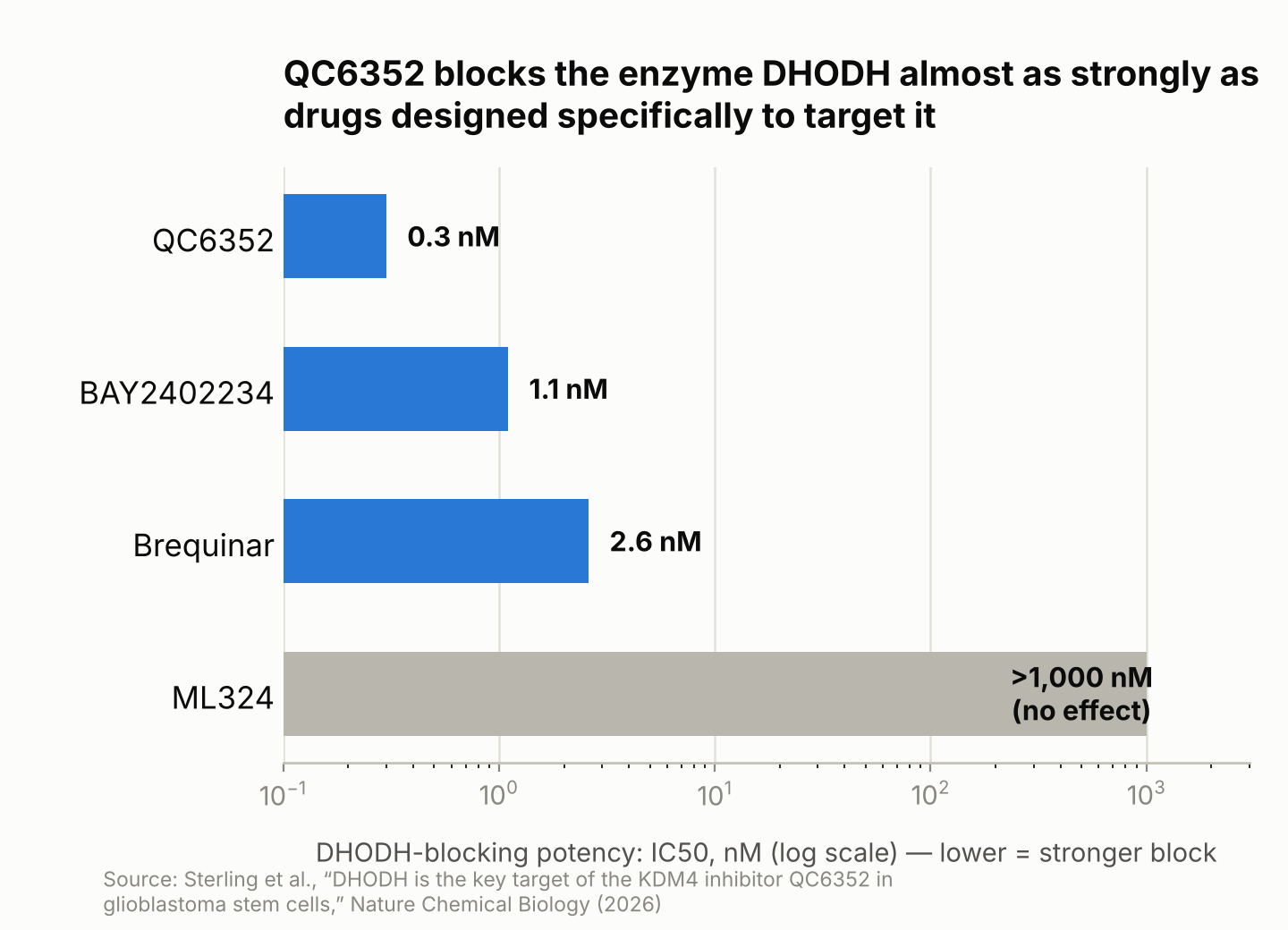
The chemistry backs this up. In a test-tube enzyme assay, QC6352 blocked DHODH at a concentration of about 0.3 nanomolar — an extremely small amount — which is in the same range as drugs built specifically to target DHODH, such as brequinar (2.6 nanomolar) and BAY2402234 (1.1 nanomolar). A true KDM4-only inhibitor called ML324, by contrast, barely touched DHODH at all even at concentrations over a thousand times higher. These numbers describe how tightly each compound grabs the enzyme in a dish, not how well it would work in a patient, but the gap between QC6352 and ML324 is the clearest sign that QC6352’s anti-cancer effect runs mainly through DHODH. The researchers now describe zavondemstat and QC6352 as “dual KDM4–DHODH inhibitors”: both targets are blocked, but the DHODH side appears to be doing most of the work against glioblastoma.
Why this matters beyond the lab
QC6352 has been used as a standard research tool in laboratories around the world to study what KDM4 does. If much of its effect actually comes from DHODH, some of those earlier studies may need to be re-examined, since what looked like evidence about KDM4 biology could instead reflect DHODH biology.
There is a more immediate concern, too. Zavondemstat has already been given to patients in a clinical trial that was designed and interpreted around the idea that it works mainly through KDM4. Professor Munoz has pointed out that getting a drug’s mechanism wrong is not just a historical curiosity — it can lead to poorly designed trials, choosing the wrong patients to enroll, and wasted research effort, and she argues this kind of mix-up is still common in cancer drug development today. To help avoid repeating the problem, her team also designed new experimental compounds that block KDM4 without touching DHODH at all, giving future researchers cleaner tools to study KDM4 on its own.
A possible upside for brain cancer patients
The mix-up also comes with a possible silver lining. In mice carrying human glioblastoma tumors, QC6352 extended median survival from 28.5 days to 34.5 days — an absolute difference of six days, or about 20% longer than in untreated mice — while normal brain support cells tolerated roughly ten times the dose without obvious harm in lab tests. That is an early signal of activity in animals, not evidence of a survival benefit in people. Still, because several drugs that block DHODH already exist and are being studied for other cancers, this discovery could give researchers a head start on exploring DHODH-targeted treatment for glioblastoma specifically, rather than starting drug development from zero. Much work would still be needed to show that an existing DHODH inhibitor can reach brain tumors at a safe dose and actually help patients.
In mice, blocking the enzyme DHODH with QC6352 stretched median survival from 28.5 to 34.5 days — six days, or about 20% longer than no treatment at all.
It is worth being careful about how far this points, though. The findings so far come only from lab-grown cells and mice, not from glioblastoma patients, and zavondemstat’s one completed human trial was not designed with DHODH in mind. Researchers elsewhere are also exploring other ways to make cancer treatment more targeted and less damaging to healthy tissue, such as an approach that gets cancer cells to manufacture their own chemotherapy drug while sparing normal cells. The DHODH finding adds another option to that broader search: not a cure in hand, but a clearer, evidence-based reason to try a treatment path that already has other drugs ready to test.
Sources: University of Sydney, Nature Chemical Biology