On October 12, 2026, the Royal Swedish Academy of Sciences awarded the Nobel Prize in Economic Sciences to Robert E. Hall of Stanford University and Michael Woodford of Columbia University, splitting the 12-million-krona prize between them. Their prize-winning idea sounds abstract — “microeconomic foundations of macroeconomic stabilization” — but it answers a very practical question: why do some recessions drag on for years while others pass quickly, and how can a central bank fight inflation without doing needless damage to jobs and growth? Their work reshaped how major central banks build the models they use to answer that question, giving policymakers a clearer theoretical map of how expectations, not just interest rates, move the economy.
When 1970s Policy Stopped Working
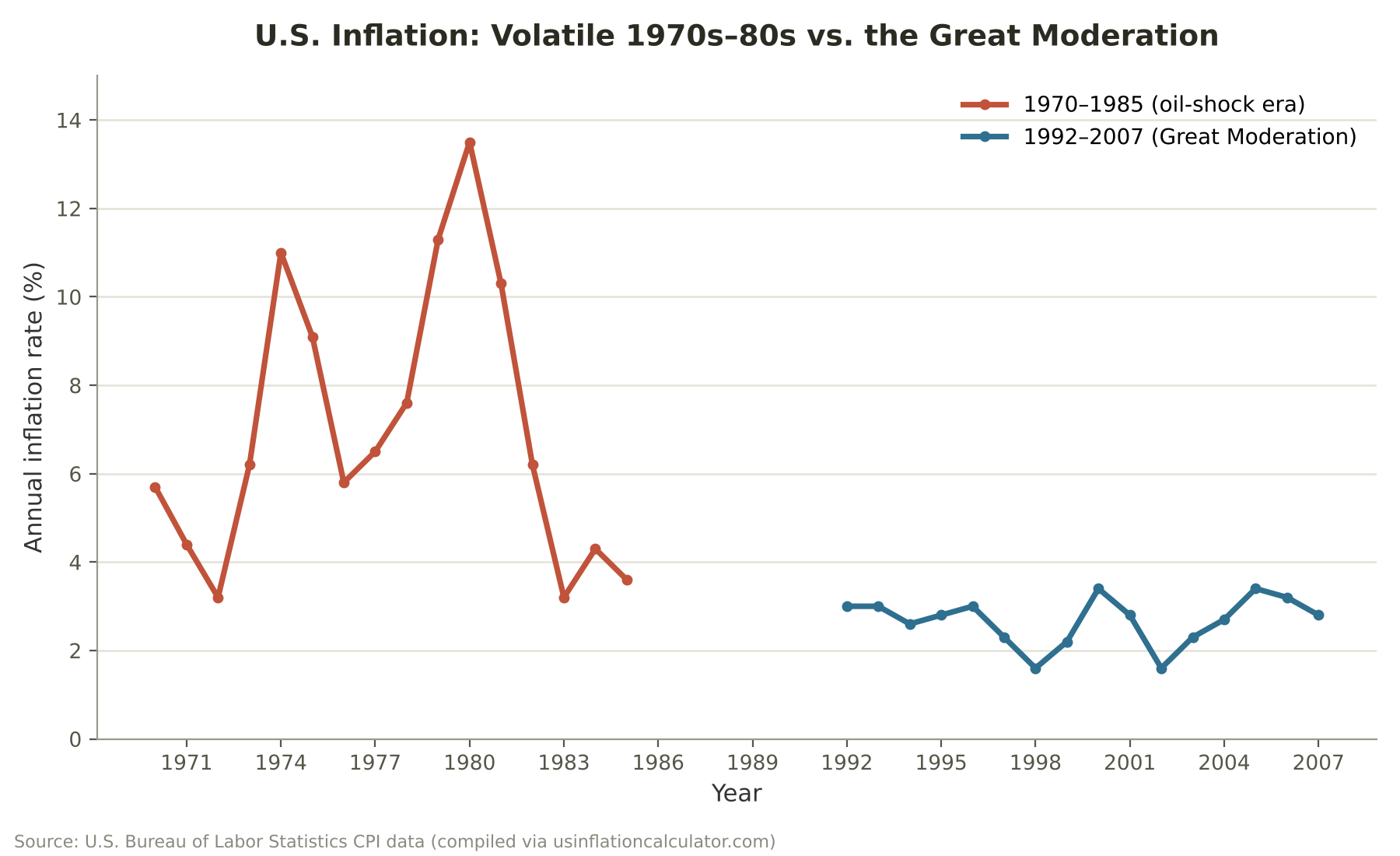
For decades after World War II, economists leaned on models built from statistical relationships between big aggregate numbers: total output, total employment, the overall price level. Many policymakers treated the link between inflation and unemployment as fairly stable, as if accepting a little more inflation would reliably buy a little less unemployment. The oil shocks of the 1970s strained that assumption badly. U.S. consumer prices rose by roughly 11 percent in 1974, eased briefly, then climbed above 13 percent by 1980, even as unemployment also stayed painfully high. This combination, dubbed “stagflation,” exposed real weaknesses in the prevailing models and forced economists to ask whether their tools for managing the economy were trustworthy at all.
Starting From How People Decide
Hall and Woodford, working in a research tradition that also included economists like Julio Rotemberg, pushed macroeconomic theory toward a different starting point: how individual households and firms actually make decisions. In their models, people are forward-looking — workers and firms set wages and prices partly on what they expect will happen next, and households decide how much to save or spend based partly on their expectations about future income and prices. Aggregate outcomes like inflation and employment emerge from how all of those decisions, expectations, and market constraints interact, rather than being assumed directly from past statistical patterns. This approach became a pillar of what economists call New Keynesian models, which combine forward-looking behavior with prices and wages that adjust only gradually, because changing them is itself costly for firms.
Why Expectations Move Markets
The forward-looking piece turns out to matter enormously, and it is arguably the most surprising part of the theory for non-economists. If a central bank merely moves interest rates without explaining its reasoning, people may barely change their behavior. But if a central bank credibly signals a future course of action and the public believes it, expectations can shift immediately, often before the policy itself has fully taken effect. Woodford, who has described his own framework as “neo-Wicksellian” after the 19th-century economist Knut Wicksell, argued that how policy is communicated is not a side issue but part of the policy itself. His work helped formalize the theoretical basis for “forward guidance,” in which central banks publicly signal their likely future interest-rate path; the idea existed informally before, but this research gave it a rigorous footing and helped turn it into an explicit, widely used policy tool from the 1990s onward.
How policy is communicated is not a side issue — it is part of the policy itself.
From Blackboard to Central Banks
These ideas did not stay confined to academic journals. Woodford’s 2003 book, “Interest and Prices: Foundations of a Theory of Monetary Policy,” became, in effect, a standard reference for central bank staff economists, and New Keynesian models of the kind he and Hall helped build are now an important part of the analytical toolkit at the U.S. Federal Reserve, the European Central Bank, and other monetary authorities, used alongside other models, data, and judgment to forecast the economy and weigh policy options. Hall’s own career illustrates how closely this research sits next to real-world policymaking: he was the founding chair, from 1978 until 2024, of the committee that is widely treated as the authoritative voice on the official start and end dates of U.S. recessions (Stanford economist Valerie Ramey has chaired it since). Hall is also known for a classic 1978 paper showing that, once people have built their income expectations into their plans, consumption should move roughly like a “random walk” — changing mainly in response to genuinely new information, not drifting along a path that could have been predicted in advance.
A Calmer Economy, in the Data
It is hard to credit any single theory alone with calming the economy, and the 2021–2022 inflation surge that followed pandemic-era supply shocks was a reminder that new volatility can still strike. Still, the contrast with the 1970s and early 1980s is notable. Between 1970 and 1985, U.S. annual inflation swung wildly, from about 3 percent in calmer years to a peak above 13 percent during the worst of the oil shocks. For a long stretch of the period economists call the Great Moderation, roughly the mid-1980s through 2007, inflation and output volatility were markedly lower; U.S. annual inflation from 1992 through 2007, for instance, mostly stayed inside a narrow band of roughly 1.6 percent to 3.4 percent. Researchers debate how much credit belongs to better monetary-policy frameworks, including the expectations-focused, microfounded approach Hall and Woodford helped build, versus other factors such as globalization, smaller supply shocks, and improved business inventory management.
What the Theory Still Can’t Fix
The framework has clear limits, and the laureates’ own later work points directly at them. The 2008 global financial crisis exposed how little early New Keynesian models accounted for banks, debt, and financial panic, since they mostly assumed credit markets would work smoothly in the background. That gap pushed subsequent research, including work by Woodford, toward incorporating financial frictions and more realistic, limited forms of how people actually process information, an area economists call bounded rationality. Critics also note that leaning heavily on guided expectations can backfire if a central bank’s promises are not believed, which is close to what happened repeatedly through the 1970s. The Nobel committee’s own citation does not claim a finished, universal fix for the business cycle; it credits a stronger theoretical foundation for understanding why stabilization policy works when it works, and why it so visibly failed before.
The research recognized by this year’s prize did not eliminate the risk of recessions or inflation; shocks, bad data, and public disbelief can still throw policy off course. What it gave policymakers is a sturdier framework for thinking about how expectations and policy choices interact — one more tool for softening the economy’s peaks and troughs, not a guarantee against them.
Sources: The Royal Swedish Academy of Sciences — Prize in Economic Sciences 2026, Columbia University News, Hall (1978), “Stochastic Implications of the Life Cycle-Permanent Income Hypothesis: Theory and Evidence,” Journal of Political Economy, Woodford (2003), “Interest and Prices: Foundations of a Theory of Monetary Policy,” Princeton University Press