Astronomers using data from the Vera C. Rubin Observatory have identified an object called 2026 ED138, currently about 46 times farther from the Sun than Earth is and perhaps 600 to 1,500 kilometers across — large enough that it may qualify as the solar system’s sixth dwarf planet. It matters because it shows that sizable worlds can still hide in the outer solar system, and that new survey data and search software are now able to dig them out.
Announcement: Possible new dwarf planet 2026 ED138 (provisional designation)
Announced by: NSF–DOE Vera C. Rubin Observatory / NOIRLab, October 27, 2026
Discoverer: Matthew Holman, Center for Astrophysics | Harvard & Smithsonian
Peer-reviewed paper: none cited in the coverage we checked. Source: University of Washington News
What the team found
The object carries the provisional name 2026 ED138. It was first identified on the evening of October 13, 2026, by astronomer Matthew Holman of the Center for Astrophysics | Harvard & Smithsonian, who was sifting through images that the NSF–DOE Vera C. Rubin Observatory had collected earlier this year; the University of Washington describes that data as preliminary. The object had been photographed before, but never recognized as a single moving body. Holman developed the search code together with colleague Kevin Napier. It links billions of detections of moving objects to work out which ones belong to the same body. Holman has described his first reaction as “excited disbelief,” and he immediately checked whether he or the code had made a mistake.
Once the candidate was in hand, more data fell into place. According to Space.com and Universe Today, Rubin’s telescope recorded it 30 times on 20 nights between March 4 and July 11, 2026. Mario Jurić of the University of Washington, who leads Rubin’s solar system team, turned up additional detections in the catalog. Archival images from other surveys, including the Dark Energy Camera on a 4-meter telescope in Chile, extend the record back to 2016. That gives the team more than a decade of positions from which to calculate the orbit.
Where it was hiding
ED138 is currently about 46 astronomical units from the Sun (one astronomical unit is the Earth–Sun distance), compared with about 40 for Pluto on average. Its orbit is tilted roughly 25 degrees from the plane in which the planets travel, a tilt Space.com says likely stems from a gravitational interaction with Neptune. Universe Today describes it as a “hot classical” object, a label for icy Kuiper belt bodies on more tilted, disturbed orbits.
The location also helps explain why it was missed. ED138 lies in a region near the plane of our own galaxy, where the Milky Way’s dense star field makes faint, slowly moving dots hard to pick out. The University of Washington’s write-up says this likely hid it from most other telescopes. Finding it took both Rubin’s repeated imaging and software built to link scattered faint detections. We covered a similar story of patient, data-driven discovery in our earlier piece on a possible hidden pair of supermassive black holes.
How big is it, really?
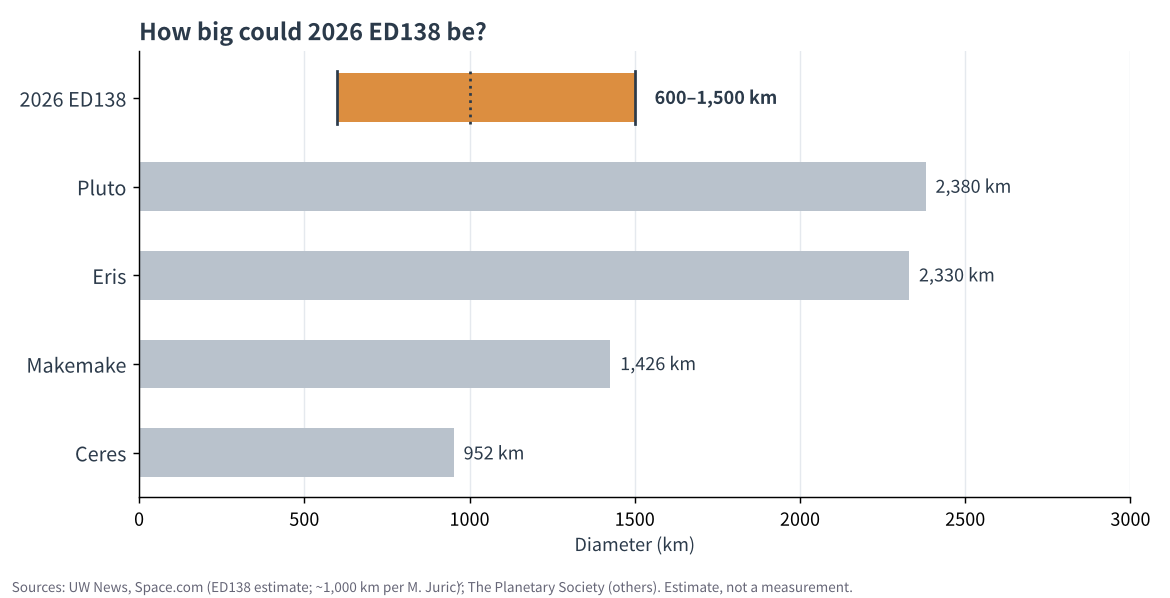
The headline estimate is 600 to 1,500 kilometers across. That would put ED138 anywhere from a modest icy world, smaller than Ceres, up to one comparable to the dwarf planet Makemake, which is about 1,430 km wide according to The Planetary Society. Jurić has put the best guess near 1,000 km and, as Gizmodo reports, called it the largest trans-Neptunian object found in about 20 years. Those figures remain estimates.
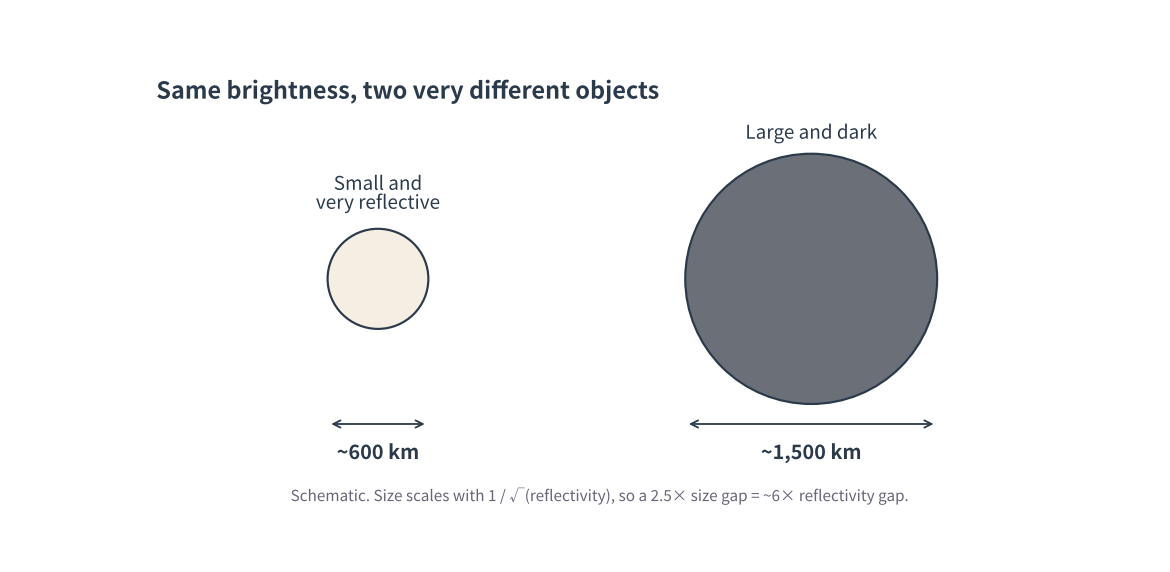
Why such a wide range? Telescopes see reflected sunlight, and how much light arrives depends on two things at once: how big the object is and how reflective its surface is (its albedo). A small, shiny body and a large, dark body can look equally bright from far away. The team estimated size from distance, brightness and an assumed surface reflectivity, so the range mostly reflects uncertainty about that reflectivity. A 2.5-fold gap in diameter corresponds to roughly a six-fold gap in albedo.
What counts as a dwarf planet
NASA summarizes the International Astronomical Union’s definition: a dwarf planet orbits the Sun, is massive enough for its own gravity to pull it into a nearly round shape, has not cleared the neighborhood around its orbit, and is not a moon. Five objects are recognized today: Ceres, Pluto, Eris, Haumea and Makemake. If ED138 is confirmed to meet the criteria and is formally recognized, it would be the sixth.
Roundness is why size matters so much. The University of Washington’s write-up notes that icy bodies of this scale are expected to be round, but nobody has yet observed ED138 well enough to see its shape. Until its diameter and shape are measured, “candidate” is the accurate word.
What happens next
Follow-up work will aim to pin down the size. Space.com reports that this requires infrared observations, naming the James Webb Space Telescope, because an object’s heat emission helps separate its size from its reflectivity. Meanwhile, Rubin’s ten-year survey of the southern sky, which began in June 2026, continues, and searches of older images — “precovery,” in Jurić’s term, meaning finding an object in images taken before anyone recognized it — may turn up more objects earlier surveys missed.
In the coverage we checked, no peer-reviewed paper accompanies the announcement, so the numbers above should be read as the team’s preliminary estimates.
Xsciens Editorial Note
This is a candidate, not a confirmed dwarf planet: its orbit is calculated from about a decade of positions, but its size is still an estimate.
- Observed versus calculated. What astronomers recorded directly were positions and brightness in many images. The distance (about 46 au) and the orbital tilt (about 25°) are calculated from them, and the 600–1,500 km diameter is a further estimate that also assumes how reflective the surface is, which is why the range spans a factor of 2.5.
- Limits. Roundness has not been observed, and the coverage we reviewed cites no peer-reviewed paper. This note rests on the announcement and secondary coverage; we could not open the NOIRLab release itself. “Hot classical” is Universe Today’s description, for a category of Kuiper belt objects defined by widely tilted orbits.
- What to watch. Infrared measurements of its size, for which Space.com points to the James Webb Space Telescope, and whether the object is formally recognized as a dwarf planet.
- From the editors — the solar-system poster on a classroom wall may soon need a new line. If Rubin keeps scanning the southern sky for ten years, more faint worlds could plausibly turn up, ones that hid in crowded star fields or slipped between older surveys. The catch is that “candidate” is the operative word, and until the size is measured the headline number could move a lot. So treat 1,000 km as a placeholder, and look again when the infrared measurements arrive.
References for this note: NASA, What is a planet?, Müller et al., Trans-Neptunian objects and Centaurs at thermal wavelengths (arXiv), Petit et al., Canada-France Ecliptic Plane Survey (arXiv)
Sources: University of Washington News, Space.com, Universe Today, Gizmodo, The Planetary Society