Ammonia is the backbone of the world’s food supply as the raw material for fertilizer, but making it burns a staggering amount of energy worldwide. A research team including Kyoto University’s Fukui Institute for Fundamental Chemistry has now worked out the previously unknown mechanism behind a molecular catalyst that converts nitrogen gas (N2) — abundant in the air around us — into ammonia under comparatively mild conditions.
A Process That Eats 1-2% of the World’s Energy
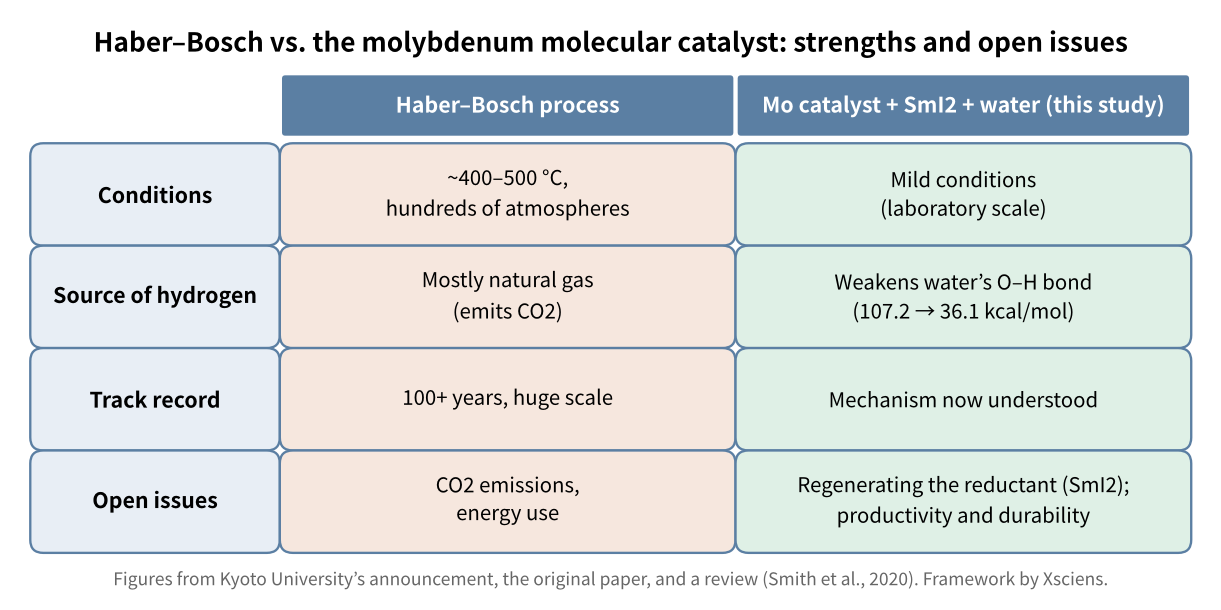
Today, almost all industrial ammonia comes from the Haber-Bosch process, which forces nitrogen and hydrogen to react at roughly 400–500°C and hundreds of atmospheres of pressure. Because the hydrogen feedstock is mostly made from natural gas, the process comes with heavy CO2 emissions. Global ammonia production is estimated to account for something like 1–2% of the world’s total energy consumption, and chemists have long sought a way to fix nitrogen under gentler conditions.
Turning Water Into a “Powerful Hydrogen Carrier”
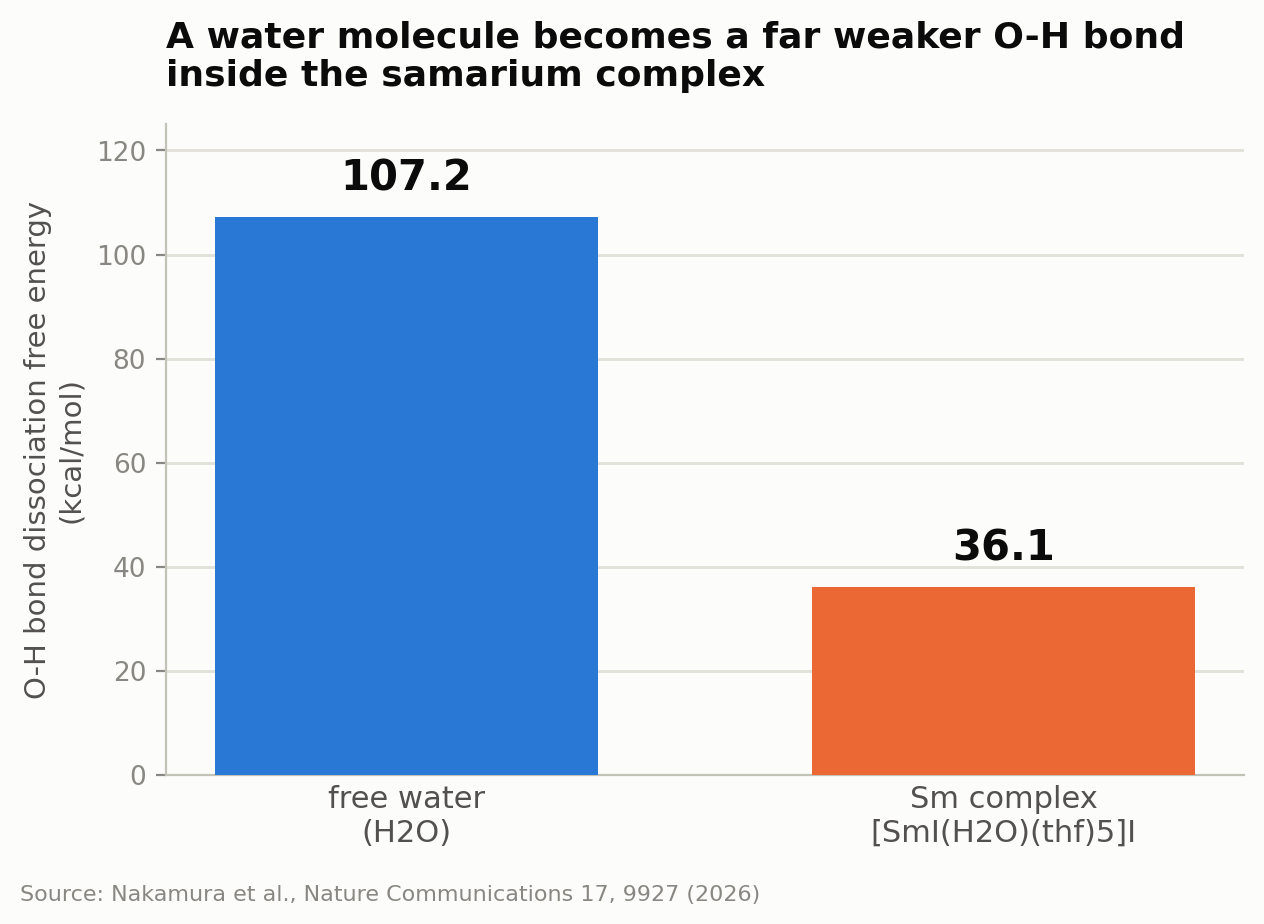
The team focused on a reaction system that pairs a molybdenum (Mo) molecular catalyst with samarium diiodide (SmI2) and water. Normally, breaking water’s O-H bond to hand off a hydrogen — in chemical terms, a proton and an electron delivered together in a process called proton-coupled electron transfer (PCET) — takes a large amount of energy. But through theoretical calculations, the team found that when water binds to a samarium ion to form the complex [SmI(H2O)(thf)5]I, that O-H bond’s dissociation free energy drops dramatically.
The O-H bond dissociation free energy of a free water molecule is 107.2 kcal/mol, but inside the samarium complex it falls to 36.1 kcal/mol — down to roughly a third, by calculation.
Mapping the Reaction Pathway for the First Time
Combining experiments with theoretical calculations, the team also worked out the step-by-step pathway by which nitrogen on the molybdenum center transforms — from nitride (Mo≡N) to imide (Mo=NH) to amide (Mo-NH2) and finally to an ammonia complex. The step demanding the most energy, by calculation, was imide formation, with an activation free energy of 5.1 kcal/mol. Structural models corresponding to the imide and amide species — related compounds carrying a methyl group on nitrogen — were actually isolated and had their structures determined.
Why It Matters
With the reaction mechanism now mapped out, the team has a design roadmap for improving the catalyst further. A related molecular catalyst the same team has previously developed has produced as many as 60,000 equivalents of ammonia per molybdenum atom, and the new mechanistic insight is expected to feed into next-generation nitrogen-fixation technology. The findings were published in Nature Communications on September 24, 2026.
The Team and Where This Work Fits
The research was carried out by Kazunari Yoshizawa of Kyoto University’s Fukui Institute for Fundamental Chemistry (professor emeritus at Kyushu University), Professor Yoshiaki Nishibayashi of the University of Tokyo’s Graduate School of Engineering, Professor Hiromasa Tanaka of Daido University, and Assistant Professor Taiji Nakamura of Kyoto Institute of Technology, among others. Nishibayashi’s group had earlier reported that a molybdenum molecular catalyst can make ammonia from nitrogen and water at ordinary temperature and pressure (the reaction system also uses samarium diiodide). This time the team tackled the question of why that reaction proceeds.
Experiments and Calculations Working Together
The team isolated reaction intermediates, the species formed partway through the reaction, as stable compounds and confirmed their structures, which backed the proposed pathway experimentally. They also used quantum chemical calculations (computer methods that predict how molecules behave from quantum mechanics) to examine steps that are hard to observe directly, confirming the structure of the samarium diiodide and water complex and the important role of proton-coupled electron transfer in forming ammonia. According to Kyoto University, the hardest step in the whole reaction is the one that forms the imide.
Hurdles Before Practical Use
The result is an understanding of how the reaction works, and it does not by itself become an industrial production method. Using this understanding as a clue, the group aims to develop high-performance catalysts that make ammonia with less energy. It also says that sustainable ammonia production needs not only better catalysts but also work on reaction conditions to enable renewable energy use and lower production costs.
According to Kyoto University, this result is part of the outcomes of NEDO’s Green Innovation Fund project (with Idemitsu Kosan as lead company). The same fund also includes a project to build a supply chain for ammonia as a fuel, such as demonstrations of technology to co-fire ammonia at 50% or more in the boilers of commercial coal-fired power plants (fiscal 2021 to 2028). That co-firing work is a separate theme from the catalytic mechanism studied here. Ammonia is attracting attention not only as a fertilizer ingredient but also as a medium for carrying and storing hydrogen and as a fuel.
Xsciens Editorial Note
The value of this study is not that ammonia has become cheaper to make. It is that we now know why the catalyst works.
- What was shown. The mechanism by which water’s O–H bond is weakened to hand hydrogen to the catalyst, and the intermediate steps by which nitrogen becomes ammonia, were supported by both experiments and calculations.
- What is still open. The reaction needs samarium iodide as a reductant. A review (Smith et al., 2020) points out that for metal-complex routes, the energy needed for the reducing agent and proton source tends to be much larger than for conventional Haber–Bosch, so how the reductant is regenerated or reduced will likely be the key to practical use.
- A caution when reading. “Mild conditions” refers to the laboratory; it does not mean a giant plant can be replaced. A comparison only means something once scale, cost and emissions are taken into account.
- Our imagination (speculation) — We wonder whether this work might not change fertilizer prices soon, but add “one more map” for catalyst designers. It could, for example, help researchers imagine small units that make fertilizer in places where a large factory is hard to build, such as remote islands or rural areas. This is only our speculation, and it depends on solving catalyst durability and the reductant problem.
References for this note: Smith, Hill & Torrente-Murciano, “Current and future role of Haber–Bosch ammonia in a carbon-free energy landscape”, Energy & Environmental Science 13, 331–344 (2020)
Sources
Kyoto University, “Catalytic mechanism of next-generation ammonia synthesis method elucidated”
Nakamura et al., “Unveiling full mechanistic picture of Mo-catalysed nitrogen fixation driven by SmI2–H2O system,” Nature Communications 17, 9927 (2026)