Switzerland’s glaciers lost about 5.5% of their ice volume during the 2025/2026 measurement year, the second-largest annual loss in the GLAMOS monitoring record after 2022. Over the past five years, Switzerland has lost nearly one-fifth of its glacier ice — a five-year loss rate more than twice that of any previous five-year period in the record. The pace matters well beyond Switzerland’s borders: meltwater from its glaciers helps sustain the Rhône, the Rhine, and other rivers that millions of people downstream rely on for drinking water, farming, and electricity, particularly during hot, dry summers.
A second-worst year, right after the worst five-year stretch on record
The figures come from GLAMOS, Switzerland’s long-term glacier monitoring network, run jointly by ETH Zurich and the universities of Fribourg and Zurich, which carries out detailed annual mass-balance measurements on 23 Swiss glaciers each year. Its 2025/2026 annual report puts the average “mass balance” — the net change in a glacier’s mass, expressed as meters of water equivalent (m w.e.), a way of converting accumulated snow minus melt into an equivalent depth of water spread over the glacier — at −2.86 m w.e. That is the second-most negative year GLAMOS has recorded, behind only 2022’s −3.13 m w.e.
Converted into ice volume, the 2025/2026 melt amounted to roughly 5.5% of Switzerland’s glacier ice. Ten of the 23 monitored glaciers lost more than 3 meters of water equivalent; Tsanfleuron fared worst at −3.9 m w.e., while Findel, near the Matterhorn, recorded the smallest loss, at −2.3 m w.e. Four glaciers — Allalin, Clariden, the Grosser Aletsch (the largest glacier in the Alps), and the Rhone glacier — recorded the greatest annual mass loss in their observational history.
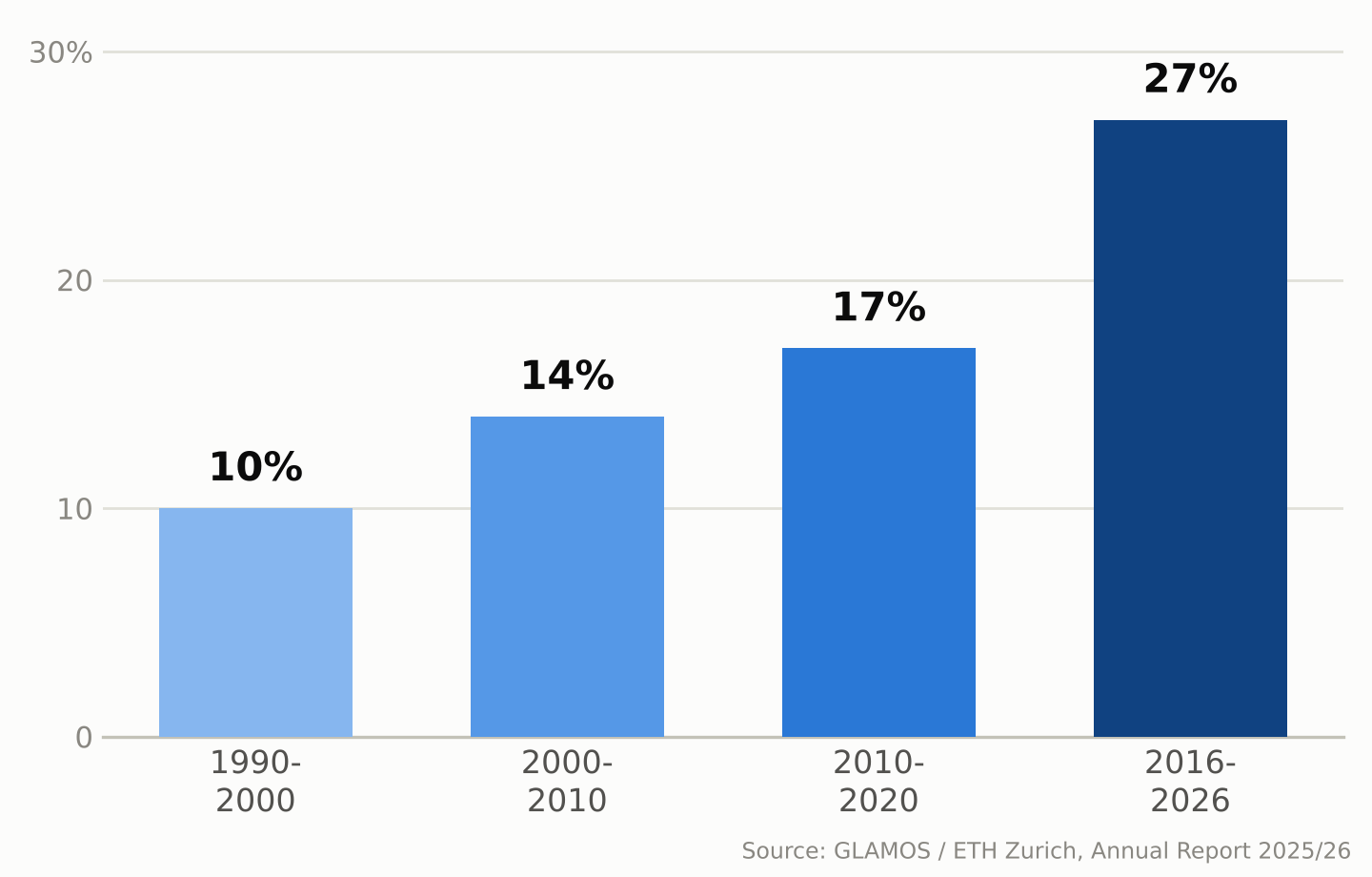
Zoom out and the five-year picture is starker. Since 2021, Swiss glaciers have lost close to 20% of their remaining volume — a loss rate GLAMOS describes as more than twice as fast as any earlier five-year period in its record. The longer-term picture shows the same acceleration: Swiss glaciers lost about 10% of their volume in 1990–2000, 14% in 2000–2010, 17% in 2010–2020, and about 27% over the most recent ten-year window, 2016–2026.
Why this past year was so bad
Two seasons combined to make 2025/2026 so damaging. Winter snowfall came in about 25% below the long-term average by the end of April, leaving glaciers with a thin protective layer heading into summer. The following April–September period was, according to glaciologist Matthias Huss, who leads GLAMOS and is a professor at ETH Zurich, the hottest and driest “summer half-year” in Switzerland since national weather records began in 1864. The freezing level — the altitude of the 0°C mark in the atmosphere — rose above 4,000 meters on 76 days, more than double the average and a new Swiss record. By September, snow cover had disappeared even at elevations around 3,500 meters.
GLAMOS calls the point when melt overtakes the winter’s snow gains — after which every melted liter comes straight out of the glacier’s mass — “Glacier Loss Day.” In 2026 that point arrived on June 29, the second-earliest date on record, three days later than the record set in 2022. One reason 2026 still fell just short of 2022’s record was the smaller amount of Saharan dust deposited on the snow that year, which let glaciers reflect more sunlight than they did in 2022, when dust darkened the surface and accelerated melting.
Melting is also carving cavities and collapse zones into some glaciers
Researchers monitoring the retreat describe an additional process layering on top of ordinary surface melting. On some glacier tongues, meltwater penetrates and flows through the ice, forming channels and cavities; where these grow large enough, sections of ice can collapse inward rather than simply retreating at the edges. Huss has described visiting high-altitude sites that were still covered in ice a few years ago — including areas near the Grosser Aletsch’s Konkordiaplatz and around the Findel glacier by the Matterhorn — and finding bare, rubble-strewn rock he compared to a lunar landscape.
Some glaciers are also disappearing outright. The Bella Tola glacier in canton Valais, which had been measured for decades, is among the small glaciers researchers now consider completely and permanently gone as of 2026. GLAMOS estimates that roughly another 100 small Swiss glaciers disappeared between 2016 and 2023 — a pace this year’s melt appears to be extending rather than slowing.
A record summer of meltwater is also a warning sign
Between July and September 2026 alone, Swiss glaciers released an estimated 2.2 trillion liters of water — more than four times the amount all Swiss households drink in a year.
Between July and September 2026, Swiss glaciers released roughly 2.2 trillion liters of meltwater — equivalent to more than four times the annual drinking-water consumption of every household in Switzerland.
That sounds like abundance, and in the short term it was: the extra runoff topped up rivers during a hot, dry summer when demand for water was high. But glaciologists are blunt about what it really represents — a one-time withdrawal from a shrinking reserve, not a renewable supply. Glaciers act as a buffer that releases extra meltwater precisely in hot, dry years when it’s needed most; snowfall can replenish that mass over time, but only when accumulation exceeds losses, which has not been the case in most recent years. As the ice reserve keeps shrinking, its ability to smooth out future droughts shrinks with it.
That matters beyond Switzerland too. Glacier melt contributes to summer runoff in Alpine river basins, including the Rhône and the Rhine, helping sustain flows during hot, dry periods for communities downstream in France, Germany, and beyond. The 2026 season offered unusually generous meltwater precisely because the ice had so much to give up. A smaller, thinner body of Alpine glaciers will have less stored ice to release in the next hot summer, and some smaller glaciers may disappear entirely.
What the long record shows
GLAMOS’s value lies partly in its length: continuous measurements stretching back decades let scientists tell a single rough year apart from a structural shift, and the longer-term record shows increasingly rapid losses, with the most recent ten-year period (2016–2026) substantially exceeding the losses seen in each earlier ten-year period. By the end of the 2025/2026 measurement season, Switzerland’s glaciers held an estimated 42.6 cubic kilometers of ice across 714 square kilometers of glacier-covered area — down by more than 30 cubic kilometers, and about a third in glacier-covered area, since 2000.
Researchers caution against reading any single year, including 2026’s near-record losses, as proof of exactly what comes next; Alpine weather still varies year to year, and a cold, snowy winter can briefly slow the trend. But the multi-decade pattern GLAMOS has documented — each ten-year period worse than the last — is increasingly relevant to how water-resource managers, hydropower operators, and mountain communities across the Alps plan around the region’s future water supply.
Sources: ETH Zurich, “Devastating year for Switzerland’s glaciers”, GLAMOS, Annual Report on Swiss Glaciers 2025/26, PBS NewsHour / Associated Press