
The chips in a smartphone, the airframe of a jet and the battery in an electric car all get their performance from materials. In materials, Japanese companies hold a majority of world share in a number of fields. This article checks the current picture and the challenges against official documents, lays out the industry structure materials sit in, and then digs into why Japan is strong through three hypotheses and company cases.
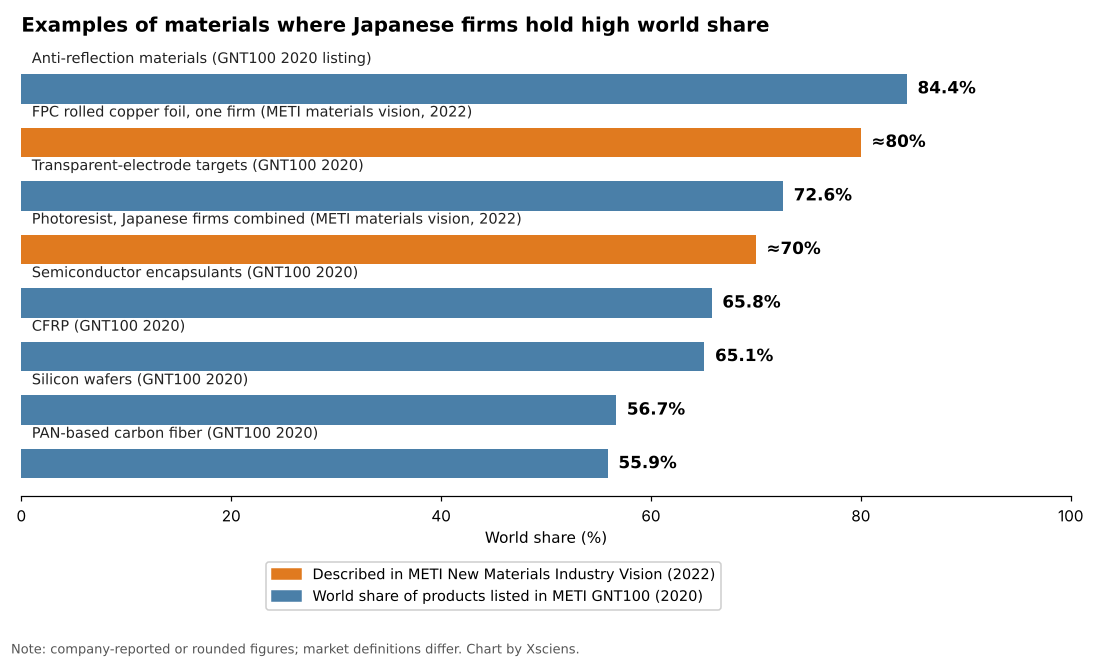
- METI, New Materials Industry Vision (interim summary, June 2022): Materials are 20% of manufacturing GDP; Japanese firms hold 70% of photoresist, and one firm (Company A) 80% of rolled copper foil for FPCs
- METI, Global Niche Top Companies 100 (2020 edition): 113 selected firms: average world share 43.4%, average operating margin 12.7% (manufacturing average 4.8%)
- Cabinet Office, Materials Innovation Strategy (June 2025): Many materials above 60% world share; names “suriawase-type development” as a Japanese strength
Where things stand: strength in share and margins
According to the interim summary of METI’s New Materials Industry Vision (June 2022), materials account for 20% of Japan’s manufacturing GDP and support 220,000 jobs in steel and 940,000 in chemicals. Japanese firms hold 70% of the world market for photoresist, the chemical used to print circuits onto chips, and one company, Company A, holds 80% of rolled copper foil for flexible printed circuits (FPCs), the bendable wiring in smartphones. The Cabinet Office’s Materials Innovation Strategy (June 2025), citing a NEDO survey, also notes many materials with world share above 60%.
The strength shows in profits as well as share. METI’s 2020 Global Niche Top Companies 100 selected 113 firms from 249 applicants. Their average world share was 43.4% and their average operating margin 12.7%, well above the 4.8% manufacturing average (fiscal 2018). In materials and chemicals alone, the margin was 13.9% and the average share 50.6%.
There are challenges too. The same METI document shows China’s share of world crude steel output rising from 15% in 2000 to 53% in 2020. The Cabinet Office’s 2025 strategy lists stagnant paper counts, a declining international presence, a shortage of people who can run data-driven materials development (materials informatics, MI), and slow social implementation. NISTEP reports that, on a fractional-count basis, Japan’s Top10% and Top1% adjusted paper counts in chemistry, materials science and basic life sciences fell by 20% or more between 2010 and 2020. PwC Japan’s analysis points to the small scale of high-share businesses, low overseas sales ratios and a “valley of death” between research and commercialization.
What industry structure do materials sit in?
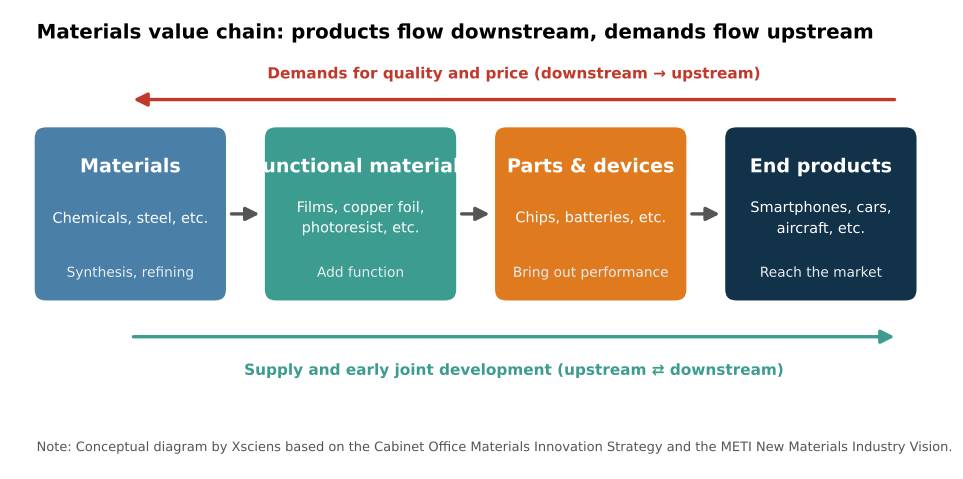
Materials are inconspicuous in the final product. The Cabinet Office strategy describes materials as both “constituents of end products and the source of their functions.” Material makers produce functional materials such as films, copper foil and photoresist; parts makers use them in chips and batteries; and finally smartphones, cars and aircraft are completed. Along this chain, material makers face demanding quality and price requirements from downstream industries. METI describes meeting them as the foundation of other industries’ competitiveness.
Sitting there, materials have an impact far beyond their cost. For Ajinomoto’s ABF, an insulating film used in semiconductor packages, a GIGAZINE article of April 2026 reports that it makes up less than 0.1% of the product price, yet its share is close to 100%, and surging demand for AI chips could create shortages. The Cabinet Office strategy likewise says Japan has many items with very high world share that hold an indispensable place in global supply chains.
Why the hypotheses matter
Strength in materials does not stay in visible form like equipment or patents. Unless we ask why Japan is strong, we cannot see what to protect or what to build on next. The Cabinet Office strategy names “suriawase-type development” (close tuning with the user), the know-how of evaluation, analysis, processing and synthesis, and strong industry-academia ties as Japanese strengths, and stresses long-term investment because materials R&D takes a long time. From this we organize the reasons into three hypotheses.
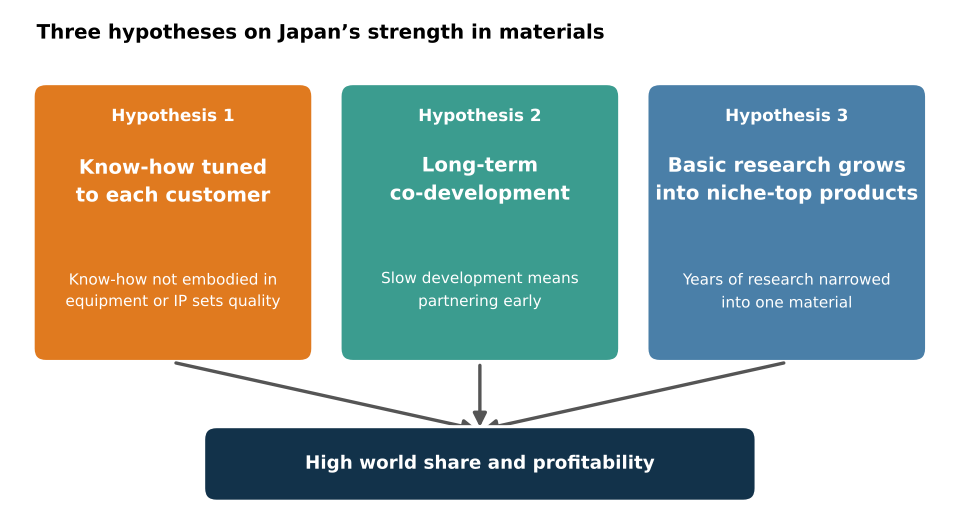
Hypothesis 1 is shop-floor “suriawase”: polishing a product to each customer. Hypothesis 2 is long-term co-development: partnering early with downstream customers and growing a product over years. Hypothesis 3 is that years of basic research grow into niche-top products focused on one material. Below, we look at why each matters and how it works in practice, using a different company for each.
Hypothesis 1: shop-floor “suriawase” tuned to each customer
The best conditions for a material differ with each buyer’s process. METI’s document says that “know-how not embodied in equipment or intellectual property is the source of the materials industry’s strength.” Equipment and patents can be bought or studied, but know-how built up in people and organizations is hard to copy from outside. The Cabinet Office strategy also calls evaluation, analysis, processing and synthesis techniques “a mass of know-how.” That is why hypothesis 1 matters: it is a source of resistance to imitation.
In practice, take TOK (Tokyo Ohka Kogyo), a photoresist maker. Its 2020 integrated report describes its strength as the ability to quickly deliver tailor-made photoresists, fine-tuned to each customer’s needs and each process’s requirements. The performance factors include sensitivity, resolution, etch resistance and purity, and the report says photoresist greatly affects a customer’s quality and yield. TOK is ranked first in the world for semiconductor photoresist, with a 25.6% share by projected 2020 shipment volume.
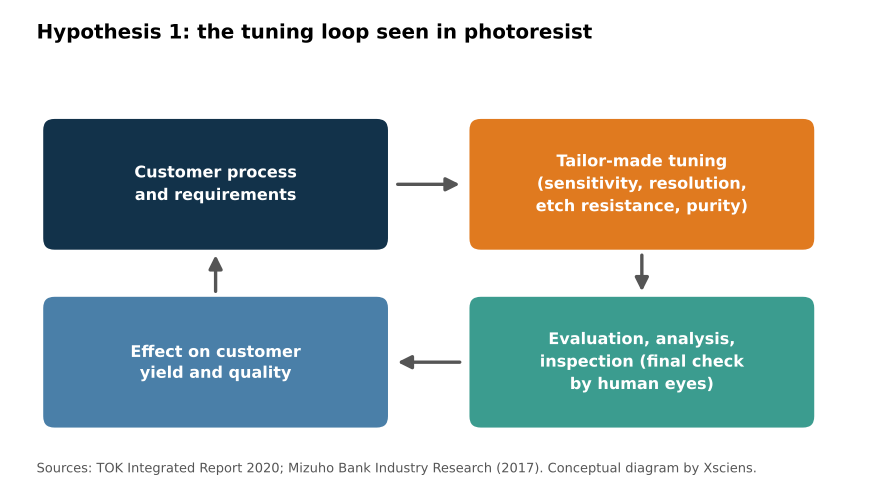
A 2017 report by Mizuho Bank’s Industry Research Division names two common strengths of Japanese material makers, the ability to develop products to customer needs and efficient, stable production operations, and says they have prized inspection steps where “in the end, people check by eye” to meet demanding domestic customers. Receive the customer’s requirement, tune, inspect, return. Repeating this loop for years builds up as shop-floor know-how.
Hypothesis 2: long-term co-development with downstream customers
Materials R&D takes a long time. The Cabinet Office strategy therefore calls for research and development in which upstream and downstream industries cooperate from the early stages. Partnering with customers early and growing uses together makes a material a lasting part of the customer’s product. That is why hypothesis 2 matters.
The practice shows in Toray’s carbon fiber. According to Toray’s investor materials, the company signed a 16-year long-term carbon-fiber composite supply agreement with Boeing in 2006. An ITmedia article (February 2009) reports that this was an exclusive contract under which Boeing buys the 787’s structural carbon fiber from Toray alone, and that Toray kept developing carbon fiber for about 40 years while accepting losses, selling it for golf clubs and the like while pursuing aircraft certification. Its model is integrated production from precursor fiber through carbon fiber to prepreg (resin-impregnated sheet). In Nagoya it set up the A&A Center, a technology development site that includes the AMC for automotive uses (opened June 2008) and the ACC for composite product development (scheduled to open April 2009). In the same document Toray projected a world carbon-fiber share of about 37% after its capacity expansion (a 2008 plan).
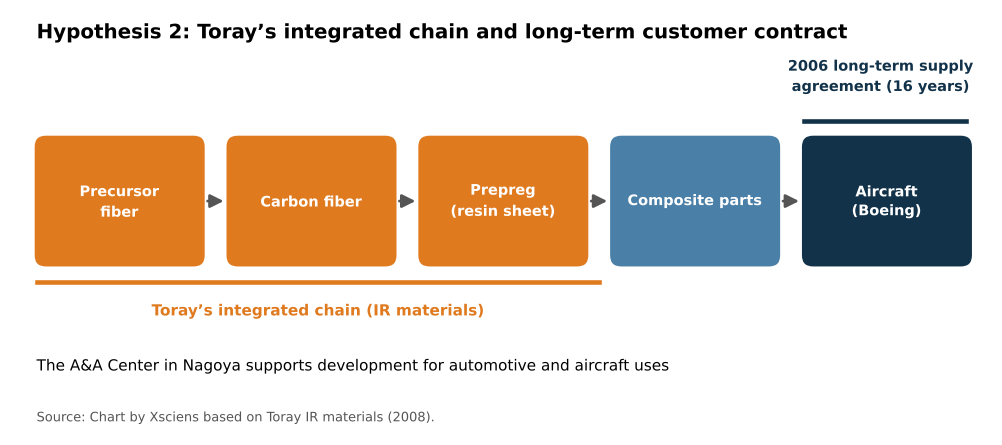
Looking from material to composite to the customer’s airframe, and promising supply under a 16-year contract: the length of this relationship becomes the base for growing uses together with the customer.
Hypothesis 3: basic research grows into niche-top products
Materials research takes years to become a product. The Cabinet Office strategy calls Japan’s materials field one with relatively strong industry-academia ties and, on the principle that “industry is the dojo of scholarship,” seeks to advance social implementation and deeper science together. A path that grows accumulated basic research into products focused on one material is why hypothesis 3 matters.
The practice shows in Ajinomoto’s ABF. According to the Ajinomoto Group, in the 1970s it continued basic research on insulating epoxy resin using its amino-acid know-how. In the 1990s, as CPUs grew denser and pin counts rose from an early 40 to over a thousand, a new insulating material for circuit boards was needed. As a latecomer, Ajinomoto took on the task of turning an ink-type insulating material into a film. The hurdle was mixing organic matter (epoxy resin and hardener) with inorganic filler and dispersing it evenly, which the research team solved to make a thermosetting film. A major chipmaker adopted it in 1999, and it is still used in leading CPUs. The company offers customers the processing method as a system, including optimized laser drilling and copper plating.
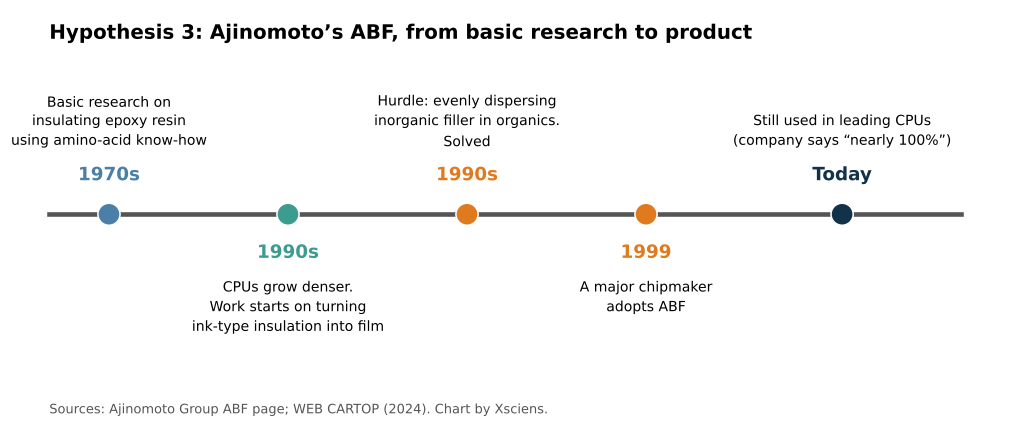
WEB CARTOP (June 2024) also reports that ABF’s history begins with amino-acid R&D in the 1970s. It is a case where basic research that began in the 1970s met a market need in the 1990s and became a product. The same flow shows in Akira Yoshino, who shared the 2019 Nobel Prize in Chemistry. According to the Nobel Foundation, the prize was shared with Whittingham and Goodenough “for the development of lithium-ion batteries,” and Yoshino’s affiliations were Asahi Kasei and Meijo University. Corporate and university research came together in a battery product.
Outlook: keeping the edge
According to METI, materials industries such as steel and chemicals account for about 80% of industrial CO₂ emissions, so in a decarbonizing world, materials that cut emissions are themselves a competitive asset. The way materials are developed is also changing. METI cites a catalyst developed with Yokohama Rubber in which MI achieved a world-best yield (60–70%) and a catalyst matching the performance of crude-oil-derived tires. The Cabinet Office notes that DeepMind predicted about 2.2 million stable compounds. Turn hypothesis 1’s shop-floor know-how into data, extend hypothesis 2’s customer ties to new uses, and sustain hypothesis 3’s basic research. Whether Japan can overlay all three is the key to the next decade. For an example of basic materials chemistry, see our article Ammonia From Air Under Milder Conditions: Kyoto University and Others Explain Why a Molybdenum Catalyst Works.
Xsciens Editorial Note
Japan’s strength in materials is easier to understand as accumulated strength in which three hypotheses overlap, rather than a single cause.
- Read share figures with definitions and dates aligned. For photoresist, Japanese firms combined are 70% in METI’s document, about 90% in PwC Japan’s analysis, and TOK alone is 25.6% (projected 2020 shipments), so figures differ by source. The GNT100 figures include company-reported values. When comparing, check the source, year and market scope.
- The three hypotheses are not proof of causation. They are leading views drawn from documents and cases, and we found no study that separates how much each one contributes. TOK, Toray and Ajinomoto are all success stories, and the same path may not apply to every material.
- The base of the strength is past accumulation, with no guarantee for the future. Ajinomoto’s ABF is a case where basic research that began in the 1970s became a product in the 1990s. If highly cited papers are now declining and materials-development talent is short, the effect may show in a few years.
- From the editors — the smartphone and battery you use every day are made of layers of materials whose names you may never have heard. Knowing that Japanese firms support a number of them may change how you read the next “new material” headline. Still, strength does not last by itself. Take pride in today’s numbers, and keep an eye on whether investment in research and people continues.
References for this note: PwC Japan analysis of the chemicals industry (scale of high-share businesses, valley of death), Mizuho Bank Industry Research, “Materials” (2017), ITmedia Business Online (February 2009), WEB CARTOP (June 2024), NISTEP RM329 press release (international paper comparison)
Sources: METI, New Materials Industry Vision interim summary (2022), Cabinet Office, Materials Innovation Strategy (2025), METI GNT100 2020, TOK Integrated Report 2020, Toray IR materials, ITmedia Business Online (February 2009), Ajinomoto Group ABF, GIGAZINE (April 2026), Nobel Foundation (2019 Chemistry), PwC Japan, NISTEP RM329